With over 86,140 patients in 2017-18, the RCH ED responds to a range of complex clinical situations and often responds to the State’s biggest emergencies. Through support from the Good Friday Appeal, the ED is trialling a new model of care. The Rapid Assessment, Planning, Investigations and Discharge (RAPID) program is designed to support senior staff and streamline care by initiating consultations in the waiting room.
This pilot program will see the RAPID team, comprised of a paediatric emergency physician as team leader, nurse practitioner, junior doctor and nurse, initiate consults and care plans in the waiting room of the ED, to streamline communications and patient care. The program aims to reduce patient wait times, enhance patient access and improve communication with families.
Everything Good Friday Appeal, straight to your inbox. Get more information about your impact and how to get involved.
Gait Analysis Laboratory System
The Gait Laboratory plays a crucial role in the long term rehabilitation and care of patients across the hospital, and thanks to support from the Good Friday Appeal, patients will soon benefit from upgrades across the laboratory.
At this world-leading facility, clinicians work with a range of highly developed video and motion capture technology to record the walking pattern of children, all which contributes to their overall treatment and care programs. Thanks to funding from the 2019 Good Friday Appeal, the lab will soon feature an innovative new three dimensional motion capture system, an upgrade of the current equipment that will feature high definition cameras to better capture patient movement, and allow for smoother integration with other equipment on site.
This new, advanced equipment will help provide a more indepth analysis of patients, providing clinicians with greater insights into their development, which in turn helps to inform essential programs for treatment and rehabilitation.
Everything Good Friday Appeal, straight to your inbox. Get more information about your impact and how to get involved.
IMRIS Machine
Sometimes, the best way to attract world-class paediatric outcomes is with a five-tonne magnet.
The intra-operative magnetic resonance imaging system (IMRIS) machine enables surgeons to perform MRI scans during brain surgery without the need to leave theatre or move the patient from the table, enhancing patient safety. The new system features an MRI scanner suspended from the ceiling which can move into the Neurosurgical theatre or Cardiology lab, allowing surgeons to access scans in real time, which assists with decision making and guidance during complex operations.
“The advantage is our other areas will be more efficient. There are direct benefits to the patients in the operating theatre, but also improved access to our imaging services for our other patients.”
Timothy Cain, Medical Imaging Specialist
Thanks to funding from the Good Friday Appeal, the RCH was the first paediatric hospital in Australia to offer the IMRIS. It currently assists approximately 1,000 patients each year.
Dr Golly introduces the IMRIS machine and speaks to two surgeons for the Good Friday Appeal 2018 Telethon
Everything Good Friday Appeal, straight to your inbox. Get more information about your impact and how to get involved.
Clinical Nutrition Service
Poor nutritional status can lead to an increased risk of surgical complications, prolonged stays in hospital and increased mortality.
With a larger team including a consultant, nurse consultant and pharmacist, the Nutrition Service will grow their dedication to the treatment and care of patients who are receiving nutrition intravenously, and look to establish the Intestinal Rehabilitation and Clinical Nutrition Service as a nationally recognised Centre of Excellence for the care of children and adolescents with complex nutrition problems.
Everything Good Friday Appeal, straight to your inbox. Get more information about your impact and how to get involved.
Point-of-care Ultrasound Program
POCUS empowers clinicians to conduct ultrasounds at a patient’s bedside, rather than a medical imaging specialist or sonographer. POCUS will be used to answer specific clinical questions to assist clinicians in decision-making as they gather information on the patient including their medical history and physical examinations.
Research increasingly shows that POCUS programs can hasten clinical diagnosis, inform the clinician about ordering subsequent medical imaging, make invasive procedures less painful, improve procedural success, improve patient flow, and increase patient satisfaction.
To support the new POCUS program, new ultrasound machines have been acquired for use around the hospital. These ultrasound machines will enable direct integration with hospital technology and will ensure each department has the equipment they need to implement POCUS.
Once successfully implemented, POCUS will decrease the demand for Medical Imaging appointments and improve the care clinicians can provide to their patients.
Posted June 2018
Image: RCH Melbourne – Creative Service Photography
Everything Good Friday Appeal, straight to your inbox. Get more information about your impact and how to get involved.
Infant Warmers for Critical Care
Funding from the Good Friday Appeal has gone towards the purchase of new infant radiant warmers and hybrid incubators at The Royal Children’s Hospital, keeping our most vulnerable babies safe, warm and closer to their parents touch.
The new infant warmers and hybrid incubators also place staff in closer contact with critically ill infants, and allow for resuscitation and care equipment to be immediately at hand.
Four-month-old Archie was one of the first patients to be supported by the new state-of-the-art devices. Born 11 weeks early, Archie required a hybrid incubator days after his premature arrival.
The night Archie was born he was transferred to the Neonatal Intensive Care Unit at the RCH by ambulance, where he was diagnosed with tachycardia, a type of heart rhythm disorder in which the heart beats faster than normal while at rest.
Being in the new hybrid incubator while he was in hospital for treatment meant it was easy for his mum Danica and dad Shaun to be close to Archie.
“Having Archie in the hybrid incubator meant we didn’t have that barrier between us. It was easy to touch him, to give him kisses, to change his nappy, it made a big difference,” Danica said.
The Director of Neonatal Medicine at the RCH, Professor Rod Hunt, said a major benefit of the new technology was that it gave doctors, nurses and allied health staff better access to critically ill and premature babies, like Archie.
“It allows us to weigh babies without removing them from the cot so that we can better monitor their nutrition. It also allows us to do procedures and surgery on babies without taking them off their bed because the sides can come down,” Prof Hunt said.
Everything Good Friday Appeal, straight to your inbox. Get more information about your impact and how to get involved.
The CLARITY Juvenile Arthritis Research Platform
With support from the Good Friday Appeal, The Royal Children’s Hospital (RCH) Department of Rheumatology has established the CLARITY Juvenile Arthritis Research Platform to better understand and treat the disease.
The RCH and the Murdoch Children’s Research Institute are home to Australia’s only paediatric rheumatology research program, and the new CLARITY study is set to help translate research findings into practice, improving clinical care for children both locally, nationally and internationally. With the aim of enrolling 250 participants annually, the study will enable new research that aims to identify biomarkers for diagnosis, prognosis and treatment of children with juvenile arthritis.
Photo: RCH Melbourne – Creative Studio Photography
Posted June 2018
Everything Good Friday Appeal, straight to your inbox. Get more information about your impact and how to get involved.
Brain Tumour Clinical Trials
To advance the care, treatment and diagnosis of these patients at the RCH, the Children’s Cancer Centre (CCC) identified the need for a greater enrolment in international clinical trials.
The CCC now has two Clinical Trial Coordinators administering a new clinical trials program aimed at improving overall survival and ongoing quality of life for children with cancer. Though often confused with drug trials, clinical trials are aimed at developing new or improved methods of care. This includes things like:
innovative drug therapies,
the best combination of procedures to provide more effective, and
less toxic treatments for better long-term quality of life.
The launch of the clinical trials programs has allowed for more individualised care for paediatric brain tumour.
“Clinical trials are the backbone of care. They provide access to the best level of international care. By participating in them, children at the RCH get the same care as those in big medical centres like New York.”
– Michael Sullivan, Head of Neuro-Oncology and Solid Tumour Programs
Thanks to your generous support, funds from the Good Friday Appeal and the Cancer Crusaders Auxiliary have supported brain tumour clinical trials at The Royal Children’s Hospital, Melbourne.
Everything Good Friday Appeal, straight to your inbox. Get more information about your impact and how to get involved.
The RCH Childhood Stroke Program
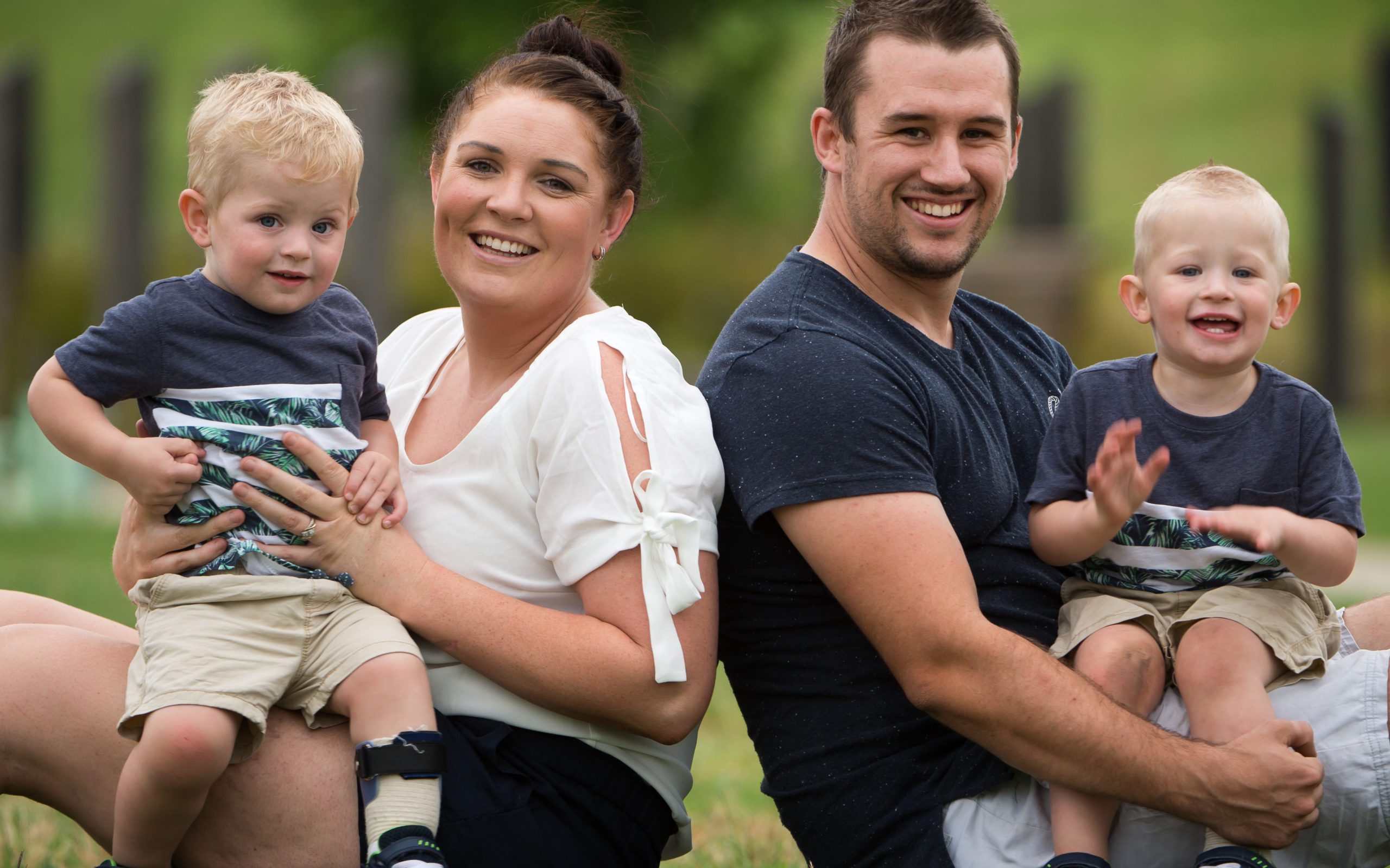
Bailey spent 11 days in intensive care and the family was referred to The Royal Children’s Hospital’s Childhood Stroke Program where Dr Mark Mackay “made everything less daunting”.
Belinda said Dr Mackay “explained things in a way that made us more relaxed and gave us hope”.
As the twins approach their second birthday it is mainly physical differences that mark their development. Bailey has been diagnosed with cerebral palsy which affects his walking and some movement on one side of his body. He also has some vision problems.
Although Bailey does need constant extra supervision, nothing stops the rough and tumble of daily toddler life for the twins. And the family’s on-going association with the Childhood Stroke Program provides peace of mind with help and advice whenever issues rise.
Mum, Natalie Reynolds, with Bailey, and dad, Tim Clarkson with the Beau.
The program is an international leader in childhood stroke care and research. Dr Mackay said it is the third largest contributor of data to the International Stroke Study Group’s registry that involves 88 centres worldwide. The RCH is the only Australian paediatric institution that meets all National Stroke Foundation criteria for a comprehensive stroke centre.
“We know (from feedback) that we are having a direct and positive impact on the families we see, but through our research we are also having a huge impact internationally,” Dr Mackay said. “This research translates into helping many other people too.”
Funded by the Good Friday Appeal, the program was set up in 2004 by Dr Mackay, a paediatric neurologist. In 2011, also due to the support of the appeal, the nation’s only Stroke Nurse Coordinator, Belinda Stojanovski, was employed.
The pair work seamlessly together to improve the outcomes for children affected by stroke, providing medical, practical and emotional support for the young patients and their families.
“When families are referred to our clinic Mark gives them all the technical information then I step in to try to answer their questions and provide the support they need to deal with the different hospital departments and link them into rehab,” Belinda said. “We are really the link between the families and the hospital.”
In 2012 the Childhood Stroke Program had 13 referrals but that had increased significantly to 41 in 2016. There are about 400 families on the program’s registry.
The program also aims to improve care by educating medical, nursing and allied health professionals in best practices; and to improve awareness of childhood stroke in the community.
Paediatric stroke facts:
Stroke is among the top 10 causes of death in childhood with the highest mortality in the first 12 months of life
Stroke affects one in 2300-5000 newborns
The cause of stroke in newborns is usually unknown
Every year about two children in every 100,000 will have a stroke
50-85% of survivors of stroke will be left with long term problems which may include seizures, physical disability, speech or learning difficulties
Everything Good Friday Appeal, straight to your inbox. Get more information about your impact and how to get involved.
Supporting Patients with Intellectual Disability and/or Autism Spectrum Disorder
Eventually these patients must make the transition from hospital care to adult healthcare and thanks to Good Friday Appeal support, the hospital is developing an appropriate and sustainable model of care for this transition.
This will provide a supportive framework, ensure timely transition from The Royal Children’s Hospital, and improve patient and family outcomes in partnership with external healthcare providers across Victoria.