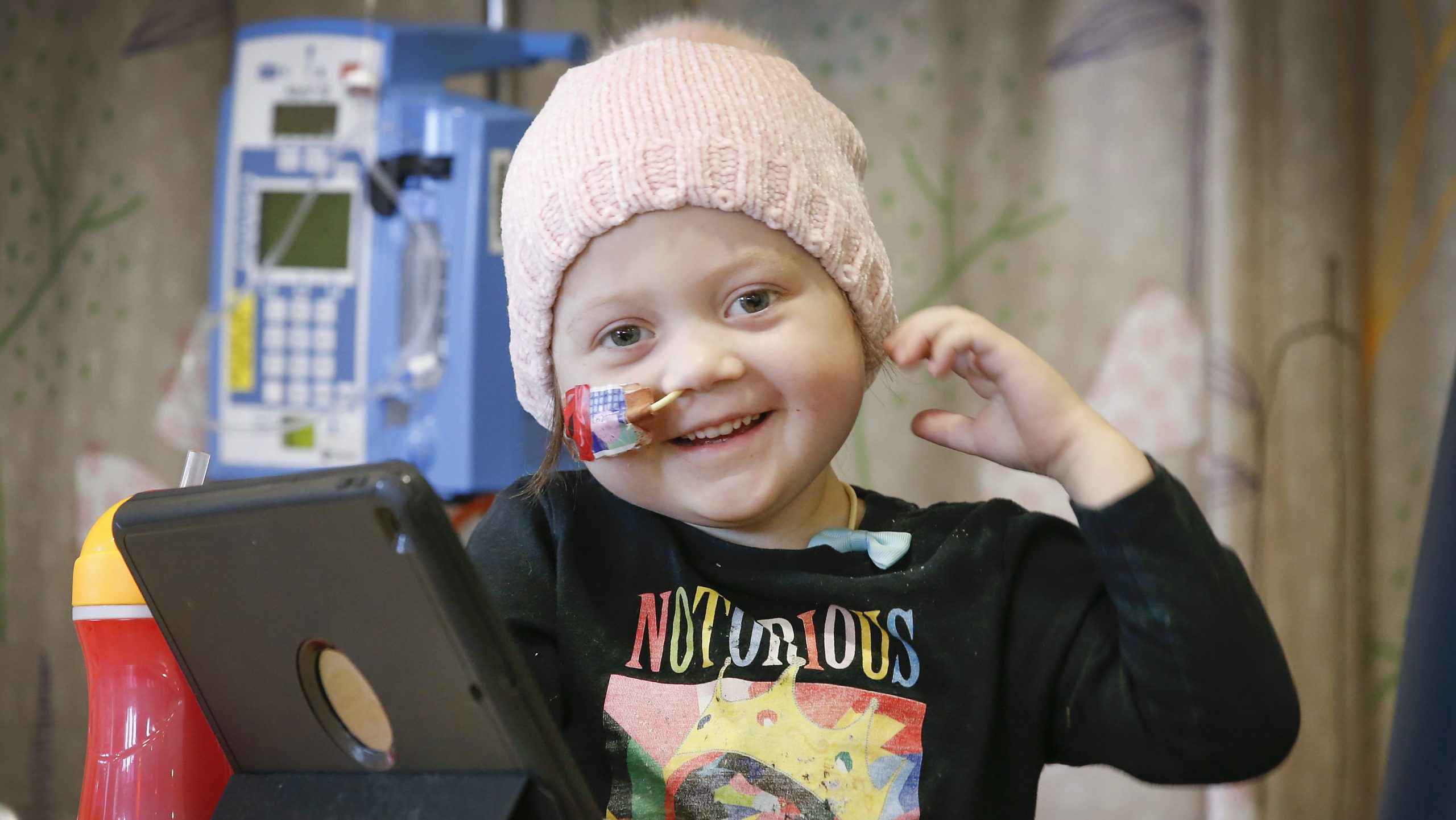
With her princess dress and runners on, her beloved doll buckled into its pram, Grace Antonello hits the track for her morning walk.
The two-year-old is tethered to an IV pole, but that doesn’t slow her down as she cuts laps of the Royal Children’s Hospital oncology ward.
It’s been a daily ritual — when she’s been well enough — to stop and check in on friends across the hall, and finish with a pit stop at the nurses’ station to do some drawing on their paperwork.
Grace’s leukaemia diagnosis five months ago shattered her parents Jessica Mekken and Daniel Antonello in just one day. They started the morning with a toddler they were taking to the GP because of concerns about lots of unusual bruising.
They ended that day cradling Grace at the RCH as she underwent a blood transfusion, the first of what would be countless procedures to quash the cancer cells overrunning her little body.
But Ms Mekken said her daughter was inspiring in how she had adapted to her new way of life, stuck largely in a hospital ward.
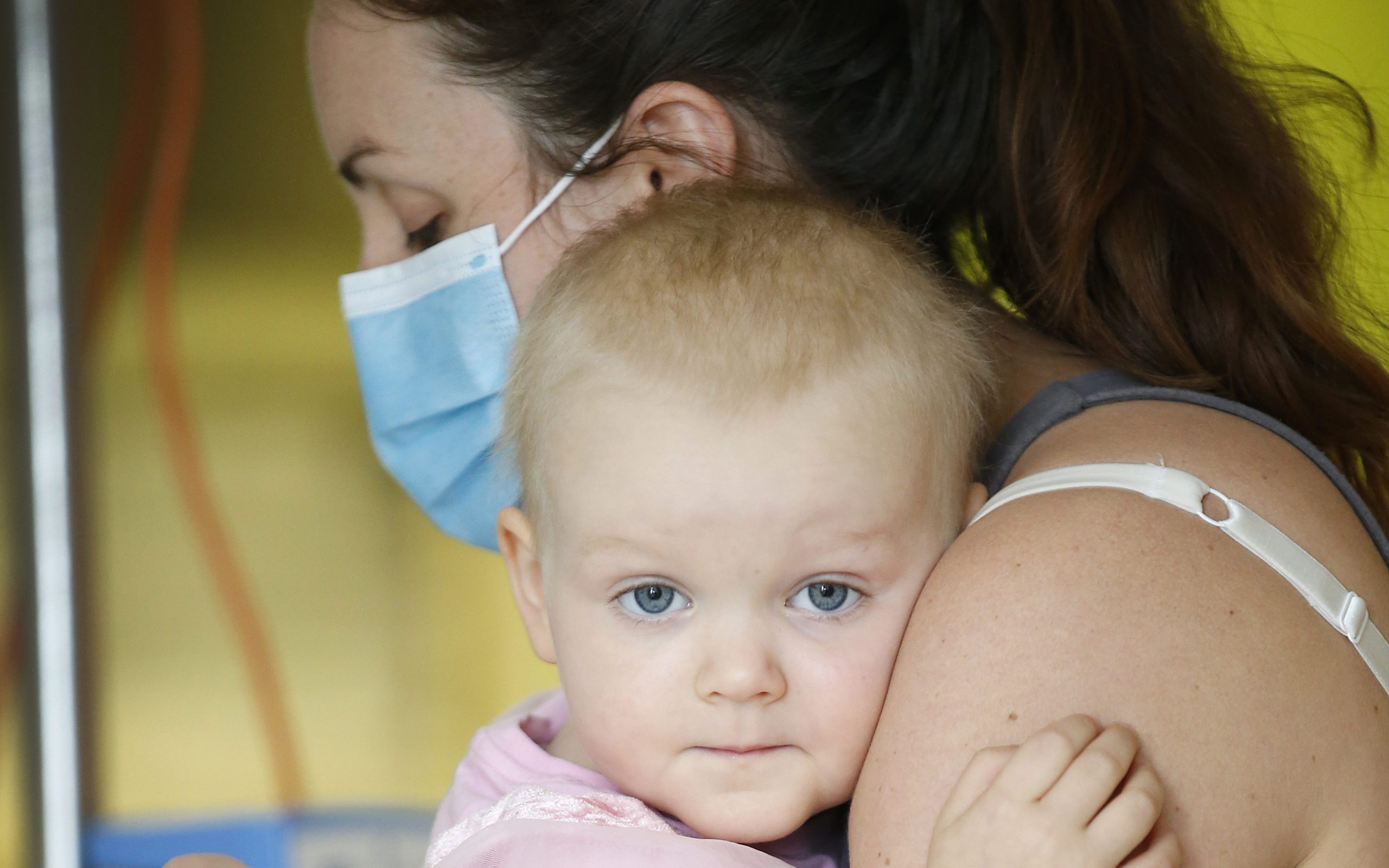
Grace, 2, finds comfort in the arms of her mother Jess Mekken during treatment.
“Being a toddler, it just becomes their life really quickly, because everything is new for them anyway. This just carried on as the next new thing that we’re doing,” Ms Mekken said.
“She understands each of the procedures. She’ll tell the nurses when they have to clean her lines. She says, ‘I’m brave, I’m brave’.
“She constantly amazes me with her strength. Going for finger pricks or having her port accessed, she sits there and talks the nurses through it as they do their job.”
Long hospital stays have been extra hard because of COVID restrictions banning visitors and shutting down many of the playtime experiences on the ward.
Slowly these chances for interaction and fun — which social butterfly Grace craves — are resuming, thankfully at a time she is entering the most gruelling phase of her two-year cancer treatment.
“I just wish for a cure for her,” Ms Mekken said.
“I want Grace to look back at this time and know that she was so strong. I’m so proud of her and so grateful for what they’re doing for her.”
Give for the Kids
Your donations helps kids like Grace receive the best possible care.
Everything Good Friday Appeal, straight to your inbox. Get more information about your impact and how to get involved.
Meet Hannah
Hannah Bradley hands the nurse an alcohol wipe and holds her plastic IV line still, ready for it to be changed.
“I help you,” she tells them, pointing to the syringe and clutching her doll with the other hand.
She is only 2, but after eight months of cancer treatment she feels she has earned her stripes.
“We call her nurse-in-training here,” said dad Mark Bradley. “She’s very observant. She watches something a couple of times, then she’ll get the prep pads to help the nurses clean her lines.
“She quite enjoys it here. She enjoys the attention, I think.”
It’s Hannah’s live-in-the-moment attitude and instinctual craving for interaction that still sees her seeking out play, connection and fun with other patients and staff on her Royal Children’s Hospital ward.
A spiked temperature and some bruising were the only signs last June that her body was in a secret fight.
For a girl nicknamed “Bull”, such is Hannah’s habit of rough-and-tumble play, it was only when the fever persisted that a trip to the nearest hospital at Kyneton made sense. The directions were clear; this ambulance will take you straight to the RCH.
Two hours later a diagnosis of ALL, Acute Lymphoblastic Leukaemia, was confirmed and 2½ years was the treatment time frame Mark and wife Sharlee were given for their youngest daughter. Hannah has spent four of the past eight months in hospital.
“It’s been a journey so far, and there’s a long way to go,” said Mark.
“But the doctors and nurses have been amazing and she’s taken to the treatment really well, even though there are ups and down that go along with a little body being smashed with a lot of chemotherapy. I just wish for some normalcy for her now.”
Originally published in the Herald Sun, 6 March 2021
Words: Brigid O’Connell
Photo: David Caird
Everything Good Friday Appeal, straight to your inbox. Get more information about your impact and how to get involved.
Meet Hasti
The bubbly 13-year-old, who suffers from spondyloepiphyseal dysplasia, has been subjected to 19 surgeries but is slowly defying the odds.
The congenital abnormality has affected Hasti’s bone and joint development since birth, meaning she has struggled with all movement and physical activity.
“I feel like it’s affected me in many ways, but especially in my social life,” she said.
“Many of my friends hang out after school together but I can’t … because of my legs. It’s pretty sad because I’m by myself a lot of the time.”
But thanks to the tireless work of The Royal Children’s Hospital, the Pascoe Vale teen is closing in on her goal of walking without crutches.
“It was horrible. There were so many nights where I couldn’t sleep. I didn’t think I would ever walk,” Hasti said.
“My main goal is to one day go to school without crutches.”
Her mother, Masoumeh, said she still could not run, jump or walk properly.
“But at least now she’s on crutches and been given a chance by the hospital,” she said. “I see what they have done for us through the years, they’ve helped us and it means a lot.”
Give for the Kids
Your donations help kids like Hasti receive the best possible care.
Everything Good Friday Appeal, straight to your inbox. Get more information about your impact and how to get involved.
Meet Luna
LUNA Phillips watched the older girl opposite her in day oncology with concern.
She is only three, but Luna knew this girl was anxious, so she held out her hand and hung on tight so her new friend wouldn’t be scared.
Next, she saw a boy crying on the same ward. She asked her mum if she could make him a card so he would feel better.
“As a parent you think, ‘Luna, you’re going through so much yourself’, but she’s always looking for a way to make other people feel better,” said mum Laura.
“We always knew she was a special little soul, but we’re seeing it a lot now. We’re getting our strength from her.”
The Wangaratta girl, who turned four on Friday, is new to cancer treatment — three months into what will be a three-year process — but she is still showing her trademark compassion in her new home away from home at the Royal Children’s Hospital.
Her leukaemia diagnosis came with little warning.
One day in late November Luna complained of a sore neck. The next day it was a sore back and some unsteadiness on her feet.
The one after that, following a late-night trip to their local hospital, tests revealed the dreaded C-word.
Luna, Laura and dad Marc were sent straight to Melbourne.
There was not even time to pack a bag.
Luna’s two-year-old brother Levi was left in the care of grandparents. Their dog was left with other relatives.
It would be another month before they were reunited again as a family of four at their new home in Melbourne, where they will stay for Luna’s most intense phase of chemotherapy.
Leukaemia patient Luna Phillips, 4
“We’ve told her your blood is a bit sick, and that’s why we’re here, to get your blood better and that’s enough for her at the moment,” her mother said.
A cancer diagnosis means parents hand much of the control and trust to the medical experts.
But there was still one big thing Laura could do for her daughter — turn her own navel-length hair into a buzz cut at the same time Luna was due to lose hers.
“We’re getting through this together, as a family, and I’m really quite positive that Luna will do well,” she said.
“We’re in the best place and getting the treatment she needs to get through this.
“It’s going to be just a story we can tell her one day, about something that she went through when she was very young.”
Originally published in the Herald Sun, 8 March 2021
Words: Brigid O’Connell
Photo: David Caird
Everything Good Friday Appeal, straight to your inbox. Get more information about your impact and how to get involved.
Meet Charlotte
Charlotte Alexander’s parents had heard the stories of miracles.
And so, with their young daughter’s life very much on the line, they put all their trust in the medical teams treating her.
An aggressive and rapidly growing tumour had taken up her entire abdomen, wrapping itself from the heart to the legs, and connected to blood vessels of every organ in between.
It took surgeons 28 hours of surgery, performed in two bouts over three days, to remove it, in the hardest tumour resection Royal Children’s Hospital surgeons have faced.
“This all hit when it was supposed to be the start of her letting loose,” dad Craig Alexander recalled this week.
“This was the first big Christmas that she understood the story around it. She was supposed to be at kinder. It was her time to shine.
“I just want her to be a kid and have a childhood.”
When you meet Charlotte, you understand why her dad and mum Jess never questioned her chances of survival.
“We ummed and ahhed, but we figured at the end of the day, regardless of the percentage, you’re never not going to go through with it,” Jess said.
“The treatment is either going to work or it’s not. There are always miracle stories out there. You still question, am I putting her through 18 months of very high intense treatment for no reason? But on the other hand, why wouldn’t you do it? … We put all our trust in them.”
Charlotte is a chatterbox and readily makes friends. Even if, for the time being, she’s having to swap the kinder sandpit for a tea party while hooked to an IV pole at the end of the oncology ward.
Charlotte is gutsy. On a good day she is dressed in homemade scrubs and a superwoman cape, patrolling the hospital corridors.
Not a weapon in the cancer treatment armoury is being spared. High-dose intensive chemotherapy, surgery, a stem-cell transplant, radiation and immunotherapy; her little body is hit by it all. There are encouraging signs about her response to treatment.
Charlotte started complaining of stomach pains and going off her food in July. It took numerous GP telehealth appointments and three trips to the RCH emergency department before the cancer was found.
It was an ultrasound that revealed there was a mass pushing all the organs in her trunk out of the way. Within a week, the then three-year-old had been assigned Jordan Hansford as her oncologist, had a Hickman line implanted in her chest so intravenous medicines could be delivered, a nasal gastric tube inserted, a bone marrow biopsy, more scans and started chemotherapy.
“There was no question about treatment,” Dr Hansford said.
“Enough kids do well that you need to pursue it. What that means is very aggressive treatment over 18 to 20 months, and it involves all the things that we do. Adults can’t tolerate the things we ask the kids to do.”
After chemotherapy, surgery was booked in for December 8. In Charlotte-speak, this surgery was to remove Mr Potato Head — the thing that was growing and making her tummy big.
She trusted her mum when she was told that, because her mum also knew the real reason she had lost her blonde hair — it was actually going on a holiday. But it would be back, Mum promised.
Paediatric surgeon Michael Nightingale expected it would take about 10 to 12 hours to painstakingly remove the tumour. A physiologist needed to be in theatre to monitor Charlotte’s spinal cord during the resection.
“The most important thing in taking out these sorts of tumours is that we don’t do any harm; we don’t damage her kidneys, liver or her spinal cord. We have to go very slowly and carefully,” he said.
They started operating at 8.30am. At midnight, and not even close to being done, they decided the safest option was to partially close her up, let her rest in intensive care, and then go in two days later for the final 13 hours.
“She had the most extensive tumour that we’ve dealt with at the RCH, certainly in the 10 years I’ve been at the hospital,” he said.
Scans taken before surgery showed the tumour was still active despite chemotherapy. Given surgeons reported the tumour felt “oozy and squishy” when trying to resect it, when typically chemotherapy turns tumours into “concrete”; everyone was worried.
Charlotte finally gets to go home and is hugging her friend Luna, 4, goodbye
But a week after the surgery, Dr Hansford — wearing a Santa hat — left a meeting early to deliver the couple an early Christmas present. Microscopic analysis of samples taken during surgery showed the chemotherapy had worked.
“Have we been given hopeful signs along the way? One hundred per cent,” he said. “There is still a long way to go.”
Jess and Craig hung on to this good news as they watched their daughter relearn how to move her whole body again after a month on a ventilator.
Best-case scenario, Charlotte — who turned four during her latest month-long admission — was halfway through treatment. Radiation is next, followed by six months of immunotherapy.
From time to time over the past seven months, Charlotte’s parents have let themselves daydream about the future. Jess imagines her daughter being able to run under a sprinkler or dig in the mud, without worrying about the access port in her chest.
Ringing the gold bell at the exit of the oncology ward — a rite of passage for each child who finishes cancer treatment — is a recurring wish for Craig.
Give for the Kids
Your donations to the Good Friday Appeal help fund the vital equipment, research, training and care that help kids like Charlotte.
Everything Good Friday Appeal, straight to your inbox. Get more information about your impact and how to get involved.
Meet Will
Will Colston-Ing doesn’t yet grasp the meaning of the scar running ear to ear across his skull.
His family has dubbed the mark his “warrior scar”, as it symbolises a marathon surgery of more than eight hours.
The operation rectified the unusual shape of Will’s head, which restricted his brain from normal growth.
Will’s doting parents Alex and Jason were only alerted to his “egg-shaped” head after they sent a picture of the adorable then four-month-old to relatives, who raised the alarm.
“I was just very sleep-deprived and totally missed the signs,” Mrs Colston-Ing said.
“Back then we were completely oblivious.”
Scans confirmed Will had scaphocephaly, the most common type of craniosynostosis.
Craniosynostosis sees bones in a baby’s skull join together too early and, as the baby’s brain grows, the skull can become more misshapen.
William Colston-Ing, 11 months old, the day before his surgery in 2019.
Will underwent a surgery known as a total cranial vault at the Royal Children’s Hospital when he was just 11 months old in 2019.
Surgeons removed the entire top of his skull, cut it into pieces and put it back together to give the brain enough room to grow.
“It was honestly one of the most stressful and emotional days of our lives,” Mrs Colston-Ing said.
But Will made it through the long operation and was released from hospital within days. His mum said he made a “really quick recovery”.
“When we got home he immediately started crawling and talking a little bit more, we just noticed developmentally he took off,” Mrs Colston-Ing said.
Will has not experienced any lasting impacts from his condition or surgery and is meeting milestones and developing “incredibly well”.
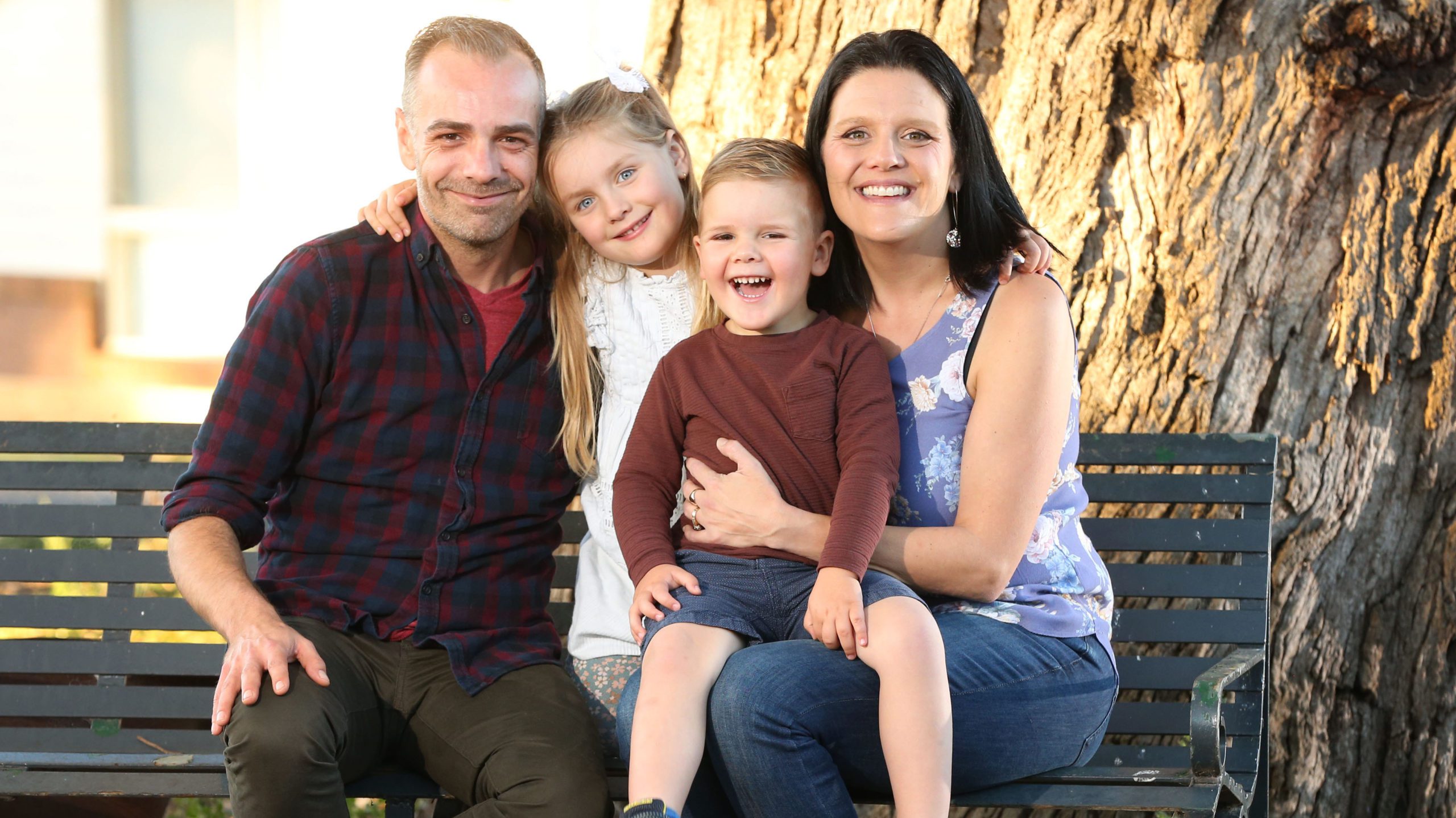
William, 2, with his parents Jason and Alex and sister Zoe, 6.
Mrs Colston-Ing said Will, who is set to celebrate his third birthday in May, was a strong boy.
“We want him to wear his scar proudly to show how strong he’s been and what he’s gone through,” she said.
“He’s an absolutely sweet little boy and melts my heart.”
She said staff at the RCH were “miracle workers”, and the Good Friday Appeal, now in its 90th year, was an opportunity to raise awareness and funds for the important work they did, and the incredible difference they made in people’s lives.
RCH chief John Stanway said this year’s appeal would buy more than 25 pieces of equipment and help support the establishment of the hospital’s new virtual care program, using telehealth and the upskilling or regional medical staff to care for more children in their own homes across the state.
Give for the Kids
Your donations to the Good Friday Appeal help kids like William.
Everything Good Friday Appeal, straight to your inbox. Get more information about your impact and how to get involved.
Meet Quinn
The Easter period evokes mixed emotions for the O’Leary family.
It serves as a reminder of how precarious bubbly Quinn’s early days, spent fighting for life at The Royal Children’s Hospital, were.
The brave Moolap boy celebrated his fourth birthday on Saturday. But mum Brooke said this time of year also brought back memories of 2017, when Quinn endured 21 surgeries in his first 10 weeks.
One of those was on Good Friday, while the Good Friday Appeal raised money to care for kids like Quinn during the annual appeal.
Quinn O’Leary during one of his 21 surgeries
Quinn was transferred to the RCH just hours after he was born. It was to be his home for 101 days, after his bowel had twisted in utero.
Just days into his life, it twisted again, due to a condition known as malrotation of the volvulus.
When Quinn was just a few days old, his family was told to prepare for the worst.
But doctors worked removing parts of his bowel and prescribed him innovative medication, and he has wowed loved ones with his resilience. Quinn bears a scar on his stomach from his time in hospital, and Mrs O’Leary said he had seen photos of himself in hospital as a bub.
“We did explain to him that he was sick when he was a baby,” she said.
“We’ve told him: ‘They had to cut you open to make you better’.
“He’s quite happy and proud of his scar and shows it to people.”
Mrs O’Leary said Quinn had not experienced any further complications since he was a baby, and had outgrown allergies.
She described her son as happy-go-lucky and affectionate.
“He loves life, always smiling,” Mrs O’Leary said. “It’s almost like he knows what we went through with him.
“He just blows us away.”
She urged people to support the Good Friday Appeal.
“The Royal Children’s Hospital saved our son’s life, without them I have no doubt he wouldn’t be here,” Mrs O’Leary said.
“We’re very lucky and fortunate to have them only an hour away from where we live.
“They went above and beyond to save his life, we owe them the world.
“We’ll be forever grateful, and always donating and trying to fundraise.”
Give for the Kids
Your donations to the Good Friday Appeal help kids like Quinn.
Everything Good Friday Appeal, straight to your inbox. Get more information about your impact and how to get involved.
Meet Abubakar
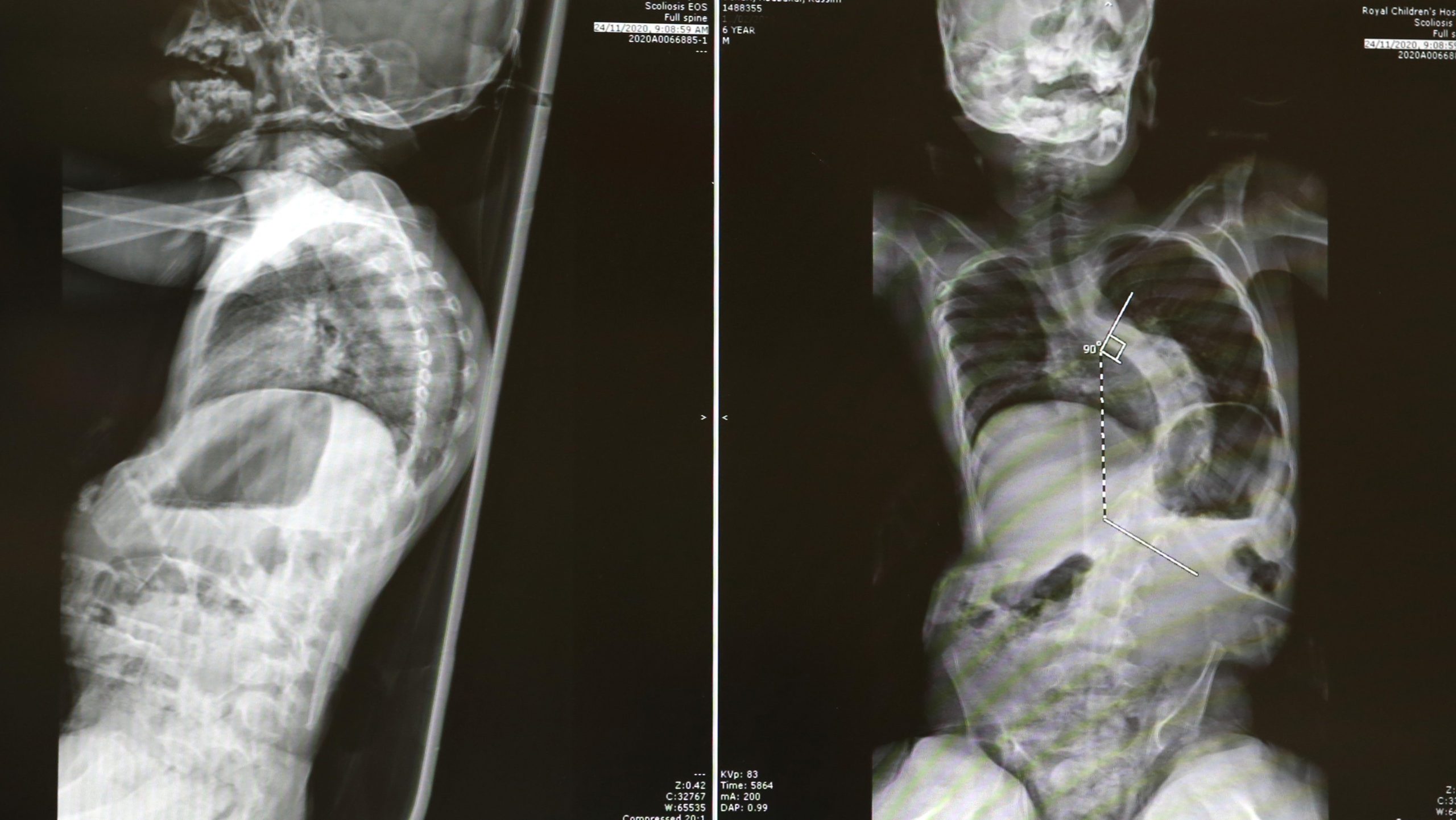
Abubakar Bakari has undergone new surgery to treat severe scoliosis. His spine was bent almost into the shape of a question mark in two directions — the sideways bend just as severe as his forward bend.
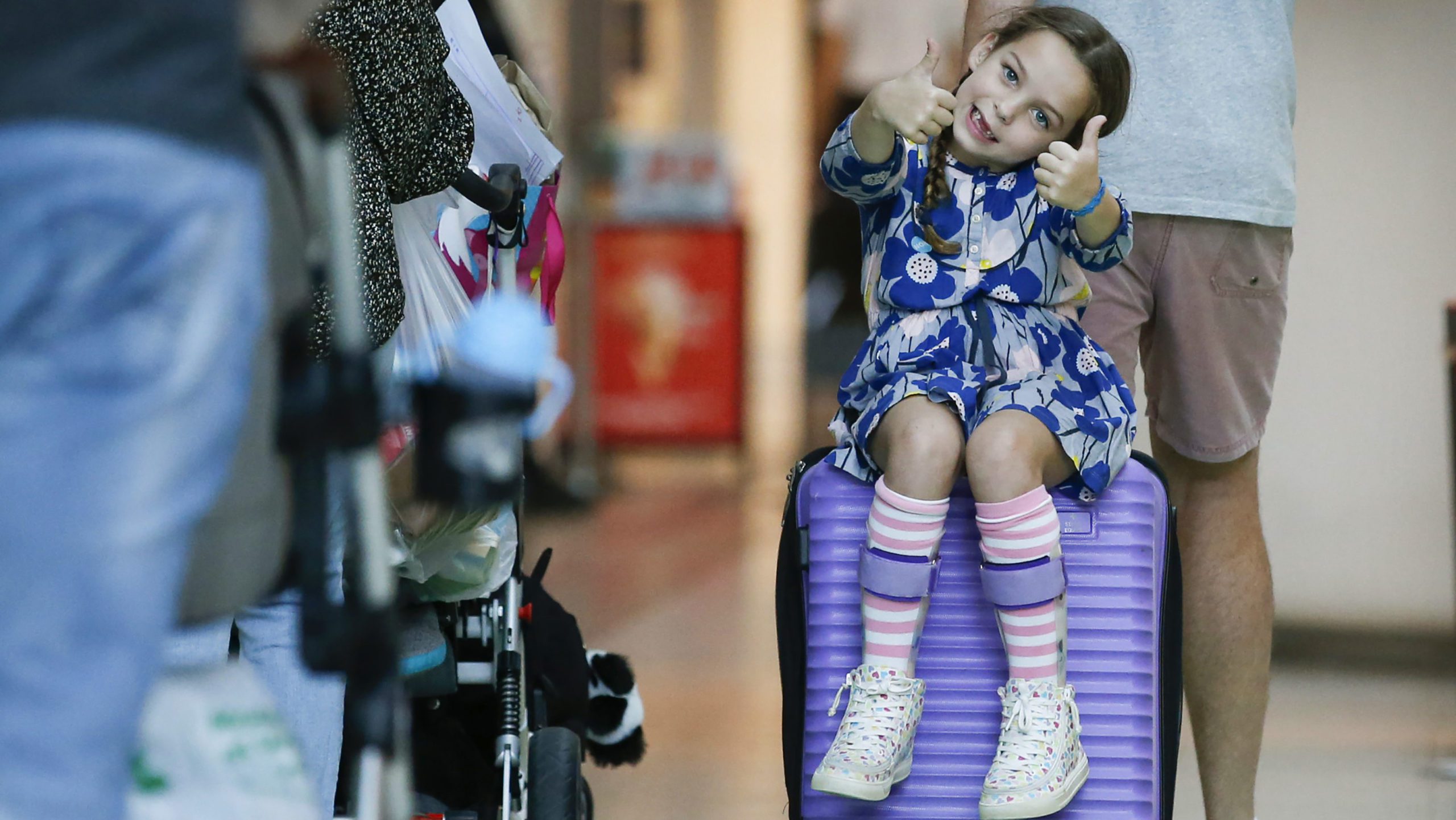
Abubakar Bakari 7, standing on his own 2 feet with a walker after successful spinal surgery.
Aged 7, Abubakar is one of the youngest patients on which Royal Children’s Hospital orthopaedic surgeons have performed this procedure, which lengthened his spine using a sliding metal rod.
The Ardeer boy was born with a condition called arthrogryposis, in which joints and muscles fail to develop properly in the womb.
His dad Kassim said the condition had put his boy behind the starting blocks with development.
“He was still able to move and crawl around, but as the curve got pretty big, his balance was affected,” Mr Bakari said.
“He would be crawling on his knees, but he would fall down.
“Later when he was older, sometimes we would go around the block as a family, but he would need his walker.”
With Abubakar experiencing increasing discomfort from his back, it was clear this was the year he needed surgery to straighten his spine.
Scoliosis usually begins to affect people in the teenager years, so Abubakar has an unusual early-onset version.
“It was a bit scary,” Ms Bakari said.
“It was a big operation.
“We didn’t go into too much detail with him. We just said ‘we need to do something for your back’.
“He doesn’t complain too much about pain, but he was starting to feel some pain.
“He knew it was affecting him.”
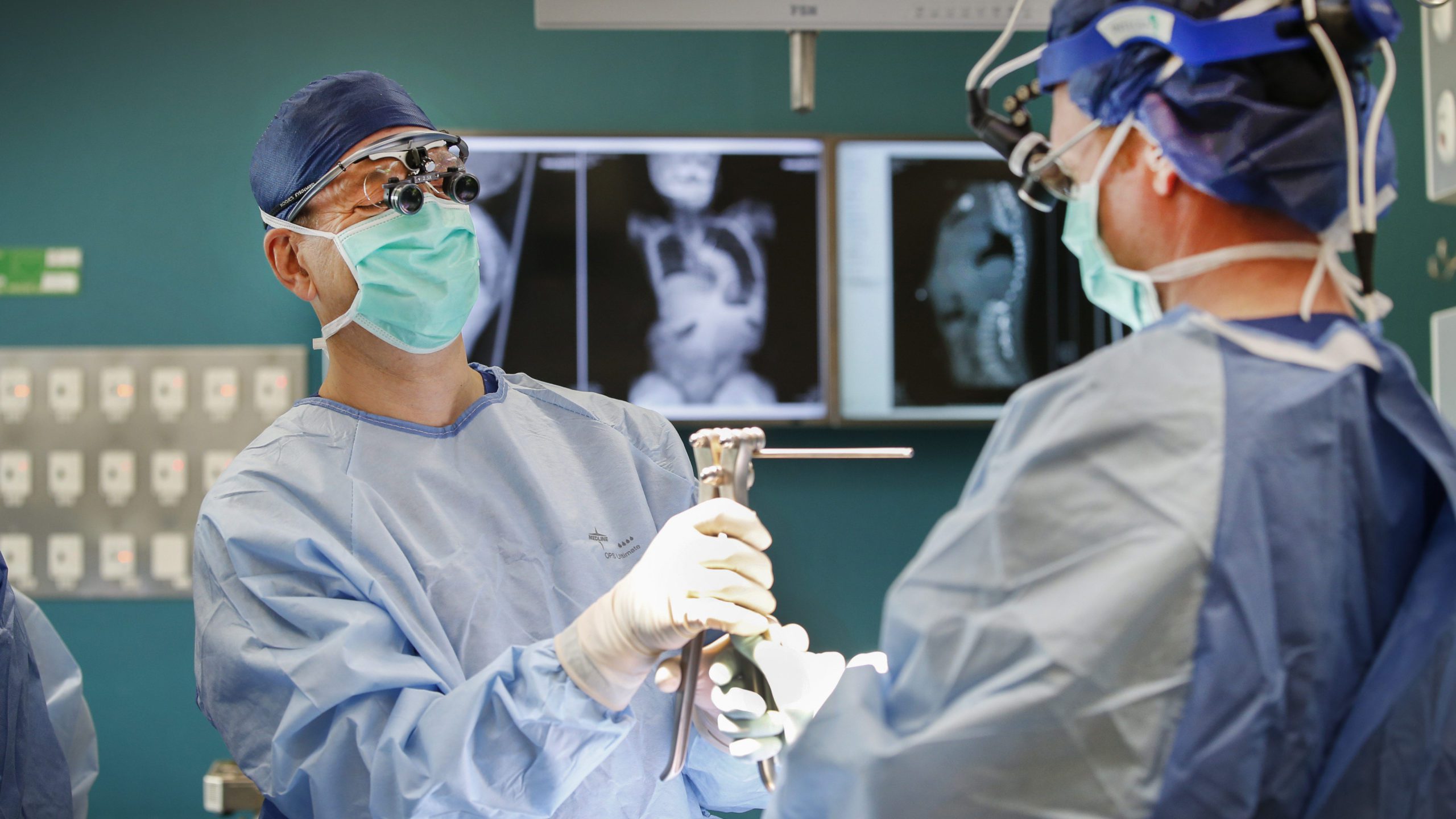
Mr Michael Johnson and Associate Prof. Aaron Buckland perform spinal surgery on Abubakar
In theatre last week, director of the RCH’s orthopaedic department Michael Johnson and spinal surgeon Aaron Buckland implanted two connecting metal rods into Abubakar’s spine; one end was attached just below his neck, and the other to a vertebrae in his lower spine.
As he grows, the rods will slide apart to bring his spine into alignment.
The team has used this sliding “growth rod” French technique for the past three years, and has become the second-biggest site to do so.
Mr Johnson said: “This sliding mechanism is one I’d liken to a cable tie. It can slide in one direction to achieve length, but it can’t go backwards.
“The main benefit is to avoid more surgery, because growth can happen without us having to do any more operating.”
It is a surgery that might soon be in hot demand, given the unit has recently received multiple referrals of teenagers with scoliosis.
Mr Johnson said he speculated that with COVID lockdowns now ended, and teenagers now out, active and more visible to their parents, this could be behind the increased detection of back problems.
“It takes parents looking at their children and seeing the curve,” he said.
“One of the ways they get recognised is in dance class or phys-ed, and all of that wasn’t happening in lockdown.
“Otherwise when kids are on holidays in their bathers, it’s spotted then as well. I suspect a lot of kids are not being observed in those settings and it hasn’t been noticed they’ve developed quite a big curve to their back — that’s the theory.”
Abubakar’s spinal deformity before surgery
Meanwhile, Abubakar has returned home.
His surgeons will monitor his condition over the next few years to see if any more treatment is needed.
“The ideal situation is he grows and extends these rods out to their full extent — about 5cm — and doesn’t need any more operating ever again. That would be the rolled gold result,” Mr Johnson said.
With Abubakar now keen to return to school next term, Mr Bakari said he hoped the surgery would free his boy to move through life with greater ease.
“He’s got a strong personality. I think what he’s been through has made him a much tougher kid,” he said.
“He’s a very switched-on boy so whatever he decides to do I hope he can do that.
“I think it will be something to do with vacuums, perhaps making or designing them.
“He is obsessed with them.”
Give for the Kids
Your donations to the Good Friday Appeal help fund the vital equipment, research, training and care that help kids like Abubakar.
Everything Good Friday Appeal, straight to your inbox. Get more information about your impact and how to get involved.
Meet Piper
From their picturesque property in Panton Hill, Piper Crawford’s family live at the whim of neurological storms that roll in and cause havoc.
When the six-year-old is seizure-free, mum Sara likens the family of five’s existence to sitting at the edge of a cliff. It’s a stunning view, but there is the immediate threat — one felt constantly — that they could topple off at any time.
“We haven’t been able to take a step back from the edge of the cliff, but we’ve come to understand that along with Piper’s condition we have a cycle of grieving,” Mrs Crawford said.
“We’re now in a place where we know we are going to get through to the other side, and we’ve learnt to really appreciate those windows in between and what quality of life is.”
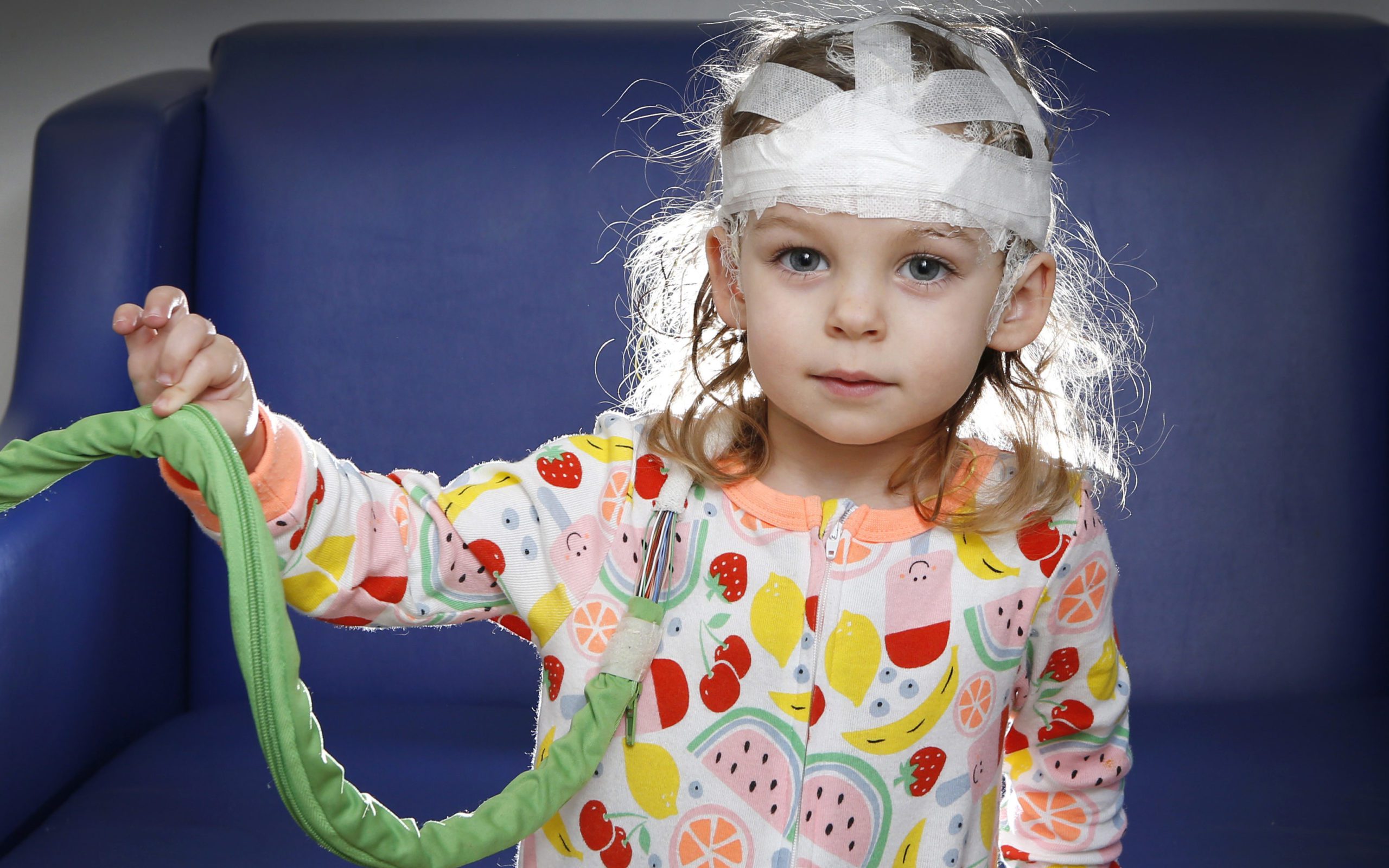
Herald Sun readers first met Piper four years ago when she was aged two.
She had been hit with eight massive clusters of epileptic seizures in as many months. The toddler needed to be resuscitated after most episodes.
Each cluster saw her needing to relearn how to walk, talk, think and even move her eyes again.
Their cause was unknown and medication could not control them.
Piper Crawford, 2, had electrodes stuck on her head for a week-long epilepsy mapping test.
But later that same year, the family made some progress.
Genetic testing revealed that her seizures were caused by a mutation of the PCH19 gene, a discovery made by internationally renowned Melbourne neurologist Ingrid Scheffer.
“What this diagnosis did is gave her neurologists permission to be very aggressive in her management,” Mrs Crawford said.
“And that’s exactly what they’ve done.”
Piper has been treated by a series of firsts at Royal Children’s Hospital over the past two years.
She has lived in ICU as a long-term patient and has been one of the youngest children to have a “pacemaker for the brain” implanted.
And now, a new drug delivery system is aiming to finally bring better quality of life to Piper and her family, despite her seizures.
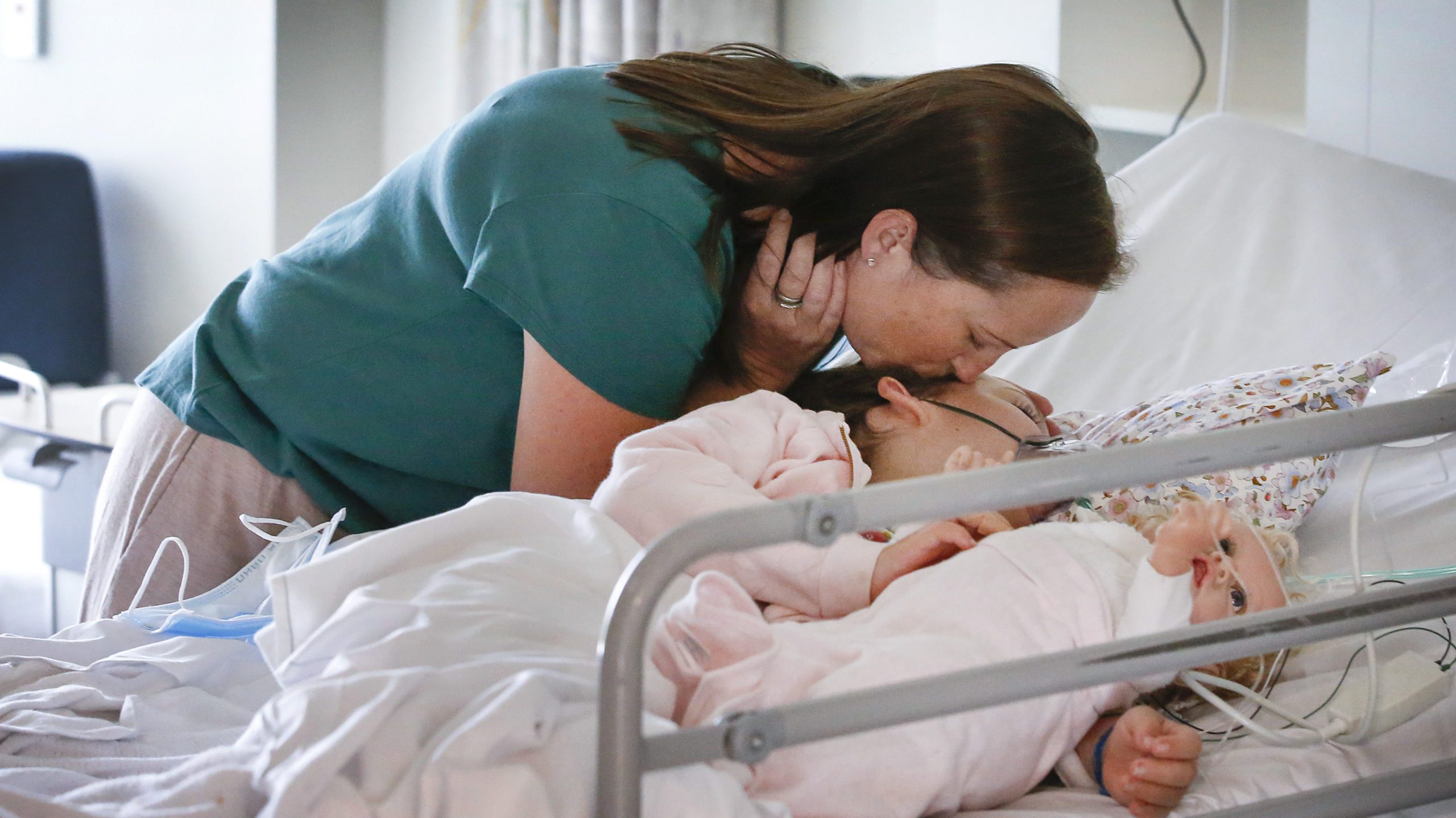
Mum Sara Crawford kisses her daughter Piper Crawford, 6, in hospital.
“There is still a lot of joy and positivity in our life, even in hospital,” Mrs Crawford said. “We’ve got a very sunny, humorous little girl that makes our day.
“The hospital has acknowledged that perhaps this is as good as it’s going to get with her seizure management.
“It’s a little bit too hard to be swallowed up by the depths of the meaning of that when we’ve got such a spirited child on our hands.”
The genetic diagnosis entailed the trial and error of anti-seizure medications. Neurologists went to the top shelf. This meant, though, that Piper needed to be admitted to ICU for each infusion.
“There haven been times that Piper was admitted to ICU for two weeks of each month, over the past few years,” Mrs Crawford said.
“We probably spent about 18 months on this treatment cycle feeling as though we were living in ICU.”
And while the treatment worked to suppress the seizures while she was receiving it and free her brain so she could develop basic childhood skills, it was not practical for a child — and their family — to live out their days in ICU indefinitely.
“But what it did was gave her the ability to develop speech, and stop progressing with physical disabilities, which were starting to accumulate back in the day due to the severity of her seizures,” Mrs Crawford said.
“It could have been very dire and we could have ended up with a very physically incapable little girl. That infusion saved her.”
Director of neurology Simon Harvey said they had to devise a plan that would improve Piper’s quality of life so she wasn’t stuck in hospital so often, but where her safety and care wasn’t jeopardised.
“The difficult thing for the family is they’re almost like some of the cancer families here; they’re in hospital for weeks at a time repeatedly. That’s not the norm for kids with epilepsy. They’d usually be out within 24 hours,” Dr Harvey said.
“We have lots of children who have challenging seizures. But Piper probably is the most challenging in terms of recurrent admissions and medical intervention.
“She’s our most frequent flyer.”
The first step was implanting a vagal nerve stimulator in Piper. About five kids with tough to treat epilepsy receive one each year at the RCH.
It works by sending electrical pulses to the brain via the vagus nerve — one of the longest nerves in the body, running from the brain to abdomen — the theory being that it acts on the nerve pathways involved in seizures.
It’s not a cure, Dr Harvey says, but it works by reducing the severity of episodes.
Piper Crawford leaves the hospital with her parents to go home to continue her treatment.
“I think that was the major turning point. Once that implant went in, we hadn’t been back to ICU until the last admission. That was an 18-month break,” Mrs Crawford said.
“Although the implant hasn’t cured her, it has reduced the severity. Although she is still having seizure clusters that need to be treated in hospital, it is not requiring ICU treatment every time now. That’s a massive difference to our lives.”
Then, Dr Harvey and his team had to think creatively again about the next option that would help Piper and their family improve their quality of life in the longer term.
In a first for the hospital, an experimental delivery of anti-seizure treatment — a drug and subcutaneous delivery usually reserved to keep palliative care patients comfortable — is the next thing being tried to slow the electrical storm in Piper’s brain. She will rely on care from the RCH’s Hospital in the Home service.
“The natural history of kids with this condition is in the second decade of life seizures are less of a problem. We’d like that,” Dr Harvey said.
“We’ve been waiting for things to settle with Piper — we thought last year was it — but the ones she’s still having at the moment suggest she’s still got a very active seizure disorder.”
For Mrs Crawford, husband Heath and their two older children Shylah, 13, and Mason, 10, waking up in the same house together was their simple wish.
“We’re ready to spread our wings and embark on the next chapter of our journey, which hopefully involves a lot more togetherness and time at home,” Mrs Crawford said.
Originally published in the Herald Sun, 2 April 2021
Words: Brigid O’Connell
Photo: David Caird
Everything Good Friday Appeal, straight to your inbox. Get more information about your impact and how to get involved.
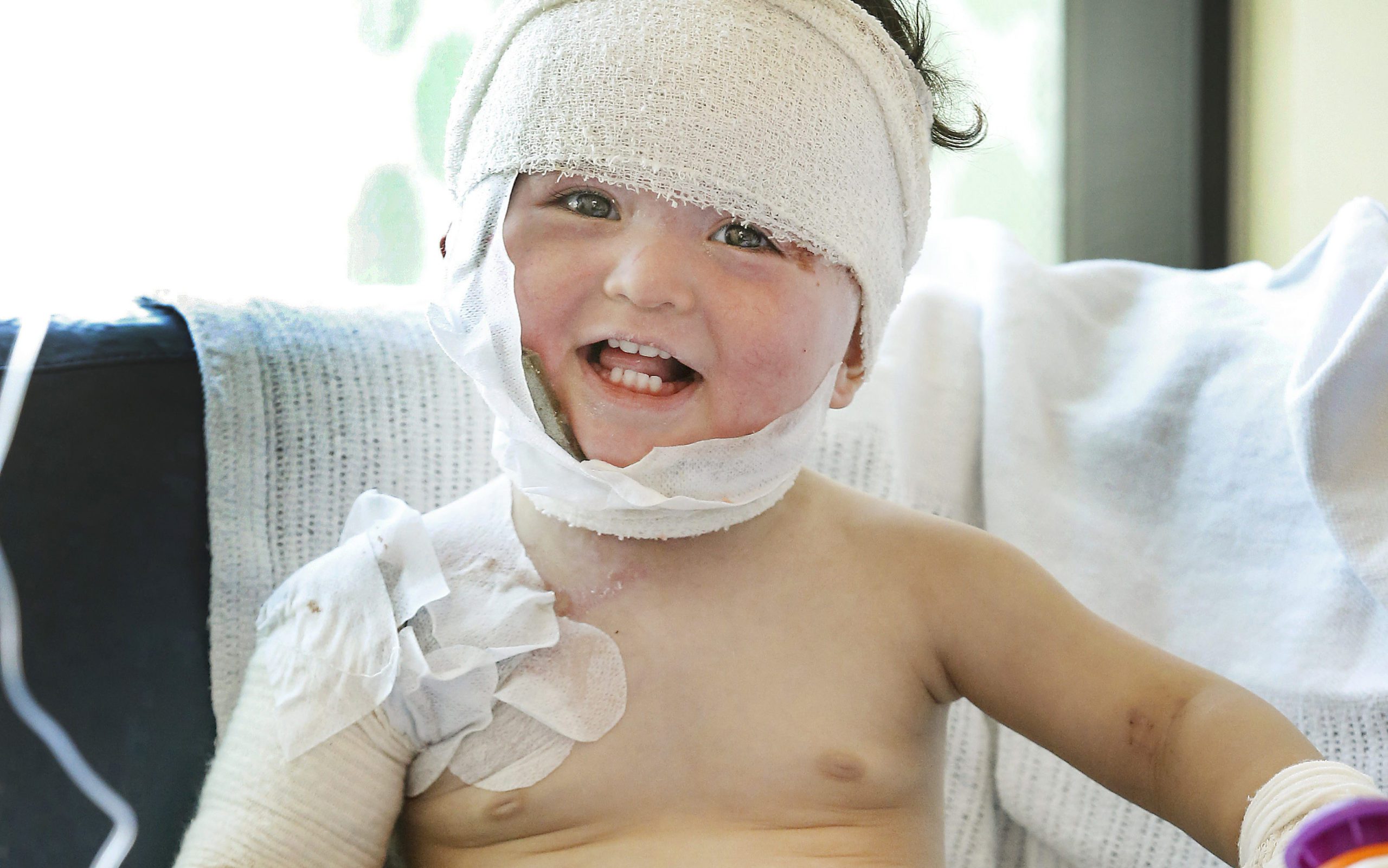
Meet Ryan
In the blink of an eye the damage was done.
Ryan Haidari had not long found his feet. All arms and legs, the 14-month-old tore around the garage as his mum Sohaillah finishing cooking.
She placed the pot of vegetable and bean stew, that they would take to park for dinner, on the shelf.
In the instant she turned her back to reach for the seasoning, the curious toddler had pulled the hot pot on top of him.
It caused third degree burns across Ryan’s face, chest and arms.
He was taken to his nearest hospital, but dad Ali said because of the burns on his son’s neck that were affecting his breathing, Ryan was transferred to intensive care at The Royal Children’s Hospital. The RCH is the statewide burns centre for children.
“It was very bad,” Mr Haidari said. “For seven days he didn’t open his eyes. He was just crying.
“The doctor said it’s a long process but he’s going better and better and better.”
Director of RCH Trauma Service and Ryan’s surgeon, Warwick Teague said this story gave other families the chance to look for ways to reduce their own risk.
“We always offer understanding to parents in this situation because it is hard. But kitchens are dangerous unless we actively seek out ways to make them less dangerous,” Associate Professor Teague said.
“In the kitchen that means not holding children and hot pans. When we’re cooking with hot water or food, that we always use the back of the stove. That we don’t move that pot or kettle unless we know exactly where the children are.
“We can’t wind back the clock, but we can make safer decisions for another time.”
After almost a month in hospital following skin grafts, Ryan went home.
Burns victim Ryan Haidari, 1
He will need to return each week to the RCH Burns Clinic to have his dressings changed for the foreseeable future.
“For the Royal Children’s, from 1 to 10, I give them 10. They’ve been good to us,” said Mr Haidari.
“My advice to other families is to always, 24/7, you have to stay with the kids.
In a few seconds everything has changed.
“Now I want him to have a good life, a better life, to be a healthy boy.”
Originally published in the Herald Sun, 21 March 2021
Words: Brigid O’Connell
Photo: David Caird