There is a particular type of scream, a rarely-used pitch, that parents reserve for issuing a cry for help for their child.
I knew this sound instinctively when I heard it one hot night in late January, when I was watering the vegie garden.
“The glass, the glass,” my husband Hayden kept yelling.
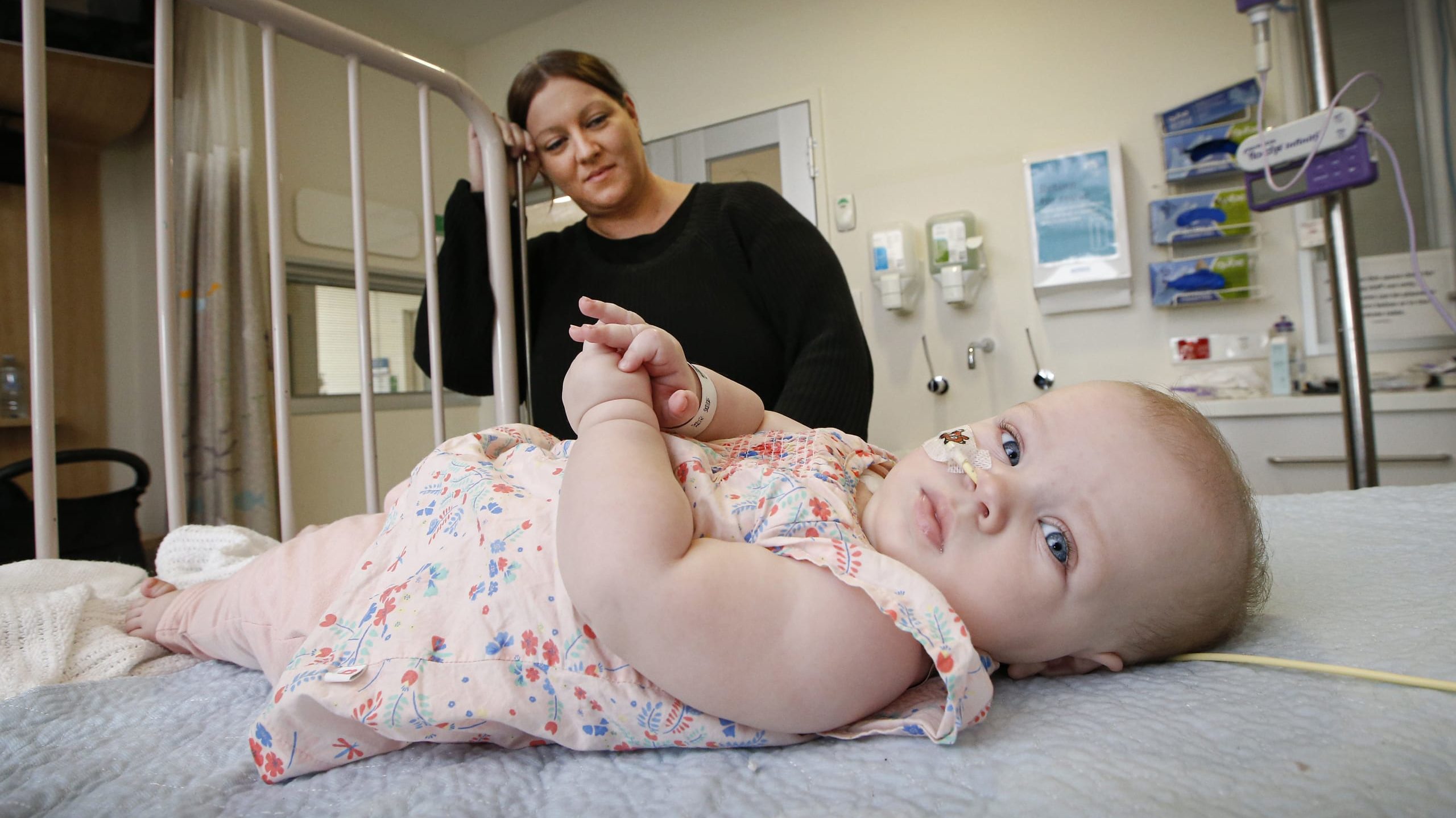
He was holding our baby daughter Fenella, who had not long celebrated her first birthday. She was screaming and bleeding all over.
A newly installed heated ceiling light had shattered all over her as she sat on the bath mat, getting dry.
Every spot where the shards landed on her was flecked with blood.
My first thought was we need to get to the Royal Children’s Hospital — now.
I’ve covered the Good Friday Appeal for the Herald Sun for more than 10 years. Each year I’m based at the hospital every day for the five weeks before Easter with a photographer.
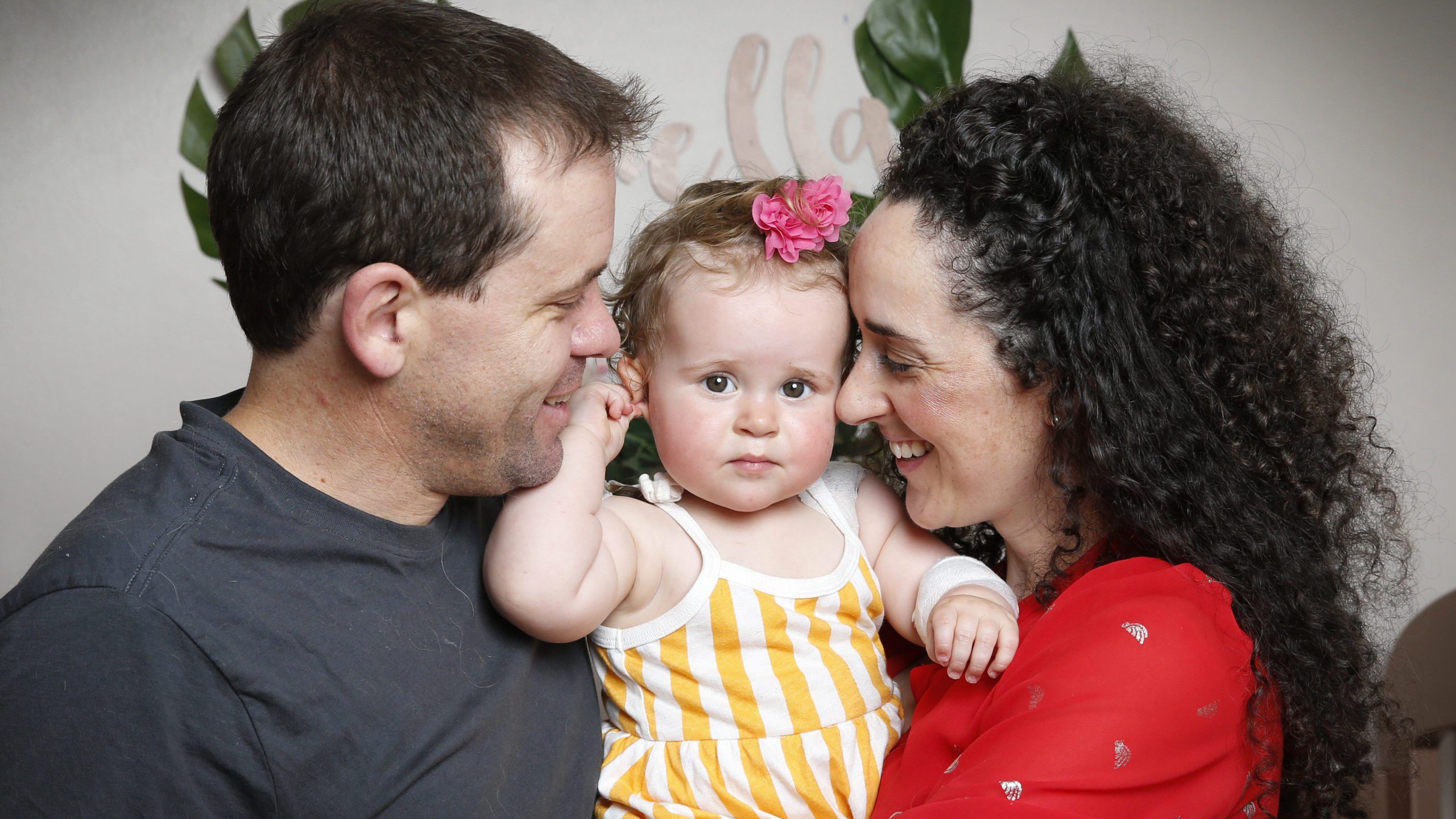
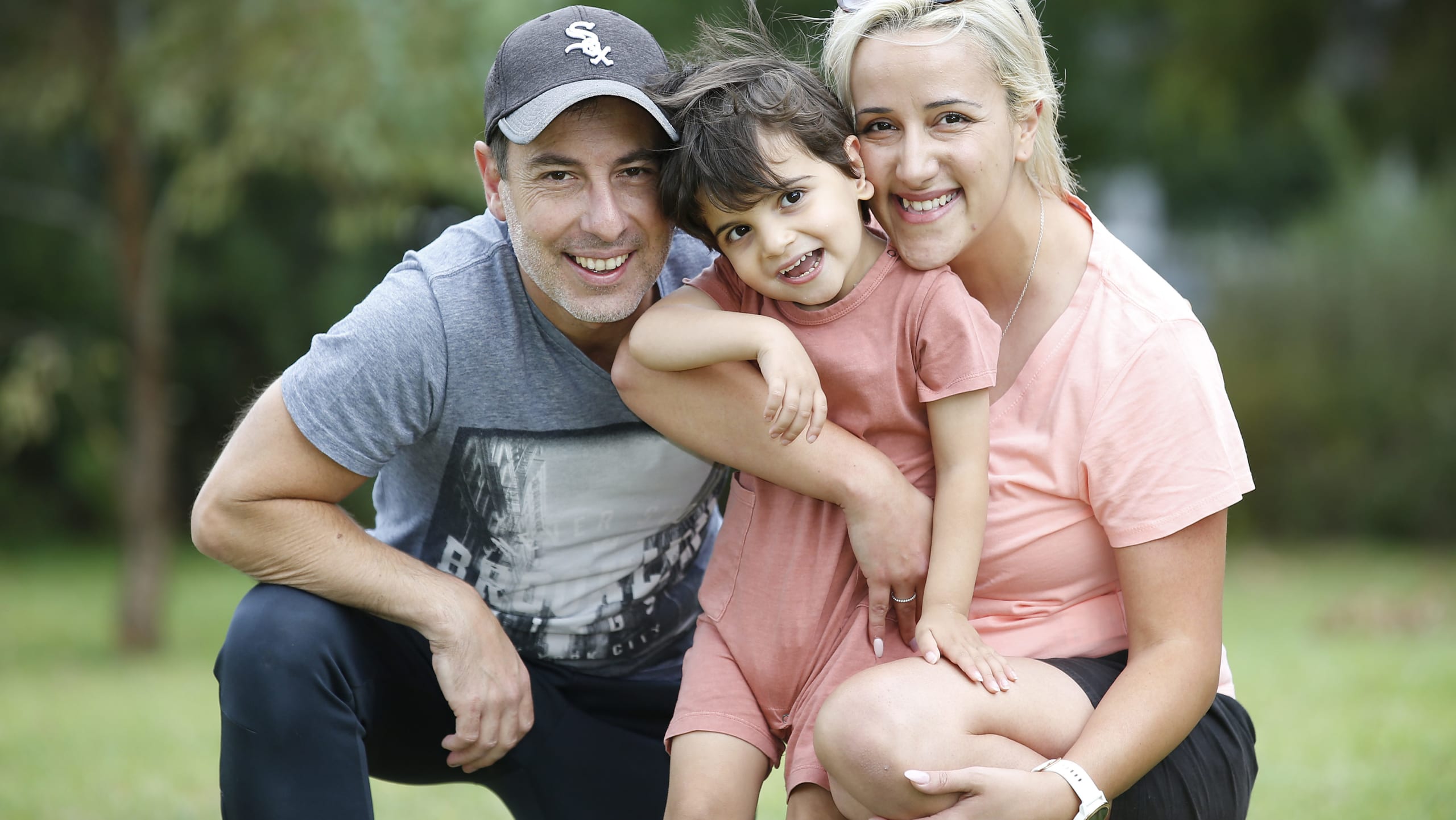
Fenella with parents Brigid OÃConnell and Hayden Lewis at home.
We walk the wards looking for engaging stories. We are invited into the operating theatres and are there when the parents say their teary see-you-laters to their children in the anaesthetic bay.
We are there when children who have lost their legs to cancer or a congenital abnormality, are fitted with prosthetic limbs.
I have seen the tender touches, the strands in the human chain of kindness, that the RCH is based on.
The neurosurgeon who lovingly keeps clippings of the baby’s hair for the parents — essentially their child’s first hair cut — from the section that needs to be shaved ahead of brain surgery. Or the nurses and doctors who raise money for the hospital in their own time, or start a side career in medical research to better solve the problems their little patients face.
And I have seen how multiple teams are mobilised for most children, each specialist putting in their piece of the puzzle to complete the picture of good health.
But until you need their services as a parent, it’s hard to really understand that power.
It wasn’t until we arrived at ED that the full extent of Fenella’s injuries were clear.
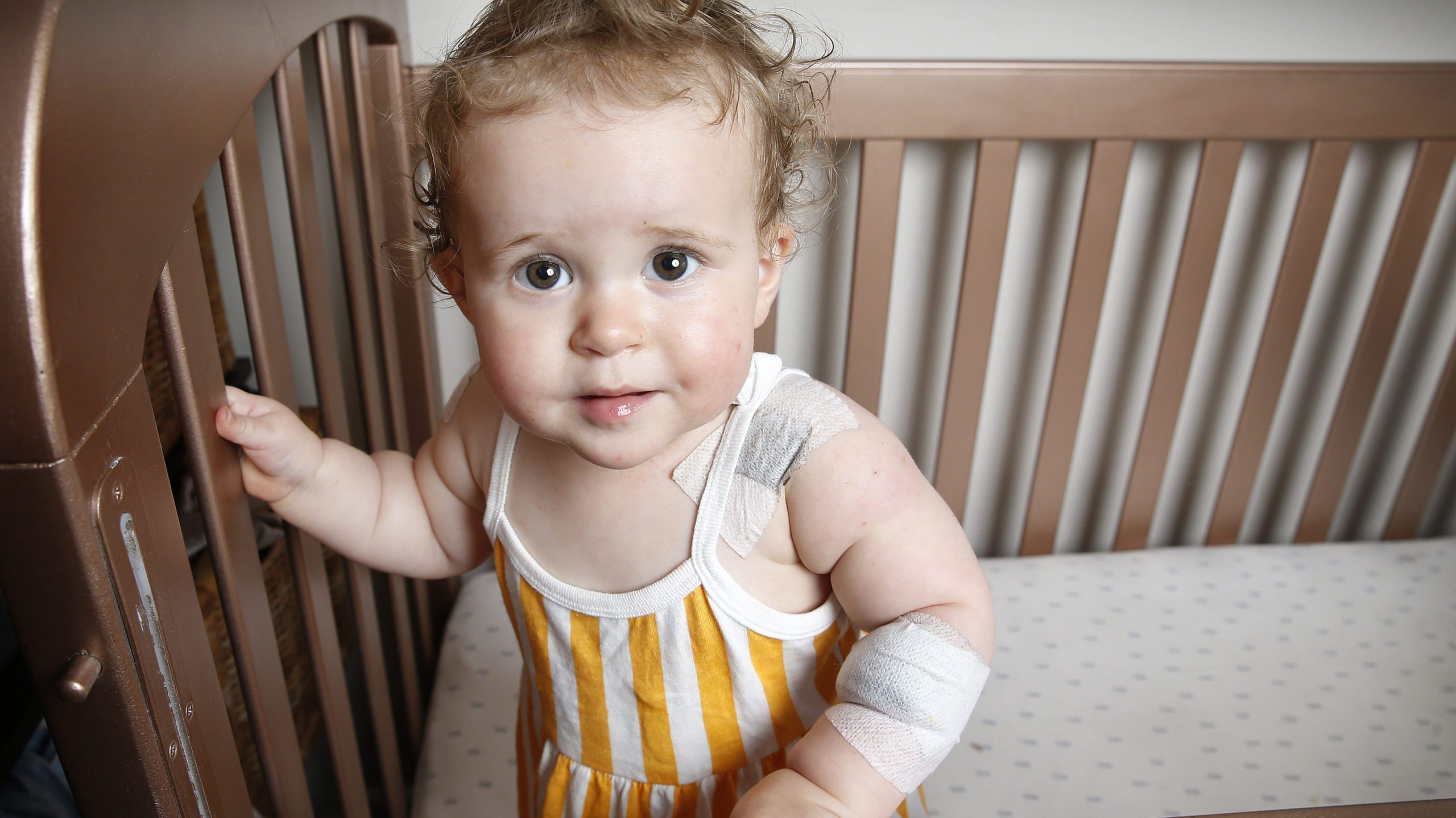
She had suffered third-degree burns across her shoulders, neck, legs and arm.
Fenella 1, suffered burns after a bathroom heater light glass exploded on her.
When plastic surgeons start talking skin grafts and preparing you for the fact you’ll be a patient at the burns clinic for at least the next year, you would do anything to change places with your child.
But the care we have been shown has been second to none. In our regular appointments, we are seen by two plastic surgeons, two nurses, two burns physiotherapists and a play therapist.
You can’t beat that care.
This has been our second encounter with the hospital in the past year.
Last June we were admitted to hospital when Fenella, then aged six months, could not stop vomiting all week.
They left no stone unturned in their search for the reason of her illness, which thankfully turned out to be a virus.
And when a blood test turned up markers linked to heart failure, they didn’t even wait for the results of the repeat blood test to come back before ordering an ECG at midnight.
This has been a different Good Friday Appeal for my family this year.
I am so grateful we are in the right city, at the right time, to access their amazing care and I give thanks this Easter.
Originally published in the Herald Sun, 2 April 2021
Words: Brigid O’Connell
Photo: David Caird
Everything Good Friday Appeal, straight to your inbox. Get more information about your impact and how to get involved.
Meet Sonny
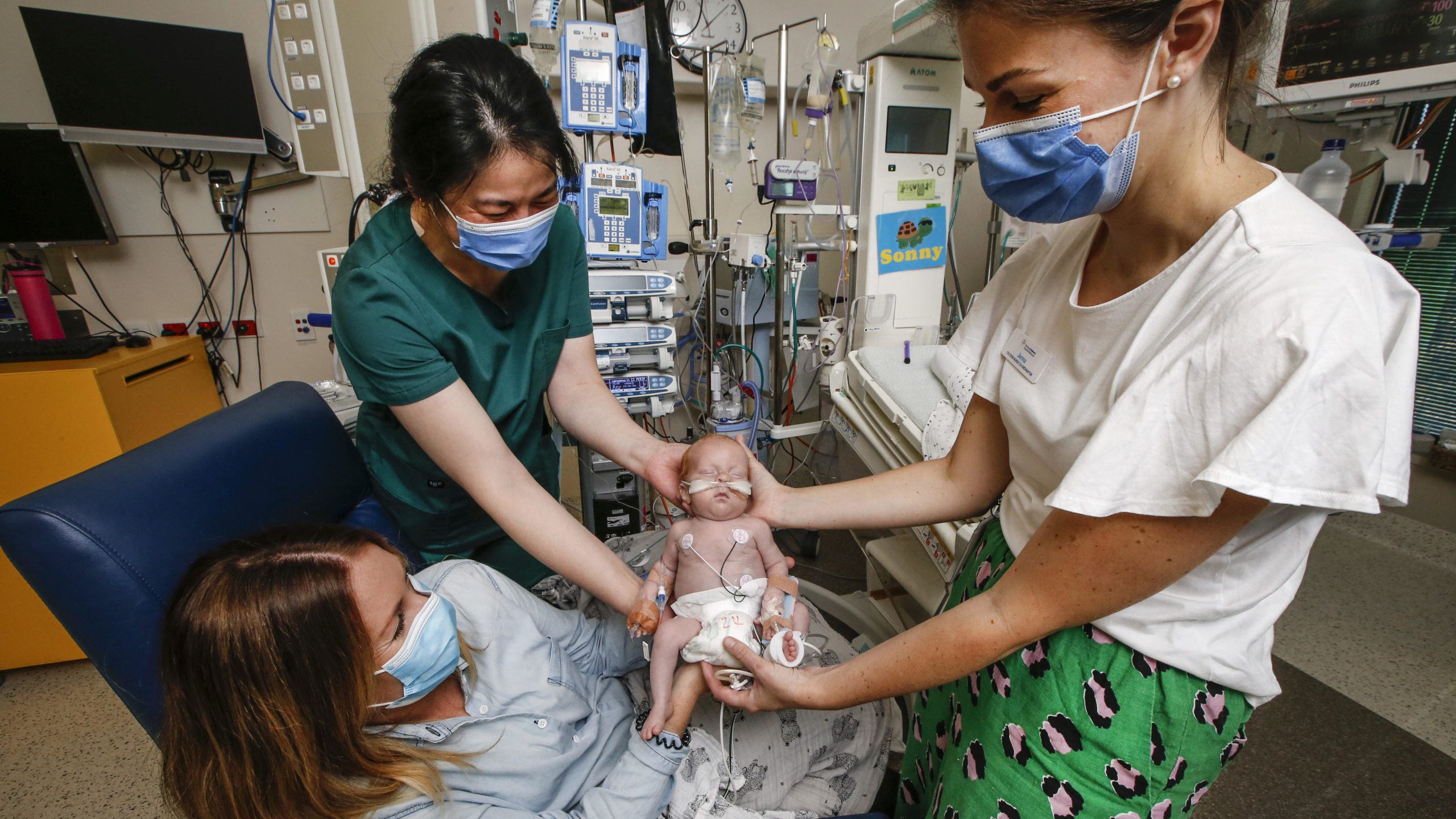
Since a rare kidney condition forced his entrance into the world three months early, it has been all hands on deck to save Sonny Grossman.
April 1, 2021 was supposed to be the first day Kim Spencer and Danny Grossman would wake up with their newborn. Instead, Sonny has spent his entire life in hospital, where specialists at The Royal Children’s Hospital have performed a delicate balancing act to boost his kidneys.
It was a textbook pregnancy up until about 20 weeks. But then fluid started to collect around Sonny.
The build-up was so big that Kim was generally measuring eight weeks ahead in the second trimester. But by 28 weeks her abdomen was the size of a full-term pregnancy.
“I’ve been pregnant before so I knew I would get big, but not that big,” she said.
“Usually the second trimester is much easier, but this second trimester was not kind.”
An amniocentesis was performed, a procedure where a sample was taken of the fluid around the baby, but that had not detected the cause.
At each scan the fluid kept building. Little did they know Sonny’s kidneys were unable to retain any fluid.
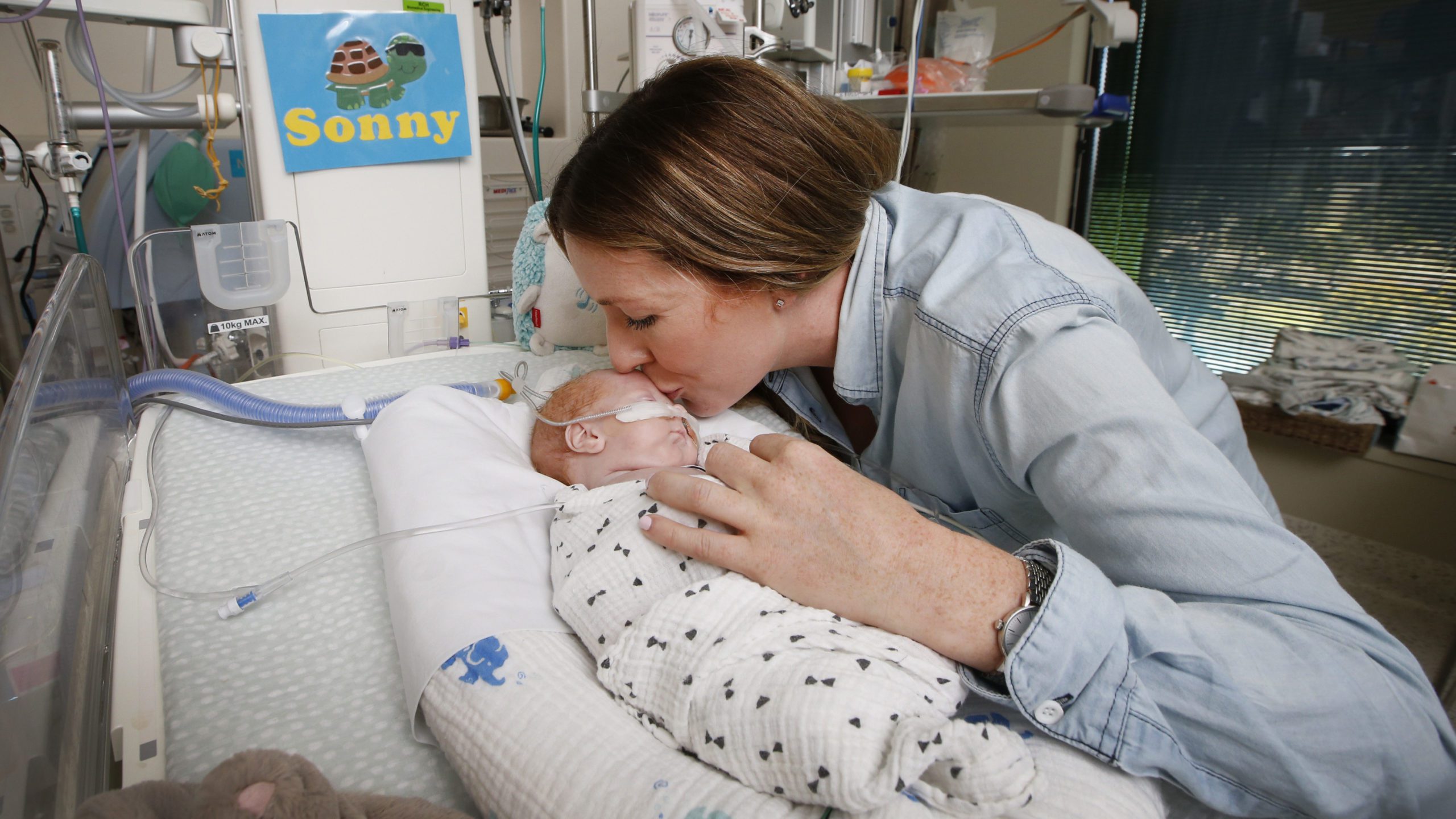
Sonny is kissed by his mother Kimberley in NICU.
When Kim reached 28 weeks and the fluid build-up was almost unbearable, doctors decided to drain some of it. But it is a highly risky procedure, as entering the amnionic sac can trigger premature labour.
In preparation, Kim was given steroids as a last-ditch effort to protect the baby’s lungs and brain if he did arrive early.
On January 8 they drained 1.4 litres, but the procedure had to be stopped when Sonny became distressed.
Three days later they tried again, and took out 1.6 litres.
“At that point we started to think something is not right. They can’t be for no reason,” she said.
After a few hours of monitoring on the ward, the couple then went downstairs for coffee. Kim collapsed in pain outside the cafe.
“I knew what that pain was straight away. It was my second child,” she said.
“I was pretty terrified in that moment. You know pre-term labour is a risk. But you never think it’s going to be you.”
On January 11, Sonny arrived weighing 1.15kg, at 28 weeks and four days gestation.
In the first few days of Sonny’s life it became clear his kidneys were causing him problems, and he was transferred to the RCH’s neonatal intensive care ward for the specialist care of the renal team.
Sonny was accepted on to a clinical trial once there, comparing the effectiveness of rapid genetic testing for critically ill bubs.
Neonatologist Ruth Armstrong said the test confirmed he had a rare genetic condition called Bartter syndrome.
“The kidneys filter water, get rid of all the stuff you don’t need, and keep hold of the stuff you do need. Because of his generic alteration, his kidneys are less able to hold on to water, and the water then is more able to freely pass through,” Dr Armstrong said.
“This can be life-threatening, particularly if it goes unrecognised. Babies can become very dehydrated very quickly. They can lose thousands of mils of fluid per kilogram of their body weight a day from their urine.”
It was initially a tricky balance to get his fluid needs right.
“He needed an awful lot of fluid poured into him in order to keep up with his urine output,” she said.
“We started him on some medication with the hope it would reduce his urine output. That has worked, along with growing up a little bit. He’s still needing lots of fluid to keep him hydrated. But he’s managing to take most of that now, orally.
“Watching him take a bottle the other day was a real joy to see.”
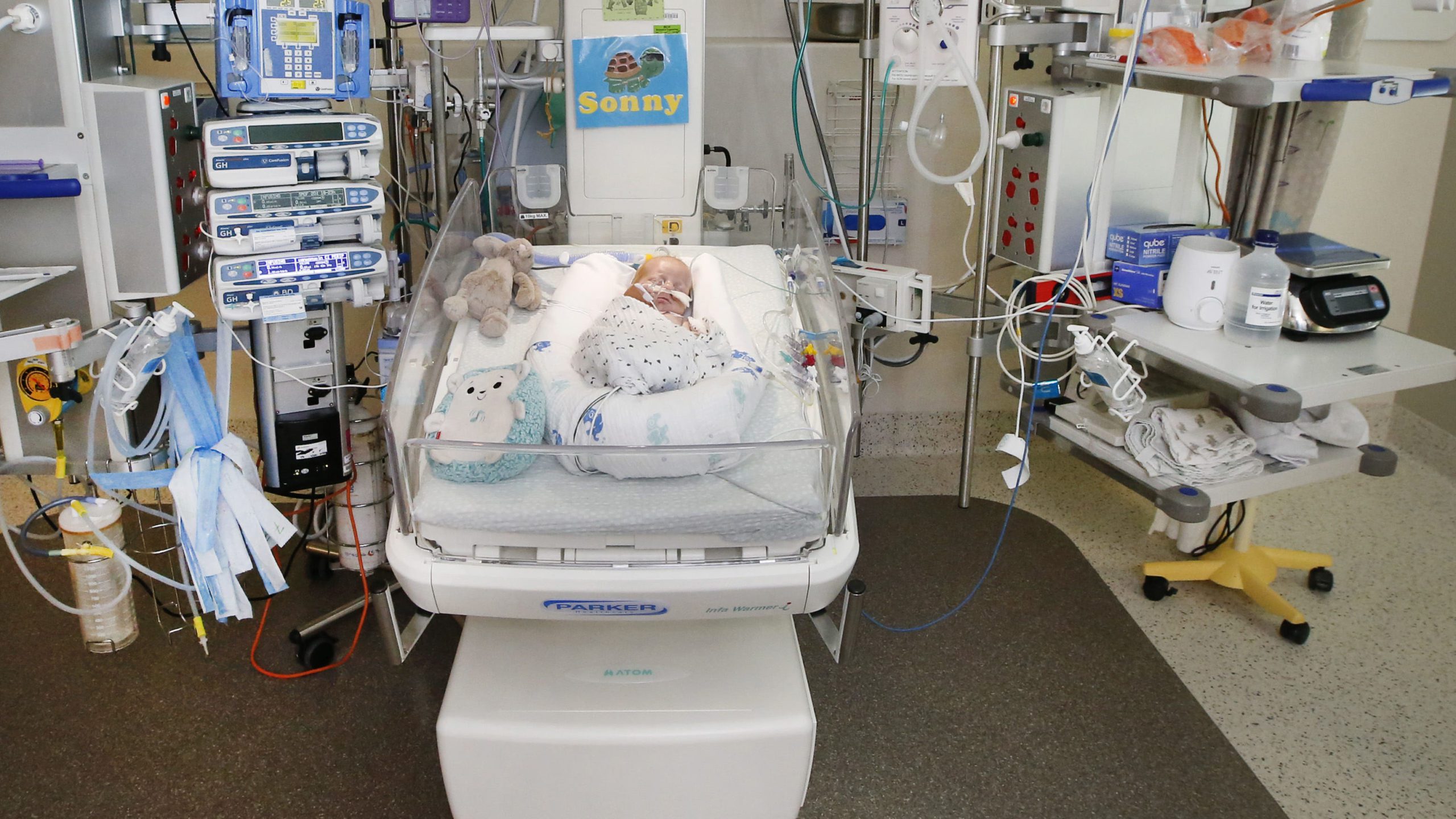
The Victorian public also played a part in Sonny’s care. He spent most of the first part of his stay living in one of the infant radiant warmer cots, which were bought through money raised from the Good Friday Appeal.
With a convertible roof and open sides, the cot allows his medical team ready access to ill newborns, without having to move them from their beds.
Sonny in the infant radiant warmer funded by the Good Friday Appeal
For Sonny this has meant six lumbar punctures to diagnose infections, and his daily weigh-ins could be done with less stress.
The beds also give parents better access to the tiny children, some who are barely bigger than soft drink cans, for the all-important tender touch and talk with their kids.
“Ultimately the baby is what we’re all there for, but we need to support the family. They need to be able to bond with their very sick baby, and the baby needs to be able to bond with them,” Dr Armstrong said.
“We do know that having parents close by, having cuddles with your mum and dad, having them sing to you or talk to you, or stroke your hand, whatever a baby is able to tolerate, we know that helps them to settle down.
“Their heart rate settles down, their breathing settles down.”
Sonny, who was due to be born yesterday on April 1, needs to gain more weight on top of his current 2.5kg and confidently take more feeds, before he can look to go home — which is likely to still be a few weeks away.
“It’s such a strange situation to have a 12-week-old baby and not know what they do at night time,” Mr Grossman said.
“That’s why we’re desperate to get him here so we can have a normal family life.”
Sonny is moved to his mum Kimberley for a cuddle.
Big brother Ethan, who has not yet met his beloved baby in the flesh because of COVID restrictions, must contend with Baby Chat — a virtual health initiative of the hospital that allows sick newborns the chance to hear the voices of their parents and siblings — for a little longer.
Sonny will need continued help with getting enough fluid, which could mean a feeding tube through his nose or directly into his stomach.
He will be watched closely by the RCH renal team over his entire childhood to ensure his kidneys are coping with the challenge.
But in the longer term the hope is that he will simply be able to manage his condition by drinking enough himself.
“A clinician told me that this condition is what we make of it. If we’re not bothered by it then he won’t be. That really stuck with me,” Ms Spencer said.
“I don’t want him to be treated any different to any other child.
“I just want him to learn to live with it and manage it, so he can do whatever he wants to in life.”
Everything Good Friday Appeal, straight to your inbox. Get more information about your impact and how to get involved.
Meet River
Baby River Reid was dying.
In just three weeks, a rare blood cancer had taken such a strong hold on the six-month-old that the brain and spinal cord were the only parts of her body without tumours.
To make her predicament worse, River’s immune system had gone into such overdrive as it tried to fight off the cancer it became an additional illness that started shutting down organ after organ. The right diagnosis and treatment came with no time to spare.
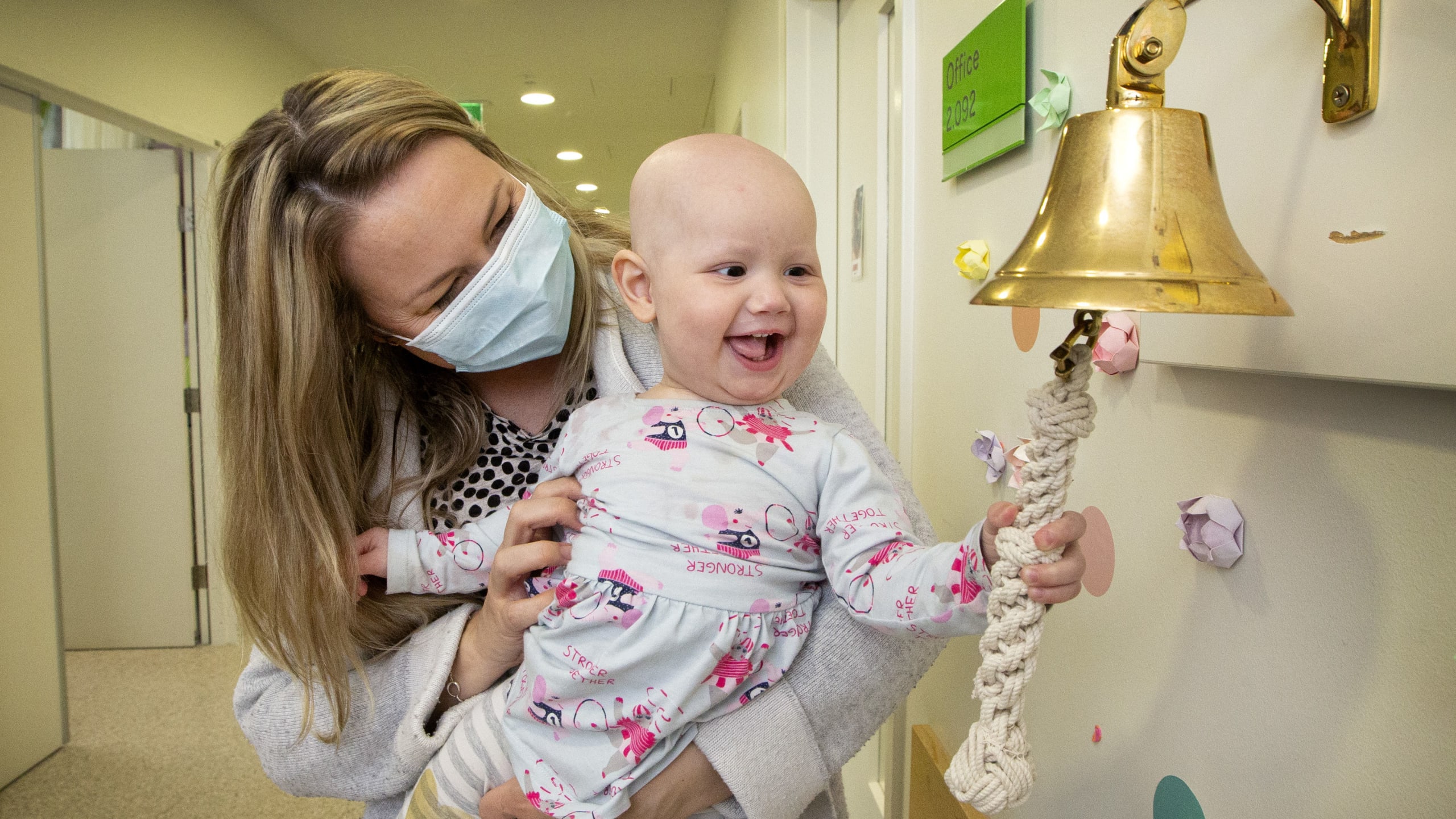
Now, after 147 nights at The Royal Children’s Hospital and a “perfect” response to treatment, the one-year-old is home and free to start living life untethered to tubes, drains, monitors and machines.
“The doctors keep looking at her and saying she’s remarkable, she’s an inspiration,” mum Julia Reid said.
“Until just this month, I haven’t let herself think about the future. But she’s passed the first three months still in remission.
“At the end of the street is the school she will go to. We walk past it and I can now let myself think; she will go to this school.”
It started as a low-grade fever in Julia and Simon’s youngest child. But after a week it had jumped to 41 degrees. A COVID test ruled that out, and via a telehealth GP consultation they were advised it was time to go to ED.
River went downhill quickly, going from a child happy to sit up and play to one with a heart rate of 220 beats a minute who was no longer crying and within a few days needed help to breathe.
Scans found masses throughout her body.
“It’s literally like an atomic bomb goes off in your life,” Julia said.
“I remember when she went to get her first CAT scan when they found the mass, I was bawling.
“I knew they were about to completely smash my heart. It’s like there is a tank coming towards you, you’re going to get shot and you can’t stop it. It’s really traumatic.”
As her need for more intensive care support grew, River was transferred to the Royal Children’s Hospital.
“She was declining and they saw it and they did something about it. We’re so grateful,” Julia said.
River, 1, rings the cancer bell helped up by mum Julia Reid on completing her treatment.
“When she was about to go under the anaesthetic to put her on the ventilator, I said goodbye. They didn’t even know if she would survive even putting her on life support.”
“Her kidneys were shutting down because they were full of cancer, her liver was shutting down.
“The oncologist said she was fighting the intubation. It shows she has sass, and she’s going to need it.”
It was a Friday night and emergency testing protocols were enacted, which saw specialists mobilised and the pathology team work around the clock to get her diagnosed by Monday morning.
“They said all the things we’re testing for are bad,” Julia said.
“I had my first panic attack. However bad and horrible and scary you think it is, it’s worse. However terrifying you image that situation, it’s worse.”
Paediatric oncologist Diane Hanna said this rapid testing was life saving for River.
“A critical part of this case is that it was really was a matter of life and death,” Dr Hanna said.
“Each day she was becoming quite unwell. When she came across to us it would have been a matter of 24 hours (left of life) if we hadn’t mobilised the troops to get a diagnosis. I don’t think she could have waited until the Monday.”
Tests found that River had stage four anaplastic large cell lymphoma. It had caused hundreds of nodes to grow through her body and in her organs.
This cancer had sent her immune system into overdrive, a rare condition called HLH or hemophagocytic lymphohistiocytosis, which also triggers immune cells to destroy many of the organs.
“We know if we treat the lymphoma, the abnormal immune response goes away,” Dr Hanna said.
It was one of the most intense prescriptions of chemotherapy that can be given. River endured 60 doses of high-dose chemotherapy back-to-back for 20 weeks. She needed to stay in hospital — largely room-bound — throughout the treatment.
While the doctors and nurses did their bit, Julia embraced the important role she needed to play.
Despite aching for her three other children at home — Grace, 4, Charlotte, 10, and Blake, 12 — each morning upon waking she would call out to Alexa, “Play some fun music” to start the day with dance and song.
There were rubber ducks for River’s bath. Her hospital room was decorated with her favourite toys.
“Someone told her being positive was going to be a big part of her recovery. This is five months of her life, half her life. I didn’t want to wish that away,” Julia said.
“You’re isolated, you can’t leave the ward, and for six weeks she couldn’t leave her room.
“I made a decision that we were going to be positive, we were going to make it fun, and she was still going to have a happy childhood.”
“It was a choice every single day.”
River’s response to the treatment was “perfect”, Dr Hanna said, “exactly what we wanted”.
“Children who respond very quickly and are in remission at the earliest time point means that their risk of relapse is low,” she said.
“The critical period is always in those first couple of years after finishing treatment. We’ll be watching her very closely.”
Home and relishing the chance to play on grass for the first time, explore the world without being connected to an IV pole, and be doted on by her older siblings, River is loving her second chance at life.
“After going through this, there are two things we’ve realised are really important: health and connection. For the rest of our lives that’s all we want. Relationships, love, happiness and connection — that’s all we want for our kids,” Julia said.
Give for the Kids
Your donations to the Good Friday Appeal help kids like River.
Everything Good Friday Appeal, straight to your inbox. Get more information about your impact and how to get involved.
Meet Elliott
Elliott Cimino can’t stop smiling and laughing. He can’t help it.
The four-year-old’s ever-sunny appearance is a hallmark of his rare genetic condition. And while his personality is a blessing for his family as they navigate life with a non-verbal child with profound other needs, it also masks the seriousness of his condition.
Elliott has hundreds of seizures a day — and that’s on a good day. He will collapse without warning, suffering chipped teeth and face gashes in the process.
At other times he appears like he’s transfixed on something far away. And then there are jerking seizures, where it looks like he has been struck by lightning over and over and over.
These episodes can last for two heartbreaking hours. But a strict high-fat low- carb diet is so far working wonders.
Instead of hundreds of seizures a day, since coming under the care of the ketogenic diet clinic at the Royal Children’s Hospital Elliott is now having just one seizure every other day.
With the neurological electrical storm off the radar, this has freed his brain to start learning the basics of childhood for the first time, including taking his first steps with a walker just before his fourth birthday.
“It’s been life-changing. It’s amazing,” said mum Chrissy.
When Elliott was unable to sit on his own at six months of age, Chrissy and husband Ben went searching for answers.
Elliott Cimino 4 has rare condition called Angelman syndrome which makes him laugh and smile frequently, gives the thumbs up in his hospital bed. Picture: David Caird
It was an eight-month quest, seeing varying doctors and waiting for the results of genetic tests, to diagnose him with Angleman’s syndrome.
“He fits the syndrome to a tee,” she said.
In addition to the overly happy demeanour, he rarely sleeps, cannot speak and has low muscle tone.
The condition is often misdiagnosed as cerebral palsy or autism.
“It was a real shock that your kid will need lifelong care,” Chrissy said.
“But he is the most amazing kid ever. He makes me laugh and smile every day. He makes me proud. Everybody just falls in love with him.”
Despite his other challenges, the seizures are causing Elliott and his development the biggest problems.
Unusually, Elliott is under the care of three epilepsy specialists at the RCH.
Neurologist Jeremy Freeman said Elliott had been “particularly challenging” given he had such injury-prone seizures and had already failed many choices of standard treatment.
After failing nine first-line anti-seizure medications, he was given compassionate access to medicinal cannabis. This did work for six months, but his body became tolerant and the electrical storms rolled back into his brain.
A ketogenic diet, under the strict supervision of RCH nurses, dietitians and neurologists, is the latest treatment they are trying.
The theory is that as the body burns fat rather than carbohydrates for energy, this ketosis state gives the brain an alternative source of energy, which can alleviate seizures for some children.
So far, so good for Elliott.
“Because he’s not constantly having seizures, the right messages have been able to get through in the brain,” Chrissy said.
“Everybody is amazed at what he is now doing from a developmental point of view.”
It is not uncommon to walk past Elliott’s hospital room and see him holding court with doctors on their ward rounds, trying to communicate with him through his love of slapstick humour, songs and silly faces.
For her son who craves social interaction and has to rely on locking eyes or taking someone’s hand to initiate communication, Chrissy hopes that perhaps with a seizure-free brain Elliott may one day learn to use an iPad and “talk” through that.
He has started kinder. He is communicating more, and can finally take part in hydrotherapy for his physical disabilities without the risk of having a life-threatening episode in the water.
“I just wish that he will live life to his capabilities,” Chrissy said
“If we could take away his seizures, I can handle everything else that comes with his disability and what comes along with having a kid with such special needs.
“But getting those seizures under control is our dream.”
Give for the Kids
Your donations to the Good Friday Appeal help kids like Elliott
Everything Good Friday Appeal, straight to your inbox. Get more information about your impact and how to get involved.
Bright souls fight cancer
For the 200 young people — some in their first week of life — who enter the Royal Children’s Hospital’s Children’s Cancer Centre each year, everything is thrown at outsmarting the rogue cells that have hijacked their childhood.
“We cure somewhere between 80-85 per cent of children who walk through the door. Not extend life, which is the focus of care for adult medicine; we cure,” said paediatric oncologist Jordan Hansford.
“The thing we do well is we have international collaborative projects for rare disease so our outcomes are outstanding.”
But it is a hard road to walk.
Cancer treatment is long, intense and isolating, not just for the patient but their family, too. It typically leads to families living apart for weeks or months on end; parents play tag team to spend the night on the couch by their child’s side.
And the stress doesn’t ease once they are at home for brief periods between rounds of chemotherapy. A spike in fever can be life threatening, so patients must get to the emergency department within the hour. Battered immune systems mean families are forced to live in COVID-style lockdown for months or years, to keep their child safe.
It’s a precarious way to live.
Eddie Biemans, 7, has a rare cancer condition called Hepatoblastoma.
But for families like Eddie Biemans’s, they take strength and solace in the resilient way their child endures the treatment, and the dedication of their medical team.
Sammy and Hayden Biemans were forced to quit their jobs, leave their cattle farm in the state’s far east and find a temporary home for the family in Melbourne, after their seven-year-old was diagnosed with liver cancer in September.
“It’s a really surreal situation. You have to put your blinkers on, like horses do, and have the vision of getting out of it and dealing with everything else later,” Ms Biemans said.
Despite the cancer initially spreading to Eddie’s lungs, high-dose chemotherapy cleared it. The Alberton boy had surgery two days before Christmas to remove the tumour and most of his liver and gallbladder.
With Eddie able to ring the gold bell in the oncology ward — a hospital tradition to signify the end of treatment — the family will continue to travel to the RCH for the next two years for monthly blood tests and regular scans.
“It’s hard for people to understand that every admission into hospital, it’s blood tests, it’s scans, the kids having to deal with random people coming into their room invading their personal space,” Ms Biemans said.
“But he’s been able to make connections with play therapists and the education team — people who weren’t coming to poke and prod him — so it meant he had things he looked forward to.”
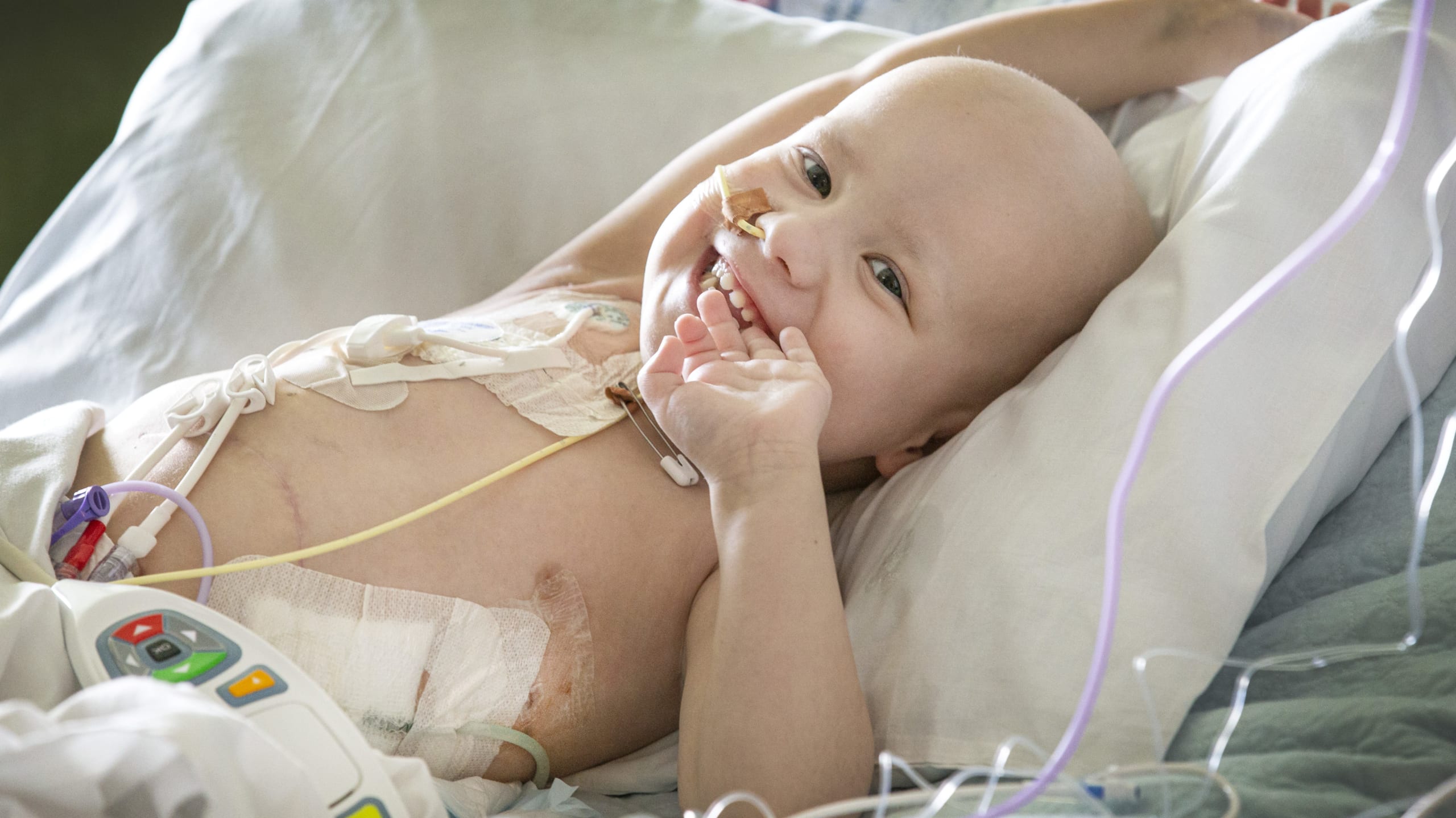
Oli Pluelkhahn 3, endured a 10-hour surgery
All the tools in the oncologist’s kit are being thrown at three-year-old Oli Pluelkhahn after he was diagnosed with a rare and aggressive neuroblastoma in September.
He has undergone chemotherapy and a 10-hour surgery, and faces more chemotherapy, a stem cell transplant, radiation and immunotherapy, which will start as soon as he recovers from treatment complications.
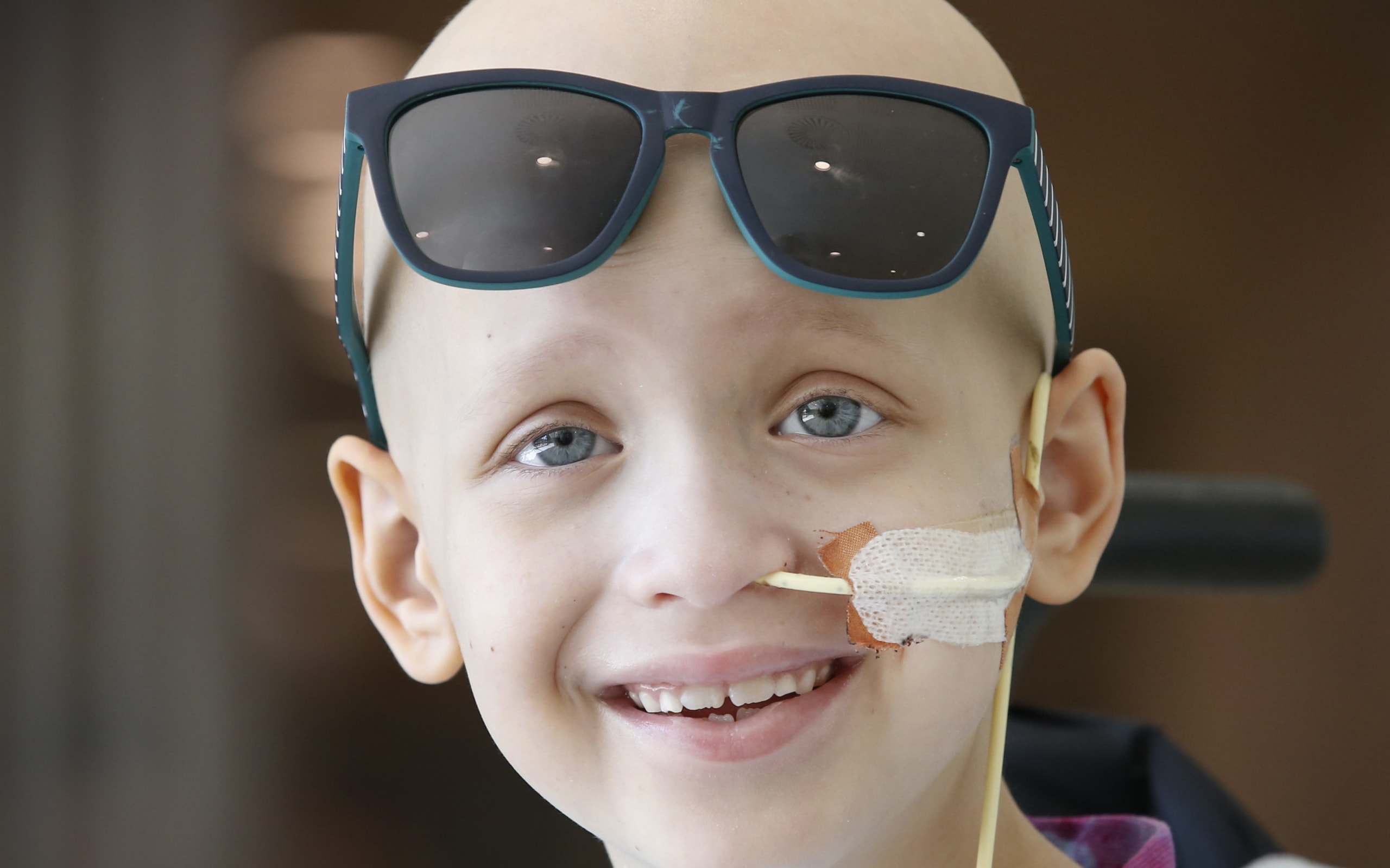
Further down the ward, Nolan Hiotakis, 7, is experiencing his own side effects from chemotherapy. The treatment for his brain tumour has made him light-sensitive, meaning he must don shades when chilling out.
Nolan Hiotakis, 7, is being treated for brain cancer
Dr Hansford, who also runs the oncology clinical trials unit, said the centre relied on donations to support their mission statement of getting each child access to the most promising treatment.
“Our model of care is such that every child who walks through the door and needs treatment, our goal is to enrol them on a clinical trial,” he said.
“The only way we get success with these children is through our collaborative clinical trials. Much of our money to staff and operate this program is soft, it’s not ongoing.
“We’re reliant on the goodness of public will through the Good Friday Appeal and through other charities and competitive grants, to help run our facility.”
Give for the Kids
Your donations to the Good Friday Appeal help kids such as Eddie, Oli and Nolan.
Everything Good Friday Appeal, straight to your inbox. Get more information about your impact and how to get involved.
Generations of Giving
The Royal Children’s Hospital has been world renowned for providing world-class care, for whatever that means throughout each era. That includes caring for Christine Phillpot and Finley Sherwood, who have both been patients at the RCH more than six decades apart.
Finley’s diagnosis of a rare low blood sugar disorder has only been possible through sophisticated genetic testing, which didn’t exist a decade ago. With her mum living by her side, multiple teams around the hospital have rallied around the seven-month-old to help her as she regains her strength and health following suffering dangerously low blood sugar episodes.
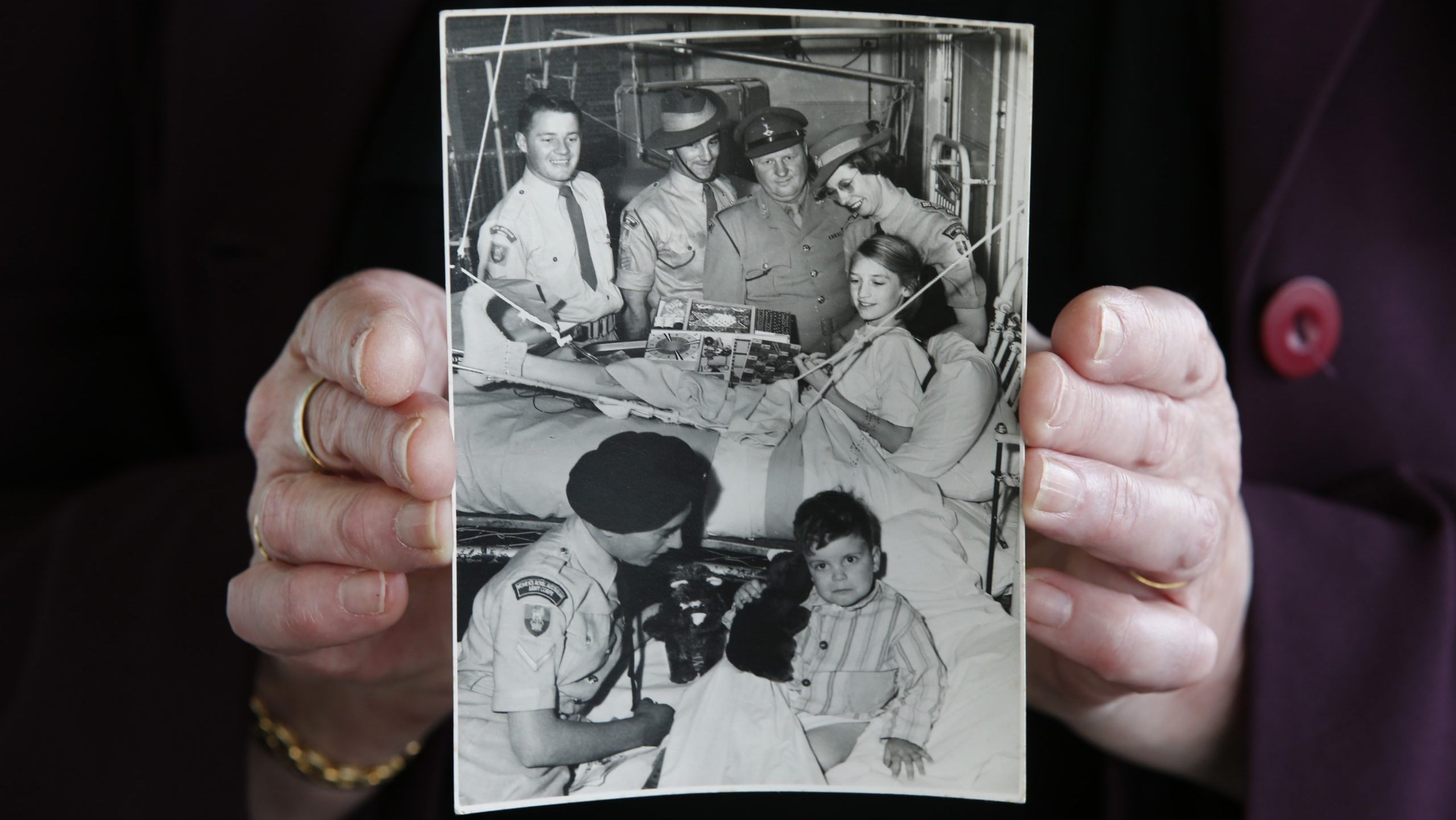
Her experience is a far cry from the 40-bed open intensive care ward Phillpot spent nine weeks in as an 11-year-old after she was hit by a car. A hospital stay meant a long time away from family.
But the hallmarks of their care are similar; a dedication to excellence.
As the Good Friday Appeal celebrates 90 years in 2021 — and the advances in care made possible through the $381 million donated by generous Victorians since 1931 — we reflect on its legacy of improving the lives of children now, and into the future.
CHRISTINE PHILLPOT
Christine, 73, remembers the split-second dread of being caught in the middle of Canterbury Rd in the path of an oncoming car, like the accident was yesterday.
It was November 13, 1958, and the then 11-year-old had followed a friend across the main road, bound for Forest Hill Shopping Centre.
“I don’t remember being hit. I was thrown. I remember floating through the air. I thought I was dead. I thought I was floating up to heaven, until I heard my friend screaming,” Ms Phillpot said.
“I’d landed in the gravel. It wasn’t a sealed road in those days. I’m lucky I haven’t got scars on my face. When I came here to the hospital they wouldn’t give me a mirror. I could feel it all on my face. My leg was apparently bent back under me.”
The impact shattered her hip socket and broke her leg.
“My parents were told I probably would never walk again,” she said.
Ms Phillpot spent nine weeks in the intensive care unit of RCH, which was then on the corner of Pelham and Rathdowne streets in Carlton.
Christine holds a picture of her taken by the Herald in 1958 when she was in the RCH
Surgeons drilled a hole through her calf bone and attached a horseshoe which was connected to traction. The rope that ran over the end of the bed was tied to a fruit can. Gradually each week more lead weights were added to slowly pull the bones apart and back into place.
Now a regular contributor to the Good Friday Appeal Ms Phillpott said she could walk today, because of amazing work of the hospital.
Finley Sherwood
It has taken a sleuth of medical marvels to unlock the secrets to Finley Sherwood’s tiny body. A new type of genetic testing has uncovered the rare disorder the Albury seven-month-old is carrying and allowed effective treatment to start.
“We’re seeing a very different baby now that she has got those very stable blood sugar levels,” mum Chantell Johnson said.
“She’s gone from a baby that screams all day, to a really cheeky, funny girl. She’s so social. The doctors come in and she’s blowing raspberries at them. She’s a real sweetie.”
Baby Finley Sherwood with her mum Chantell.
Ms Johnson and partner Justin had noticed their baby had started to hang her chin on her chest, like she was constantly tired. Then she stopped being able to sit up, even when supported, as her trunk was sapped of its strength.
But it was after a day out on the river with her parents and siblings that her condition really worsened. Finley lay down on the floor at home, her legs and arms moving oddly and her eyes rolling back in her head.
She was mid-seizure.
In the battery of tests performed by paramedics on that day in late-February, Finley’s blood sugar levels were so low they barely registered on the machine. Hypoglycaemia had caused the seizures.
They pumped medicines, apple juice and glucose into her at Albury Hospital over the next two days, trying to boost the critically low blood sugar levels that threatened to starve her vital organs.
But with few tools left to treat her in the country, Finley was flown to the RCH.
“Teams came from everywhere; an endocrine team, metabolics, general medical, genetics. It was quite overwhelming. There were lots of doctors and lots of tests,” Ms Johnson said.
“The doctors have been blunt. They’ve said 10 years ago … the genetic test … wouldn’t have existed and we wouldn’t know what’s wrong with her.”
After a month in hospital, the pair are edging closer to home. Endocrinologist specialists from the RCH visit Albury every three months, so their next appointment will be in their home town.
“It’s a massive team behind us. There is an enormous amount of work that goes on behind the scenes. ”
Give for the Kids
Your donations to the Good Friday Appeal help fund the vital equipment, research, training and care that help kids like Christine and Finley.
Everything Good Friday Appeal, straight to your inbox. Get more information about your impact and how to get involved.
Meet Noah
IT has been a back-to-front beginning for Noah Doulkeridis, after his little body was found to be hiding an unconventional secret.
The three-year-old will be a patient at the Royal Children’s Hospital for his entire childhood, where he will attend a clinic — unique in Australia — dedicated to keeping his lungs, ears and nose healthy.
Noah was two days old when he was found to have a rare condition where his major organs — heart, liver, stomach, lungs and spleen — are all reversed from their normal positions.
Rapid breathing and a fever caused an alert nurse to order extra tests.
“We were petrified. We thought, ‘are we going to lose him?’. We didn’t know what it meant,” said mum Christine.
But given all the plumbing connecting Noah’s organs is just as it should be — just the organs are a mirror image — this condition, remarkably, causes Noah no concerns.
What he has daily treatment for is a related illness.
Half of children with situs inversus also have primary ciliary dyskinesia, a rare and lifelong condition affecting the airways. The cilia, the tiny hairs that line the lungs, ears and nose, can’t move to clear out mucus and infections.
Imagine the worst head cold and the sensation of breathing into a pillow, said Philip Robinson, and this is what these children feel like all the time. “They get recurrent ear infections and progressive deafness. Their nose is constantly blocked and running,” Prof. Robinson said. “Day to day therapy is very important for them.”
Noah gettin exercise with his parents Nick and Christine Doulkeridis to help clear his lungs.
Prof. Robinson is the director of respiratory and sleep medicine at the RCH and started the PCD clinic eight years ago. It is the only diagnostic clinic for children with this condition in Australia and is able to diagnose the disease early and get kids onto useful treatment.
The average age in Victoria for diagnosis was 12 years before the clinic began. In the UK it is typically picked up when kids are 18 months old.
People in their 50s and 70s have now been diagnosed with the disease for the first time and the clinic picks up five to 10 new cases each year.
“It’s quite an uncommon condition but very difficult to diagnose, partly because it presents with very common symptoms such as a chronic cough and runny nose,” he said. “We’ve been able to reduce the age of diagnosis. Hopefully that means clinicians are more attuned to thinking of it, so they refer for testing and kids get onto their directed therapy earlier.”
For Noah this means daily medications, nasal sprays, lots of exercise and sessions to pat his back and chest, which encourages him to cough.
During this hospital stay for an annual “tune up”, the family has learnt how to make a game of blowing bubbles through a tube and how to use a nebuliser to keep Noah’s lungs healthy.
He was even given a special doll by his play therapist that he could practise using the nebuliser on to help familiarise his new treatments.
“This admission has been really hard. Last year he was 2 and put up with it all, this time he’s independent and has learnt he doesn’t have to do something,” Ms Doulkeridis said. “They’ve been phenomenal giving us lots of gentle approaches to make it fun for him.
“This is something he will experience for life, so I cry every day I’m there at the hospital out of happiness. I’m so glad that we found them.”
Very rare condition explained
Situs inversus is a rare condition where the major organs are on the opposite side of the body, in a mirror image.
Half of children with this also have PCD, primary ciliary dyskinesia, which is a rare and lifelong respiratory condition.
The tiny hairs that line the airways of the nose, lungs and ears can’t move mucus and germs out, causing recurrent infections of the chest and ears.
Symptoms include a constant blocked or runny nose, constant wet cough, hearing problems and shortness of breath.
Help sick kids like Noah
Your donations to the Good Friday Appeal help fund vital equipment, research, training and care to help kids like Noah.
Everything Good Friday Appeal, straight to your inbox. Get more information about your impact and how to get involved.
Meet Harry
The blood test results defied what doctors saw in front of them. On paper, Harry Warnock should be critically ill with such a low blood count.
But as fast as the rare condition took hold of the then four-month-old’s kidneys, he recovered just as quickly thanks to a life-saving drug and top-class medical system that joined its links across the state to help him.
Harry had always been a pale baby. Mum Lisa Warnock said it wasn’t until he started refusing feeds and sleeping all day her gut told her something wasn’t right. Harry was sent straight from hospital in Benalla to Wangaratta.
With the results of his blood tests, the paediatrician there called The Royal Children’s Hospital paediatric nephrologist Tom Forbes for advice.
“He was profoundly anaemic. Numbers for any other child, if they happened acutely, you’d say they’d be life-threatening,” Dr Forbes said.
PIPER, the Paediatric Infant Perinatal Emergency Retrieval team, was summoned to fly Harry to Melbourne. Tests confirmed he had a rare abnormality of his immune and blood-clotting system, called haemolytic uraemic syndrome, which causes blood clots to form in vessels of the kidneys.
Dr Forbes said they got special approval from the Pharmaceutical Benefit Scheme to treat Harry with a life-saving drug called eculizumab, which he will need every few weeks for the rest of his life.
He has also undergone genetic testing through the Kidney Flagship program, its establishment funded by the Good Friday Appeal, to use genetic testing to improve and personalise the treatment of kidney disease.
“The control of the disease and recovery we’ve seen in Harrison is just astounding. He’s essentially back to normal,” Dr Forbes said.
“This story speaks to the great collaboration we have between the Children’s and regional centres, the retrieval service, the application we made for this very expensive drug, and the genetic service that launched a rapid investigation. It pulls together a lot of the strengths we have for paediatric care in Victoria.”
Now home and eight months old, Harry still has an IV line in his chest for ongoing infusions.
Help sick kids like Harry
Your donations to the Good Friday Appeal help fund the vital equipment, research, training and care that help kids like Harry.
Everything Good Friday Appeal, straight to your inbox. Get more information about your impact and how to get involved.
Meet Samuel
From the first week of Samuel Edwards’ life, a healthcare army has been mobilised to carry out a trio of complex medical missions.
The 12-month-old had his first lifesaving surgery when he was barely a day old.
To parents Courtney Toms and Steve Edwards, their first born looked just as they imagined.
The only first sign that the lower end of Samuel’s digestive tract hadn’t developed properly was when he had still not had his first bowel movement on his second day of life.
By this stage the newborn was bloated and the build up of toxins was quickly becoming a medical emergency.
Samuel was rushed to the Royal Children’s Hospital for a stoma to be implanted, buying them time for a more permanent fix.
“Unless you were looking, you wouldn’t know, so it came as a big shock,” Ms Toms said.
By the time the couple could take their baby home after spending three weeks in intensive care, it had been found Samuel also had heart and kidney defects.
He will receive treatment for those conditions later, but at the moment he is a patient at RCH’s newly formed colorectal and pelvic reconstruction service.
The unit was set up by paediatric surgeon Associate Professor Sebastian King to ensure a whole team of doctors, specialist nurses and therapists could give children with complex bowel conditions complete care.
Given Samuel will be a patient at the RCH for his entire childhood, with further surgery on the cards, it is just as well he enjoys the attention and care he receives.
He flaps his arms and shrieks whenever he joins the line for COVID screening to get into the hospital.
“They’ve become like family here at the hospital. They care for Steve and I just as much as they care for Samuel,” Ms Toms said. “
After a procedure to reverse the stoma did not work, Samuel will now be given time to recover before his care team regroup in the next few months to decide the next plan of attack.
“Either way, if he has the stoma or not, I just want him to be happy and to find acceptance,” she said. “When you’re older all of this stuff can make someone different. I just hope that he doesn’t face that.”
Help sick kids like Samuel
Your donations to the Good Friday Appeal help fund the vital equipment, research, training and care that help kids like Samuel.
Everything Good Friday Appeal, straight to your inbox. Get more information about your impact and how to get involved.
Meet Henry
To be able to put one foot in front of the other, Henry Bryant is learning to walk all over again.
But the 4-year-old has proved at every hurdle he is up for the challenge.
Henry is putting all his determination into intensive rehabilitation after complex spinal surgery to treat muscle tightness from cerebral palsy, that is aiming to see him pain-free and moving more freely.
“This operation was all about giving him the therapies and interventions that he’s going to have in the future, every opportunity to have their best result,” said dad Shayne.
Traditional physiotherapy and Botox injections were only having minimal impact to reduce the stiffness in his legs. Recently he has been waking overnight in pain.
This is how Henry reached the point of needing this surgery of last resort at The Royal Children’s Hospital.
Selective dorsal rhizotomy involves cutting some of the sensory nerve fibres that send abnormal signals from the leg muscles to the spinal cord.
This frees up communication channels between the brain and muscles to improve mobility.
In a two-year journey up to the procedure, Henry’s temperament and mental health were assessed to see if he could cope with being bed-bound after surgery, the seven-week hospital stay, and the intensive rehabilitation that would follow.
“I don’t know whether it’s a result of him seeing a lot of doctors, but not much flusters him,” his dad said.
“He doesn’t cry when he gets his immunisations — he’s pretty resilient.”
Henry zooms around the ward on a padded wheel board that helps him with his cerebral palsy.
It is now taking multiple teams across the RCH to build him back up following last month’s surgery.
Henry has a strict schedule of rehabilitation, including exercises in his bed three times a day.
Then in the hospital gym he puts these muscles to the test.
His trademark grit saw him get to his feet this week for his first steps since the op.
“They did explain the surgery takes you two steps back to go forward,” he said.
“Taking 10 steps at the moment is like running a marathon for him. But he is doing it all and doesn’t complain.
“You come in here with an expectation of the staff, and they exceed it every time. We can’t be more grateful.”
Originally published in the Herald Sun, 10 March 2021
Words: Brigid O’Connell
Photo: David Caird