Skip to content
Good Friday Appeal Logo
  • Your Impact
    • Research
    • Equipment and Technology
    • Education and Training
    • Patient and Family Centred Care
    • Regional Victoria Funding
  • Stories
    • Stories
    • Share Your Story
  • Fundraise
    • Fundraise For Us
    • Fundraising Resources
    • Schools Fundraising
    • Regional Support
    • Regional Victoria Funding
    • Regional Tally Board
    • Metropolitan Collection Groups
  • Get Involved
    • Ways to Get Involved
    • Run for the Kids
    • Premiership Posters
    • Kids Day Out
    • Events
    • Good Friday Giving
  • About
    • FAQs
    • Contact us
    • About Us
    • Funds raised year by year
    • Our history
    • Our partners and supporters
    • Our Ambassadors
    • Our Suppliers
    • Our Team
    • News
    • Volunteer
    • Login
  • Shop
Search DONATE Open menu
Close Search

Meet Malu

Chasing after his brothers with a beaming smile on his face, two year old Malu Hunt is bursting with energy as he wanders around his backyard.

Looking at him now, you’d never know that he’s adapting to his new life with half a functioning brain.

At 12 months of age Malu was diagnosed with infantile spasms – a rare type of epilepsy in children.

Referred to the Neurology department at The Royal Children’s Hospital, Malu’s care team discovered that the right side of his brain was not developing properly.

Finding little success through various medications, options to minimise the impact this condition was having on his developing brain were running out, so the RCH Neurology team offered one final solution – a hemispherotomy.

An extremely complex surgery, a hemispherotomy includes completely disconnecting one half of the brain, while leaving it inside the head.

The only paediatric hospital in Victoria to take on this specific surgery, the RCH performs less than six hemispherotomies per year. 
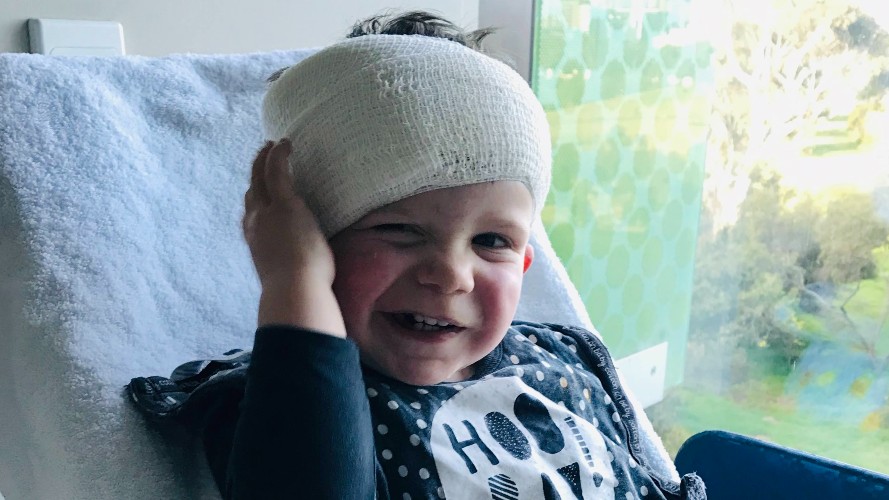
After months of medications, tests and anxiously seeking a cure for his seizures, Malu’s parents, Morgan and Erin, were faced with the difficult decision – whether or not to have their one-year-old undergo invasive brain surgery.

Considering all possible outcomes, they came to the decision that a hemispherotomy would give their toddler the best chance of a normal life, without the debilitating seizures that were impacting his development. 

On the day of his surgery, Erin and Morgan handed Malu over to the RCH Neurosurgery team.

While the neurosurgeons worked tirelessly for 12-hours, creating incisions to disconnect the right hemisphere in Malu’s brain, his family waited for what felt like the longest day of their lives.

Just after 9.00pm, Erin and Morgan received the news that Malu’s surgery had gone well and the troublesome side of his brain had been successfully disconnected.
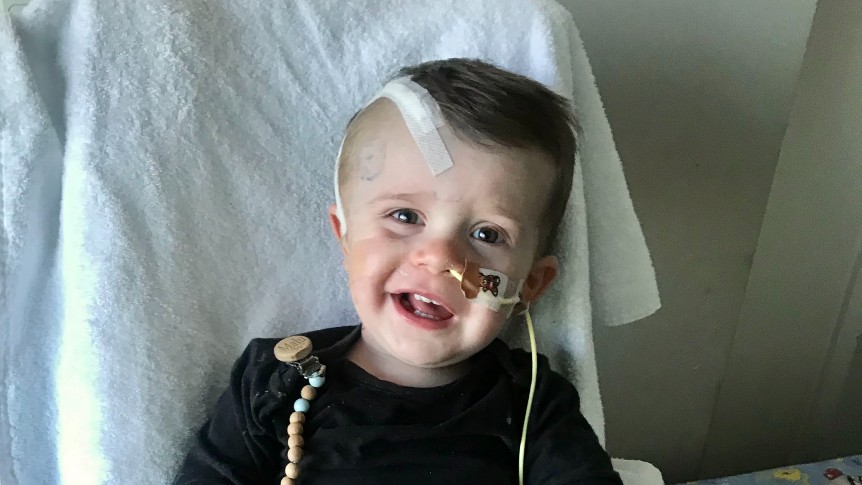
Malu spent the next four weeks at the RCH, working with the hospital’s rehabilitation team.

Expected to make slow, steady progress, Malu exceeded his doctors’ expectations and began walking again less than one month after surgery.

With the right side of the brain controlling the left side of the body, Malu had partial paralysis on his left side but is gaining strength and confidence and is hitting developmental milestones. 

Thanks to the incredible care at the RCH, Malu has been seizure-free since his surgery in July 2020. While his condition will be managed regularly over his life, he will continue to visit the RCH until he graduates to adult care. 

Thanks to your generous support, we can make a difference to children like Malu and support world-leading care at the RCH.

How you helped

Equipment and research that were funded by donations to the Good Friday Appeal were used in Malu’s surgery and treatment.

DONATE NOW

Every time a child is wheeled into the operating theatre for brain surgery — always a lifesaving or life-changing exercise — the generosity of Victorians graces the procedure.

The Good Friday Appeal, in its 90th year, has raised more than $381m for new equipment, staff training and medical research at the Royal Children’s Hospital.

Neurosurgeon Wirginia Maixner said the neurosurgery and neurology departments had been grateful recipients of appeal donations, which allowed them to pursue the best for their patients.

In Malu Hunt’s case, surgery to disconnect the epilepsy-ridden half of his brain relied on an intraoperative MRI machine, which allowed him to have brain scans during his surgery without leaving the operating table.

The appeal further funded research looking at the genetic origins of brain dysplasias like Malu’s, as well as an upgrade of the neuronavigaton system that acts as a 3D GPS of the brain for surgeons.

“I actually couldn’t do any that I do, without those donations — all of them,” Ms Maixner said.

“We use the generosity of the public every time we operate.”

Explore More
FUNDRAISE
VOLUNTEER
PATIENT STORIES

Our Newsletter

Everything Good Friday Appeal, straight to your inbox. Get more information about your impact and how to get involved.

Aurora adds to Hospital’s Appeal

Aurora Fei is celebrating every day as she takes her first steps in a cancer-free future.

After two years of treatment at the Royal Children’s Hospital, with more than 300 days spent on the ward, the four-year-old has started the new year with news she is in remission.

“The doctors have said after the surgery it is totally finished,” mum Tianmei Lu said. “It has been so hard. Our family is so happy.”

Ms Lu and husband Frank Fei noticed their then 2-year-old’s stomach had become abnormally protruded.

Scans revealed Aurora’s abdomen had been taken over by two sizeable tumours.

“I was so shocked. In my family, no cases of the cancer. So why Aurora?” Ms Lu said.

Aurora endured multiple rounds of high-dose chemotherapy to shrink the neuroblastoma before surgery before Christmas to remove them.

Her latest hospital stay — in which she celebrated her 4th birthday yesterday — was so she could receive immunotherapy to keep an ongoing attack mounted against any new cancer cells that could appear.

It is stories like Aurora’s that the Good Friday Appeal is calling on Victorians to tell in the lead-up to the annual Easter appeal.

As part of this year’s 90th appeal, GFA director Rebecca Cowan said it was looking for current and former patients, staff, volunteers and fundraisers to share their connections to the hospital.

Share Your Story

To help celebrate 90 Years of Giving, we would love you to share your story and images. Do you have fond memories of being involved with the Appeal over the years through volunteering or fundraising, or have a few generations of your family been impacted by the RCH?

SHARE YOUR STORY

Originally published in the Herald Sun, 1 February 2021
Words: Brigid O’Connell
Photo: Tim Carrafa

Explore More

FUNDRAISE
VOLUNTEER
PATIENT STORIES

Our Newsletter

Everything Good Friday Appeal, straight to your inbox. Get more information about your impact and how to get involved.

Emotions flow for little Lucy

Young Lucy Lazzari has overcome more setbacks than most on the road to her first day of school.

The five-year-old from Geelong was diagnosed in 2019 with multiple bilateral Wilms tumours, a rare type of kidney cancer.

She has undergone major surgery, chemotherapy and blood transfusions and made dozens of trips to the Royal Children’s Hospital.

When she started prep on Thursday, emotions flowed from her proud parents.

“There were tears of joy, we were so happy for her,” mum Georgie Lazzari said.

“It’s such a massive milestone after such a humungous year. Our hearts were just full of joy and happiness.

“It just seemed so far away from when she was first diagnosed, the thought of school was so distant but now it’s here it’s like ‘wow’. We gave her the biggest hug and kiss.”

Ms Lazzari said while she and husband Sam were apprehensive, Lucy showed no signs of nerves and was eager to join her older brother Harry, 7, at school.

“She’s been excited for school for a long time. Lucy’s a very organised girl. She’s got her school uniform out in the morning and her shoes and her socks and her headband, she says, ‘Mum I’m ready to go’. She’s the extreme opposite to her brother.”

In April last year, Lucy appeared on the Herald Sun front page as part of the Good Friday Appeal coverage.

At the time, she was going through week-long stints of treatment. In May, doctors declared she was in remission.

Lucy said her favourite things at school were “meeting new friends and learning new things”.

Originally published in the Herald Sun, 30 January 2021
Words: Josh Fagan
Photos: Supplied and Alex Coppel
Read Lucy’s story in the Herald Sun from April 10, 2020

Explore More

FUNDRAISE
VOLUNTEER
PATIENT STORIES

Our Newsletter

Everything Good Friday Appeal, straight to your inbox. Get more information about your impact and how to get involved.

Meet Hugo

At six weeks old, Hugo was diagnosed with Sturge-Weber Syndrome, a rare congenital condition that can affect children’s skin, brain and eyesight. For Hugo, the most conspicuous characteristic of the condition is his port wine stain that covers the left side of his face.

“I want to get Hugo’s face out there so people can see that he is different, but that it’s ok to be different; the more awareness about port wine stains, the less people stare,” said Kait.

Hugo is the youngest of Kait and husband Dane’s four children and when he was born, they knew it was going to be a bit chaotic with four children under five. What they didn’t expect was the steep learning curve and numerous medical appointments in the weeks and months following Hugo’s birth.

“After Hugo was born it was a bit of a blur. I knew a little about port wine stains as my niece has one on her arm and I knew there could be a possible underlying health condition linked to Hugo’s brain, due to where the birthmark was on his face,” said Kait.

Hugo was born with a rare
congenital condition

Hugo was originally assessed in Adelaide, undergoing an MRI to check his brain function, which confirmed he would likely go on to suffer seizures by the time he was one; an eye test to check for glaucoma, which was clear; and at just a few weeks old, Hugo was referred to The Royal Children’s Hospital (RCH) for treatment for his port wine stain.

“With support from my obstetrician and Hugo’s paediatrician I did a lot of research about port wine stains, which showed the earlier treatment begins, the more effective the outcome,” said Kait. “For me as a mum, I thought my hands are tied when it comes to Hugo’s brain and any potential issues, but if I can help his stain, I will.”

When Hugo was five weeks old, Kait and Dane loaded up their four children into a minivan and drove from their home in the Adelaide Hills to the RCH in Melbourne. It was there that they met dermatologist, Dr Belinda Welsh, for the first time.

“Dr Welsh changed our lives. I’ll never forget it, she was the first doctor who said to us ‘you have a beautiful family and congratulations on Hugo’, rather than immediately looking at his face. She looked me in the eye and said we can help you, we felt like we were at home – we started laser treatment there and then,” said Kait.

Since then, Hugo has been undergoing regular vascular laser treatment to help lighten his birthmark.

Hugo is one of the first patients who has been helped by a state of the art pulsed dye laser that the RCH was able to purchase thanks to the generosity of Victorians through the Good Friday Appeal.

The laser, which is the gold standard for treating birthmarks and vascular lesions, means shorter treatment times for patients and reduced pain for children like Hugo undergoing treatment. The laser is the only one of its type in use in a children’s hospital in Australia.

Associate Professor Phillip Bekhor
and Dr Susan Robertson with the laser

Hugo had his final intensive, early intervention treatment in February, and he will restart treatment at around 18 months old when he will go under a general anaesthetic. That will allow the Dermatology team to focus the treatment around his eye area.

“The care we’ve received at the RCH has been incredible. The team are kind, empathetic, compassionate, gentle and quick,” said Kait.

“I can’t say the treatments have been nice, and I get really anxious in the lead up, but for me, as a parent you have to weigh it up. The treatment isn’t just about cosmetics, it’s also about looking after his skin and helping to care for the vessels in his skin. Over time, if left, Hugo’s skin would darken, harden and tighten. His eye would bulge, his lip would bulge, and nodules would form underneath his skin causing lumps.”

Kait was also worried about what would happen when Hugo started school.

“I’m a teacher, so one of my biggest fears is for when Hugo started school as I know how kids can be unintentionally cruel. Hugo doesn’t look like a normal toddler, and so I just wanted to do everything I could do to help him,” said Kait.

“I intend to raise four resilient children but no one should have to deal with body shaming because they have a physical difference. Hugo will be resilient because of this, but he also shouldn’t have to listen to anyone being mean or shaming him.”

Hugo has so far responded well to treatments, with his port wine stain having already been significantly lightened. He will undergo nine more treatments before starting school and will then be seen yearly by the Dermatology team.

“The technology the RCH is using is state of the art, so it was a no brainer for us to travel over. Even though it’s expensive for us to travel, by the time we factor in airfares and car hire, we knew that early intervention was key,” said Kait.

“And all of my kids love going to the RCH, the whole family love it. The fish tank, the sculpture in the main foyer – they love visiting and coming to Melbourne. The RCH feels like home, even though we are from South Australia.”

While Hugo has had some medical setbacks, including a recent eight week stay in hospital in Adelaide due to his seizures, and ongoing rehabilitation due to some paralysis on his right side, Kait said Hugo is already demonstrating his determination and strength.

Kait has a message for everyone who sees, or comes into contact with her littlest love, Hugo. “Please look beyond the red skin on Hugo’s face, because underneath that birthmark is a gorgeous, brave, strong and very loved little boy,” said Kait.

Explore More

FUNDRAISE
VOLUNTEER
PATIENT STORIES

Our Newsletter

Everything Good Friday Appeal, straight to your inbox. Get more information about your impact and how to get involved.

Meet Sarah

WHEN little Sarah Miguelez Gallardo is up and going, there’s no stopping her.

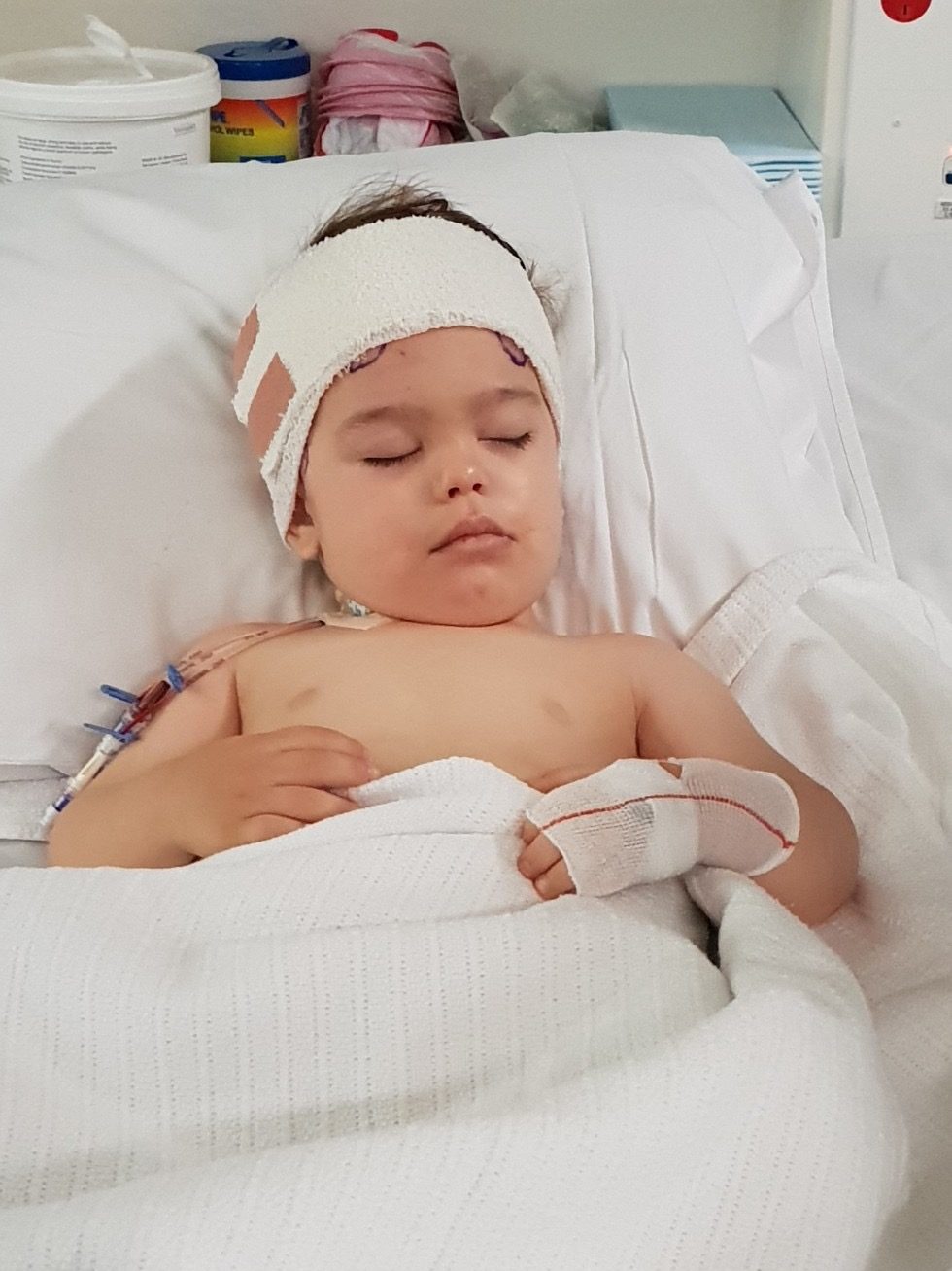
The 22-month-old toddler is inquisitive. She climbs, she runs and she smiles all the way — despite the bandage wrapped around her little head.

Just shy of her first birthday, Sarah began having seizures, which the family now knows to be infantile spasms.

“I could see that she was doing something funny — every now and then her head would come down and her arms were up,” mum Anay Gallardo said.

“The next time she did it I filmed her … and we drove down to The Royal Children’s Hospital.

“They forwarded the video to their neurology team and within a few hours we were in a room. It all got a bit scary and overwhelming.”

Sarah Miguelez Gallardo recovering in hospital.

Almost a year later, and after trialling different drugs, doctors still hadn’t completely got to the bottom of Sarah’s condition.

She was placed under observation for 24 hours, confined to her bed and a square patch of floor barely big enough to stretch her little legs, while she underwent an EEG scan.

A surveillance camera was placed on the ceiling to capture any unusual movements.

On her back, a miniature backpack filled with cords and wires and monitors mapped her brain activity to find out why her tiny body sometimes convulses in fits.

But looking at Sarah, you would barely know she is fighting an internal battle.

Her energy is contagious and her smile infectious.

“Because their brains are still developing at this age, no one really knows how things are going to pan out,” Ms Gallardo said.

“It’s (about) making sure we keep the seizures under control and doing all the tests to make sure things aren’t getting any worse.”

– Ms Gallardo

“Its been a bit of an adventure. You cherish each little step that she takes.”

Originally published in the Herald Sun, 23 March, 2020
Words: Alanah Frost
Images: Alex Coppel

Explore More

FUNDRAISE
VOLUNTEER
PATIENT STORIES

Our Newsletter

Everything Good Friday Appeal, straight to your inbox. Get more information about your impact and how to get involved.

Meet Orlando

Normal is not a word Orlando Gulizia’s family knows. Their life has never been normal, and probably never will be.

In the last three years their life has consisted of doctors rooms, hospital beds, surgery, scans, and watching their youngest child – the cheeky one – deteriorate before their eyes.

“Prepare for a marathon, not a sprint,” was how it was put to parents Anna Surace and John Gulizia.

Orlando, 3, has a rare sub-form of paediatric brain cancer which to this day has not been diagnosed.

And although he has now been in remission for a year, the reality of that diagnosis – or lack thereof – meant Orlando was a regular at the Royal Children’s Hospital from the time he was 17-months-old.

The youngster had started to have absentee seizures and one day his parents couldn’t bring him out of the trance, prompting a trip to the emergency department and scans which revealed he had a 10mm growth on his brain.

Orlando in hospital

“They advised us that it’s quite common for children to have abnormal growths in their brain which can cause seizures. With regular monitoring and medication they go on to live a normal life,” Mr Gulizia said.

So home again the family went, under the premise they would be back in a few months for an MRI and check-up.

But when the MRI came around, their world was shattered.

“I knew that there was something wrong,” Ms Surace said.

“I just knew that there was something wrong.”

“The surgeon said to us unfortunately there is a tumour that has grown in his head – it’s about the size of a peach – and he is going to need immediate surgery to try and remove it.”

“I was in shock.”

Mr Gulizia said his “blood ran cold.”

Orlando and his family, including his two older sisters, barely had a minute to think before they were kissing him goodbye as he went in for a nine-hour surgery to remove the growth.

He was left in the steady hands of Alison Wray, one of the hospital’s best surgeons, who said she would do everything she could to remove the tumour and give the toddler the best shot at life.

The surgery was a success – but what the family didn’t realise was that because Orlando’s tumour was considered highly malignant and dangerous, he would also have to endure high-dose chemotherapy and then radiotherapy.

A year on Orlando is full of beans.

He loves everything Cars and ravishes the chance to play outside – rain, hail or shine.

And although the family still have a long way to go, Orlando’s positivity and charisma give them hope.

The family hopes that by sharing their story more people will be inspired to help kids like Orlando, through the Good Friday Appeal and by raising awareness for childhood cancer.

Originally published in the Herald Sun, April 10, 2020
Words: Alanah Frost
Images: Alex Coppel

Explore More

FUNDRAISE
VOLUNTEER
PATIENT STORIES

Our Newsletter

Everything Good Friday Appeal, straight to your inbox. Get more information about your impact and how to get involved.

Meet Marcus

The youngster contracted a rare disease known as transverse myelitis when he was eight months old, which left him with paralysis in parts of his body.

“By the time we got to The Royal Children’s Hospital he was paralysed from the neck down and was virtually a ragdoll,” Mum Jessica Sian says.

“It was the most terrifying time.”

But thanks to an innovative team of surgeons at the RCH, Marcus can now walk, run and play on his own.

“He’s turned into a very, very different child,” Ms Sian says.

“He’s walking literally everywhere on his own, everywhere. He can run, he can ride his bicycle, he’s learning to play tennis at school.

“This time last year he wasn’t able to stand steady on his own. We wouldn’t have dreamt of him being able to ride a bike or play tennis.

“We wouldn’t have come this far without that surgery and everything else the hospital has done.”

The Good Friday Appeal, which supports the RCH, ensures children like Marcus continue to receive the care they need.

Originally published in the Herald Sun, April 10
Words: Alanah Frost
Images: Alex Coppel

Explore More

FUNDRAISE
VOLUNTEER
PATIENT STORIES

Our Newsletter

Everything Good Friday Appeal, straight to your inbox. Get more information about your impact and how to get involved.

Meet Harry

The Mount Martha boy was born with “half a heart”, a condition known as hypoplastic left heart syndrome.

He carries the wounds of four open-heart surgeries, where surgeons cut from the top of his chest to below his belly button to “change the plumbing” and ensure enough blood was getting pumped through his tiny body.

“He’s a bit of a pincushion,” Harry’s mum, Simone Munro, said.

A routine 20-week scan had revealed to Ms Munro and husband Chris there was something wrong with their unborn son’s heart.

And when he was whisked away to the Royal Children’s Hospital after birth, the family was given a taste of what was to come.

“The left side of Harry’s heart didn’t grow so they had to change the plumbing to make the right side do both jobs,”

Ms Munro said

“They changed the way the blood circulates to a single circuit.”

The first time he was wheeled into an operating theatre Harry was just three days old.

The next, he was three months old.

Harry being helped to walk by his parents in hospital after heart surgery
Harry being helped by his parents

And two more open-heart surgeries followed.

After the four major operations, hospital stays and doctors appointments, Harry, who has just started prep, is “thriving”.

“He loves school,” Ms Munro said.

“He’s thriving at school. Loves reading and maths. He’s a planner.

“He loves caravans and building things, he loves bossing people around.

“He’s becoming more aware of his scar, (but) he says now he has a special heart.”

The youngster will be under the care of the RCH for the rest of his childhood, but for now he can enjoy just being Harry.

“He’s so much more than a kid with a heart condition. He’s a really good kid,”

Ms Munro said

Originally published in the Herald Sun, April 5, 2020
Words: Alanah Frost
Images: Alex Coppel and Jason Edwards

Explore More

FUNDRAISE
VOLUNTEER
PATIENT STORIES

Our Newsletter

Everything Good Friday Appeal, straight to your inbox. Get more information about your impact and how to get involved.

Meet Breanna

Like most kids, the then three-year-old loved to bounce and jump and play with her siblings and that day in 2015 was no different.

“(Breanna) and her sister had been jumping on the trampoline and they collided,” mum Carolyn Thomas remembers.

“I was watching them, it was such a gentle knock … but Breanna came inside holding her tummy and screaming.

“She was inconsolable.”

Breanna, aged 3, in hospital

The bump was perhaps a blessing in disguise.

Ms Thomas and husband Stewart Geerling took Breanna to the doctors, who sent her straight to The Royal Children’s Hospital for an ultrasound.

There, doctors delivered the heart-wrenching news: Breanna had a cancerous tumour — known as a Wilms tumour — the size of a small football growing inside her stomach.

“That was pretty confronting,” Ms Thomas says. “It was really hard because we lost another daughter in 2007.”

A day later, Breanna had a port put in her chest and started chemotherapy.

She also needed two blood transfusions and a platelets transfusion.

“She had her surgery in March to take out her tumour — it didn’t shrink (from the chemotherapy).

“It was the size of a small football. It took up all of her left-hand side — it was just this tumour.

Ms Thomas said

“She lost a lot of weight — she was probably 18 or 19kg when she first got sick. At her lowest she was 12kg.”

Breanna, who had her last round of chemotherapy in 2015, is now on the mend and has just been cleared to have six-monthly check ups.

And there’s no stopping her. The eight-year-old is the second youngest of seven siblings and is determined to keep up with the bigger kids.

“She does dancing and karate.

“She’s very bright and switched on. She’s not sickly. She loves the outdoors.

“If she has the option of going outside, playing with the dogs, swimming in the pool, jumping on the trampoline — she will. She’s just a fit and healthy little girl.”

Originally published in the Herald Sun, April 4, 2020
Words: Alanah Frost
Images: Alex Coppel

Explore More

FUNDRAISE
VOLUNTEER
PATIENT STORIES

Our Newsletter

Everything Good Friday Appeal, straight to your inbox. Get more information about your impact and how to get involved.

Meet Maddox

The six-year-old, from South Yarra, was born with cystic fibrosis, a disease which affects the lungs and can make it hard to breathe.

It’s meant he’s needed regular treatment at The Royal Children’s Hospital since birth — from clearing mucus from his tiny lungs to getting vital medicine via the port-a-cath.

“As a new mum it added to the whole learning of everything,” Maddox’s mum Teuila says.

“You’re learning to be a new mum and learning about this medical condition and what our life would be like. It was our new normal.”

But thanks to a new wave of at-home care by a team called Hospital in the Home, Maddox is spending more time with his mum and less time in hospital.

“We’re lucky. Maddox has his port flushed every five weeks or so, and they visit us daily with the nurse. Whether he’s at school or when he was at daycare, I didn’t have to be there,”

Ms Ropati said.
Maddox kicking a rugby ball in the park
Maddox has started playing rugby

“And that service has enabled me to go back to work — that was lifesaving.”

Dr Penelope Bryant is the medical lead of the Hospital in the Home team.

She says being able to provide care to kids in a familiar environment, where possible, is always better.

“Their quality of life in general is just better – they’re laying with pets, outside playing basketball and with their siblings,” she said.

“We know that parents say their kids are just happier at home, the family is able to function better at home — the holistic look at the child (is better).”

“It’s about trying to think a little bit outside the box.

“We’re trying to challenge ourselves and families. There are always new patients where we’re saying, ‘Why couldn’t we look after this child at home?’”

The mobile service has meant Maddox was able to start playing rugby for the first time – something that would not have been possible between regular hospital visits.

“That was the first sport he ever asked me to play,” Ms Ropati said.

“I thought, I can’t wrap him in cotton wool. He’s the strongest kid I know. He’s a happy kid, and just fearless.”

“It’s amazing. I can’t speak highly enough (of Hospital in the Home). A ‘thank you’ will never be enough.”

Originally published in the Herald Sun, April 10, 2020
Words: Alanah Frost
Images: Alex Coppel

Explore More

FUNDRAISE
VOLUNTEER
PATIENT STORIES

Our Newsletter

Everything Good Friday Appeal, straight to your inbox. Get more information about your impact and how to get involved.

Follow Us
  • Facebook
  • Instagram
  • Twitter
  • You Tube
  • Your Impact
  • Research
  • Technology
  • Patient Care
  • Education
  • Get Involved
  • Fundraise
  • Volunteer
  • My GFA Portal
  • Stories
  • Patients
  • Volunteers
  • Fundraisers
  • Hospital Heroes
  • About Us
  • Who We Are
  • Our history
  • Partners and supporters
  • Contact Us
  • Your Impact
  • Fundraise
  • Volunteer
  • Stories
  • About Us
  • Contact Us
  • My GFA Portal
  • Privacy Policy
Proudly supported by
Herald Sun Logo Seven Plus Logo
Website powered by
XWP
ACNC Logo Good Friday Appeal ABN 69 084 797 965 Privacy Policy