Skip to content
Good Friday Appeal Logo
  • Your Impact
    • Research
    • Equipment and Technology
    • Education and Training
    • Patient and Family Centred Care
    • Regional Victoria Funding
  • Stories
    • Stories
    • Share Your Story
  • Fundraise
    • Fundraise For Us
    • Fundraising Resources
    • Schools Fundraising
    • Regional Support
    • Regional Victoria Funding
    • Regional Tally Board
    • Metropolitan Collection Groups
  • Get Involved
    • Ways to Get Involved
    • Run for the Kids
    • Premiership Posters
    • Kids Day Out
    • Events
    • Good Friday Giving
  • About
    • FAQs
    • Contact us
    • About Us
    • Funds raised year by year
    • Our history
    • Our partners and supporters
    • Our Ambassadors
    • Our Suppliers
    • Our Team
    • News
    • Volunteer
    • Login
  • Shop
Search DONATE Open menu
Close Search

Meet Kirra

Five years ago Kirra Wright was learning to walk again. Today she is aiming for gold.

The 11-year-old’s goal is to compete at the 2024 Paralympic Games in Paris.

And despite having had a stroke at age two, and three major brain surgeries, she’s full of the grit and determination needed to get there.

Kirra is a state and national cross-country runner and a budding long jump contestant, and is being mentored by Olympian Brooke Stratton.

She has a chest of medals to her name, and is already running ahead of her older peers. But it hasn’t always been so positive for the Grade 6 pupil.

“She had a stroke when she was two in 2010 and had a 20-minute seizure,”

Kirra’s mum Kylie Portelli says.

“We rushed her by ambulance to the Royal Children’s Hospital.

“It turned out that it was a brain AVM (arteriovenous malformation). That’s when her vessels, capillaries, arteries — all the major things in her brain — are clustered together like spaghetti. And because there was so much pressure it burst,” she said.

The two-year-old was rushed in for a marathon 12½ hours of surgery.

Ms Portelli and Kira’s dad Byron Wright feared the worst. But the surgery was a success and their little fighter bounced right back.

Kirra doing a long jump in the air
Kira is a budding long-jumping contestant

In 2012, and then again in 2015, Kirra had to undergo further procedures to remove more of the AVM.

“The bad one was 2015 because neurosurgeons had to go in deeper — a surgeon even told us that she wouldn’t be able to walk, her speech would be affected,” Ms Portelli said.

But Kirra again defied the odds.

Since then she had also had to manage a diagnosis of epilepsy and lives with cerebral palsy, but it hasn’t stopped her from reaching for the stars. And it’s patients like Kirra that make Dr Olivia Lee’s job so fulfilling.

“The key is finding a team in the community to support the family,” Dr Lee said.

“Whether it’s children who love sport, who want to get competitive.

“We used to have many individual programs, as well as group programs and transition programs. And we have peer groups.

“But we also have sports groups to help children find their place in the community.

“Rehab is all these little components — whatever the goals are.”

Ms Portelli said Kirra was a reflection of the support she continues to receive — both in and out of hospital.

“What makes her special is not just her persistence, but she’s had the support networks who say ‘Never give up’,” Ms Portelli said.

“Rehab has been absolutely amazing for Kirra. I said to her, ‘The sky’s the limit and life’s what you make it’.

“She’s come a long way from that kid in the hospital.”

Originally published in the Herald Sun, April 10, 2020
Words: Alanah Frost
Images: Alex Coppel

Explore More
FUNDRAISE
VOLUNTEER
PATIENT STORIES

Our Newsletter

Everything Good Friday Appeal, straight to your inbox. Get more information about your impact and how to get involved.

Meet Scarlett

Teaching a three-year-old how to move her muscles via video-link isn’t always easy, as there are distractions and difficulties.

But for Scarlett Khoo, it’s meant she can now zip up and down the footpath on her bright green scooter.

Scarlett has a rare disease known as transverse myelitis — an inflammation of the spinal cord, which interrupts the messages nerves send throughout her body — which has left her left arm paralysed.

She developed the disease at just 18 months after contracting the common childhood virus hand, foot and mouth disease.

“It’s a very rare condition,” Scarlett’s mum Felicity Khoo says. “She had the hand, foot and mouth disease about three or four days before her left arm was paralysed.

“She woke up and was just sitting there and her whole left arm was just limp.”

After a few trips to the Royal Children’s Hospital, Scarlett was finally diagnosed with the debilitating disease.

Her left arm still hasn’t recovered, stopping her from reaching up to her parents or lifting toys.

But last year surgeons operated on Scarlett’s shoulder to try and bring back more function to her arm.

“She lost most of her biceps muscle (due to the disease) — so they moved the triceps nerve to the deltoid muscle,” Ms Khoo said.

“She had no shoulder movement — she can’t lift up her arms high.”

Scarlett rides her scooter

It could take up to 18 months to tell if the procedure is successful.

It’s been a long road for the toddler, but she’s been helped all the way by a special rehabilitation team who have made it their mission to ensure she has been able to enjoy a normal childhood.

The team at the RCH have taught Scarlett how to grip the handlebars of her scooter properly — which she now races around on.

And she has regular telehealth sessions (telecommunication consultations) where all allied health teams — from physiotherapists to occupational therapists — can teach Scarlett new exercises or make changes to her rehab based on her physical surroundings.

Dr Olivia Lee is one of the 45-strong team of rehab consultants who provide such care to children from the hospital. They can be stroke patients, car crash victims or kids with rare conditions.

“As a team we work to get them back to a new normal,” Dr Lee says.

“From in hospital to in the community and at home … every kid has a different dream and with this disability we don’t want that dream to go.

“It’s based on looking at what their daily needs are.

“We have always tried to manage kids and support them in the community — with telehealth we’re able to troubleshoot their needs.”

Dr Lee said many children who required rehab were patients for life, meaning teams “watch them grow” and deal with all stages of home, school and even work life.

“We look at how to maximise function to be able to participate,” she said.

Scarlett will continue to see teams of specialists throughout her childhood, but her family is getting back to a new normal at home.

“She needs a lot of telehealth encouragement and entertainment,” Ms Khoo said.

“And we are still waiting for the surgery to work. It’s trial and error … to see whether it will be better for her, to see if she can gain some function.

“She will never recover fully, but otherwise she is a typical three-year-old.”

Originally published in the Herald Sun, April 10, 2020
Words: Alanah Frost
Images: Alex Coppel and David Caird

Explore More

FUNDRAISE
VOLUNTEER
PATIENT STORIES

Our Newsletter

Everything Good Friday Appeal, straight to your inbox. Get more information about your impact and how to get involved.

Meet Ariana

She knows that because of her, other kids are now able to have the special operation she did.

The now 9-year-old was wheeled into surgery in 2016 after doctors found a mass buried in her lungs.

But instead of opening up her chest and removing part of the lung to get to the growth, a highly-skilled team of surgeons performed an endobronchial ultrasound, which had previously only been carried out on adults.

“The placement of the mass was in a tricky position — they couldn’t just remove it, they would have to take out parts of the lung to get the biopsy,” mum Lisa Plafadellis says.

“Instead they put her under and went through her throat to get through a tiny tube (in the lung) with a needle to get the biopsy.”

Plafadellis says life stopped for the family watching their little girl whisked away for the hospital-first procedure.

But the results were life-changing.

“In the end that procedure was still inconclusive but it was enough for the surgeon and paediatrician John Mass to say it doesn’t look as harmful as we had imagined.

“This biopsy gave them the confidence that they could sit on it — monitor, with regular X-rays, to see if it would grow.

“And then last year we got the news that we didn’t need to keep checking on it.

“And now she’s awesome. She tries everything. She gives anything a go.”

Originally published in the Herald Sun, April 4, 2020
Words: Alanah Frost
Images: Alex Coppel

Explore More

FUNDRAISE
VOLUNTEER
PATIENT STORIES

Our Newsletter

Everything Good Friday Appeal, straight to your inbox. Get more information about your impact and how to get involved.

Meet Matilda

Watching her daughter ­Matilda, 7, play is a joy Eryn Bugden never takes for granted.

Born with tuberous sclerosis — a condition that left hundreds of benign tumours growing throughout her little body — Matilda has been in and out of Royal Children’s Hospital for most of her life.

A routine 36-week scan revealed Matilda had ­tumours in her heart, and a post-birth MRI showed there were also growths in her brain, kidneys and under her skin.

“They really didn’t think she was viable with life,” Ms Bugden said.

“The tumours were taking up 80 per cent of her heart.

“She’s got hundreds of ­tumours in her brain and has struggled with seizures her whole life.”

But Matilda has always been determined to prove the doctors wrong.

Matilda sitting outside a pink tent
Matilda doesn’t let her illness stop her playing

Since her diagnosis the now-grade 2 student has also battled through 19 rounds of chemotherapy for a desmoid tumour in her arm — a growth independent of the condition she was born with.

“We nearly lost her several times during that treatment,” Ms Bugden said.

Matilda uses a wheelchair and had to learn how to walk again after surgery on her hips.

And five weeks ago she had surgery to remove a ­tumour pressing on her brain in the hope of putting a stop to the seizures — a procedure which seems to have worked.

“Given what Matilda has been through, she’s healthy,” Ms Bugden said.

“She loves to play outside, play on the swings. She loves her Lego and Duplo and to colour and draw.

“She plays wheelchair basketball and wheelchair tennis weekly at the hospital.

“Really for the first time she fits in.

“She’s had to fight and she’s had to have a team in her corner fighting for her.

“But here we are, eight years later.”

It’s thanks to the work of those at the RCH, which is supported by the Good ­Friday Appeal, that Matilda can enjoy being a kid again.

Originally published in the Herald Sun, April 6, 2020
Words: Alanah Frost
Images: Alex Coppel and David Caird

Explore More

FUNDRAISE
VOLUNTEER
PATIENT STORIES

Our Newsletter

Everything Good Friday Appeal, straight to your inbox. Get more information about your impact and how to get involved.

Meet Lucy

And it takes an even bigger group to look after a child ­battling cancer.

As well as mum Georgie, dad Sam, older brother Harry, 6, and Lucy’s grandmother Janne — who put her life on hold to help out — friends, neighbours and strangers have come ­together for her. A local cafe even held a fundraiser.

But there’s also the many doctors, nurses and specialists after a cancer diagnosis.

It also takes a special child to attract such a following.

“She’s the captain,” Sam Lazzari says, looking at four-year-old Lucy. That much is clear as Lucy sits on her dad’s knee when we meet at The Royal Children’s Hospital.

The family are in the middle of a four-night stay to see if Lucy is ready to begin chemotherapy again.

She was diagnosed with a very rare bilateral Wilms ­tumour last October — a diagnosis which meant Lucy had tumours growing on each of her kidneys.

Usually bubbly and energetic, Lucy kept getting ­fatigued, and that started the alarm bells ringing.

“For about two months leading up to Lucy being diagnosed, she was just constantly unwell,” Mr Lazzari says. “Then she started to lose a bit of weight.

“She wasn’t eating, she had no appetite and she wanted to lie down all the time, as sitting up was so uncomfortable. She was just so out of sorts.”

Then she got a fever, but nothing could have prepared them for what was to come.

Ms Lazzari took Lucy to their local GP in Newtown, Geelong, and the doctor sent Lucy straight to Geelong Hospital for an X-ray and further testing. There, she was given the preliminary diagnosis of a Wilms tumour.

“They didn’t even have to say cancer. I knew,” said Ms Lazzari, who has herself ­battled cancer.

Lucy and her parents Sam and Georgie

Lucy and family were transferred to The Royal Children’s Hospital in Melbourne, where her treatment began.

Doctors soon found Lucy had double trouble.

“On her left kidney there was an 18.5cm tumour, and they found lesions on her right kidney too. That was on the Thursday – on the Friday she had her port put in and started chemotherapy that night,” Mr Lazzari says.

“The moment it was bilateral, it was all hands on deck.”

Six weeks of treatment later, scans revealed Lucy’s ­tumours had shrunk, so she got the green light for surgery.

“It took eight hours. They removed her left kidney and found three tumours on it, and four on her right kidney,” Mr Lazzari says.

“The right one was cherry-picked, stitched up and clamped (to preserve it).”

Since October, Lucy has also undergone eight lifesaving blood transfusions.

“Those blood transfusions are liquid gold,” her mum said.

“We can’t thank everyone enough. She was brought back to life. We are so grateful for those blood donors out there.”

Finally, after four nights in ICU and four nights on the ward post-surgery, the Lazzaris were allowed to return home.

Lucy has two more rounds of chemotherapy ahead of her — ending 26 weeks of treatment — and then regular three-monthly check-ups.

But she is back home, surrounded by so many who care.

“It really takes a village to get through a challenge like this. And we feel we’ve got the most incredible village out there,” Ms Lazzari says.

Lucy is one of the many children who enter the RCH each year. Today’s Good Friday Appeal helps ensure they can receive the care they need.

Originally published in the Herald Sun, April 10, 2020

Words: Alanah Frost

Images: Alex Coppel

Explore More
FUNDRAISE
VOLUNTEER
PATIENT STORIES

Our Newsletter

Everything Good Friday Appeal, straight to your inbox. Get more information about your impact and how to get involved.

Meet Jack

Little Jack Hayes has had more than his fair share of hospital visits.

Born with one small lung, one enlarged lung and “floppy” airways, his start in life was spent inside the walls of the Royal Children’s Hospital.

But watching him now, aged 4 ½, mum Elanor Hayes bursts with pride.

She will never forget how the doctors, surgeons and staff at the hospital refused to give up on her son — the son who can now ride up to 7km on his bike.

“The amount of times that we thought he was going to die or be really severely disabled … things were really touch and go for him,” Hayes says.

“(But) they were always willing to give something else a try.”

Jack when he was 8 months old, sitting in a cot in the RCH

When Jack was less than a year old, a team of innovative surgeons used a 3D printer to design a makeshift stent which would “hold open” his airways.

But because Jack’s body was still developing, the stent had to be dissolvable so it wouldn’t get stuck in his airways.

“There were a few complications,” Hayes says.

“They had to give him transplant medication to try and reduce the amount of (tissue) scarring.

“Which was good but it meant he had no immune system for quite a long time.”

And about six months later, at just 14 months old, doctors made the decision to put his tiny body in an induced coma to help heal the airways and reduce any swelling and further scarring.

“But what they did during that time was they held their ground and waited and let his airways settle down.

“He’s had his challenges since then but he’s amazing. He climbs, he runs, he does everything any other 4-year-old would do.

“He’s a really happy, normal, little kid and we’re really proud of him.”

Originally published in the Herald Sun, April 4, 2020

Words: Alanah Frost

Photos: Alex Coppel and David Caird

Explore More

FUNDRAISE
VOLUNTEER
PATIENT STORIES

Our Newsletter

Everything Good Friday Appeal, straight to your inbox. Get more information about your impact and how to get involved.

Meet Tia

Tia Sharp, now 10, was battling septicaemia, a life-threatening condition than occurs when bacteria enters the blood. In the weeks prior she had been unwell and had struggled to walk properly, and doctors said she most likely had the flu.

After a week off, she returned to school but had a sore throat.

Days later, Ms Cater said Tia was up at 3am, distressed with stomach pains.

“She asked me, ‘why can I hear my heart rate’,” Ms Carter, of Newtown, recalled.

Tia was taken to Geelong hospital on a Monday morning, where medical staff investigated multiple possibilities.

On the Wednesday night she went into septic shock and was put in the ICU.

Her heartbeat wouldn’t regulate itself and Tia was transferred to the Royal Children’s Hospital ICU.

“(Staff) said, ‘you need to understand how serious this is’,” Ms Carter said.

Tia at the Royal Children’s Hospital

“For us it was really horrible, you don’t ever want to hear that.”

Tia’s organs had started to fail and her heartbeat was still not regulating itself.

Her antibiotics were adapted and excess fluid was drained from her lungs, which stabilised her heart.

After the fluid was drained two days into her stay at the RCH, doctors were confident Tia would be all right.

She ended up staying 11 days at the RCH, and the hospital organised her family accommodation at Ronald McDonald House.

Doctors believed she had the flu which compromised her airways and then she became septic, which leads to poor circulation.

Up until the incident, which could have cost Tia her life, she had been a fit and healthy child.

“It can happen very quickly,” Ms Carter said. “We were very lucky.”

Apart from renal impairment that corrected shortly after she was released from hospital, Tia had no ongoing impacts and has made a full recovery.

Her mum describes her as an active, caring and smart kid who loves animals.

Tia said she was “a little bit scared” at the hospital but she felt well looked after.

“The staff were really nice and friendly,” Tia said.

“I was grateful and happy when I left the RCH.

“If the doctors weren’t there something worse would have happened.”

Ms Carter said she hoped everyone got on board this year’s Good Friday Appeal.

“Until you need it you don’t understand how important the RCH is and what a good job they do,” she said.

Originally published in the Geelong Advertiser, April 8, 2020

Words: Tamara McDonald

To read the original story, visit the Geelong Advertiser website.

Explore More

FUNDRAISE
VOLUNTEER
PATIENT STORIES

Our Newsletter

Everything Good Friday Appeal, straight to your inbox. Get more information about your impact and how to get involved.

Meet Audrey

Audrey Laurent’s parents are convinced doctors at The Royal Children’s Hospital sowed flecks of gold onto her heart all those years ago.

In 2011, at just four-months-old, Audrey needed surgery to mend tiny holes in her tiny heart.

Like any parents, Jacquelyn Laurent Goeman and husband Ross Goeman just wanted to see their child healthy at the other end.

“It was really terrifying because she was so young,” Laurent Goeman says.

“It’s scary when you’re faced with your child, your baby, being unwell.

“I feel so lucky (now) because obviously other children are in a much worse situation.

“But when your baby is having surgery it’s massive.”

The family soon learnt Audrey could not have been in safer hands.

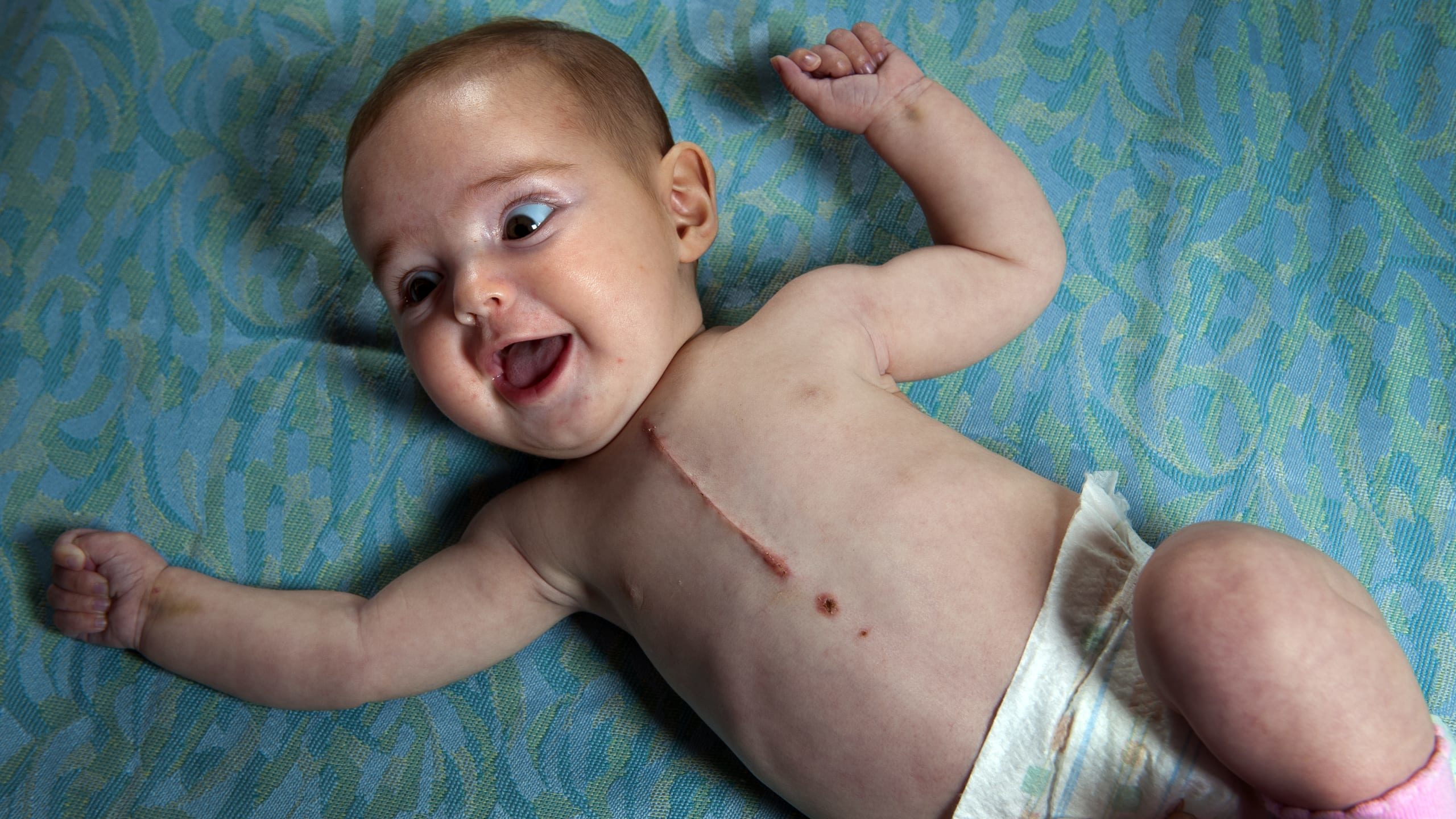
During the operation, surgeons stitched up two of the three holes in Audrey’s heart, leaving the third to heal on its own so the youngster would not have to wear a pacemaker.

“And she recovered in three days. She was home in three days and back feeding. And I put that down to the great care that she had.”

Now 9, Audrey has a “heart of gold”.

“I say often they sowed on some specks of gold,” Laurent Goeman says.

“Audrey’s a fantastic little ballerina and sometimes her classmates ask about her scar — and she proudly tells them.

“It hasn’t held her back in any way — she’s just wonderful and can do anything any other child can do.”

Originally published in the Herald Sun, April 3, 2020

Words: Alanah Frost

Images: Alex Coppel and Jay Town

Read Audrey’s story written by Brigid O’Connell for the Herald Sun in 2011.

Explore More

FUNDRAISE
VOLUNTEER
PATIENT STORIES

Our Newsletter

Everything Good Friday Appeal, straight to your inbox. Get more information about your impact and how to get involved.

Meet Jasper

At a check-up for her baby Jasper, a maternal health nurse told mum Louise Sherriff to get her son straight to the emergency department.

Jasper was 11 weeks old but only 130 grams heavier than his birth weight.

He was being fed formula but had been throwing up after feeding since he was eight weeks old.

At 10 weeks old he was prescribed anti-reflux medication, but he lost 220 grams in nine days even after being medicated.

Jasper was taken to the emergency department on Aug­ust 13, 2015 — a day that will stay with Mrs Sherriff forever.

He was taken to Geelong hospital, where tests found Jasper had pyloric stenosis, an uncommon condition in infants that blocks food from entering the small intestine. It can lead to vomiting, dehydration and weight loss in babies.

Mrs Sherriff, of Belmont, said Jasper was moved to the children’s ward, and his heart stopped beating for seconds at a time.

He was moved to the intensive care unit before being transferred to the Royal Children’s Hospital in Melbourne.

In a matter of hours Jasper’s health had declined rapidly.

Jasper was skinny, dehydrated, lethargic, and severely depleted of potassium, and had several drips and tubes inserted into his tiny body to replenish him.

“Every time people would come in and ask what had happened I was crying, as you would seeing your baby on his death bed,” Mrs Sherriff said.

“Seeing him lying there with all these tubes and drips, it was heartbreaking.”

But within 24 hours, Jasper amazed doctors with his improvement.

He underwent surgery to remove the large mass that had been blocking him from digesting formula.

After three days in the ICU little Jasper was moved to special care, and then two days later sent back to Geelong hospital for one night before being discharged.

“It was a rollercoaster, it was the longest seven days I’ve ever experienced,” Mrs Sherriff said.

In the month after being sent home he put on 380 grams.

“As soon as we had the surgery and he had the fluids and potassium we haven’t looked back,” Mrs Sherriff said.

Jasper had already had a difficult start to life, with a traumatic birth.

“He’s definitely our miracle rainbow baby,” Mrs Sherriff said. “It was such a relief when he recovered.”

Mrs Sherriff said Jasper, who is one of four kids, is now a healthy four-year-old with a vivid imagination.

“He is the most kind and caring kid,” she said.

Jasper knows the scar on his stomach symbolises how the Royal Children’s Hospital saved his life.

“This hospital is amazing — if it wasn’t for them Jasper wouldn’t be here,” Mrs Sherriff said. “Five years later I still can’t thank the Royal Children’s Hospital enough; if it wasn’t for them he wouldn’t be celebrating his fifth birthday this year.”

Every year, Mrs Sherriff’s mum makes a donation to the Good Friday Appeal in her grandson Jasper’s name.

The family loves to get involved by donating and encouraging others to support the hospital that saved Jasper.

Originally published in the Geelong Advertiser, April 9, 2020

Words: Tamara McDonald

Explore More

FUNDRAISE
VOLUNTEER
PATIENT STORIES

Our Newsletter

Everything Good Friday Appeal, straight to your inbox. Get more information about your impact and how to get involved.

Meet Bailey

It was exactly 1.48am on November 14, 2014, when everything stopped for Ryan.

Cancer.

His daughter, Bailey, who was just shy of celebrating her fourth birthday, had cancer.

The usually bubbly child had only complained of a sore stomach but, after two hospital visits, her dad knew something else was wrong.

“It happened so quick,” Mr Atkin said. “They’re throwing everything at you (the diagnosis, treatment).

“That’s when everything stopped. That was (the time) when life stopped.”

A rhabdomyosarcoma tumour the size of a “small football” was growing inside Bailey’s pelvis.

The diagnosis meant months of chemotherapy, radiation and a Hickman line to feed medication into her small body.

Bailey sitting on her hospital bed in 2015. She has a nasal tube.

“They smashed her with everything straight away,” Mr Atkin said.

“The loss of hair, the skin colour change.

“They froze half her ovarian tissue — they’re thinking 20 years ahead.”

After months of treatment, doctors prepared to operate on Bailey to remove the now-shrunken tumour from her pelvis.

That was almost six years ago, and the treatment has given Bailey a new lease on life.

“As soon as she was out she wanted to do everything,” Mr Atkin said.

“She’s out playing cricket and playing footy.

“She loves school. She doesn’t remember all the pain and hardship of it — we do. But that’s what’s great about it.

“The resilience of kids is just amazing. She’s the strongest person I’ve ever met.”

This year’s Good Friday Appeal, which supports the work of the RCH, will help ensure kids like Bailey continue to receive the care they need.

Originally published in the Herald Sun, April 6, 2020

Words: Alanah Frost

Image: Alex Coppel

To read the original story, visit the Herald Sun website.

Explore More

FUNDRAISE
VOLUNTEER
PATIENT STORIES

Our Newsletter

Everything Good Friday Appeal, straight to your inbox. Get more information about your impact and how to get involved.

Follow Us
  • Facebook
  • Instagram
  • Twitter
  • You Tube
  • Your Impact
  • Research
  • Technology
  • Patient Care
  • Education
  • Get Involved
  • Fundraise
  • Volunteer
  • My GFA Portal
  • Stories
  • Patients
  • Volunteers
  • Fundraisers
  • Hospital Heroes
  • About Us
  • Who We Are
  • Our history
  • Partners and supporters
  • Contact Us
  • Your Impact
  • Fundraise
  • Volunteer
  • Stories
  • About Us
  • Contact Us
  • My GFA Portal
  • Privacy Policy
Proudly supported by
Herald Sun Logo Seven Plus Logo
Website powered by
XWP
ACNC Logo Good Friday Appeal ABN 69 084 797 965 Privacy Policy