

Implementing a Vascular Access Specialist Team at the RCH
Approximately 50 per cent of children admitted to The Royal Children’s Hospital (RCH) will require a peripheral intravenous catheter (PIVC), also known as a cannula or drip.
Thanks to the generosity of the Good Friday Appeal and its supporters, children receiving care at The Royal Children’s Hospital (RCH) will soon be the first in Australia to have an expert team of specialist nurses providing support with the insertion of peripheral intravenous catheters (PIVCs).
Also known as a cannula or drip, PIVCs are used to deliver life saving medications and fluids to patients across the RCH. Each year, approximately 30,000 PIVCs are inserted at the RCH, making it the hospital’s most common invasive procedure.
For some patients, the trauma of their first PIVC insertion can leave a lasting impact, causing high levels of anxiety and fear. Routine assessments or even simple checks, such as looking at the site, can become distressing triggers for children and young people.
This is where the Vascular Access Specialist Team (VAST) comes in.
Committed to revolutionising paediatric care, the VAST brings together a group of expert clinicians equipped with advanced knowledge and skills in vascular access. Recognising the challenges and trauma faced by young patients, the VAST is dedicated to improving expertise, reducing complications, enhancing staff education, and championing a patient-centred approach to PIVC insertion.
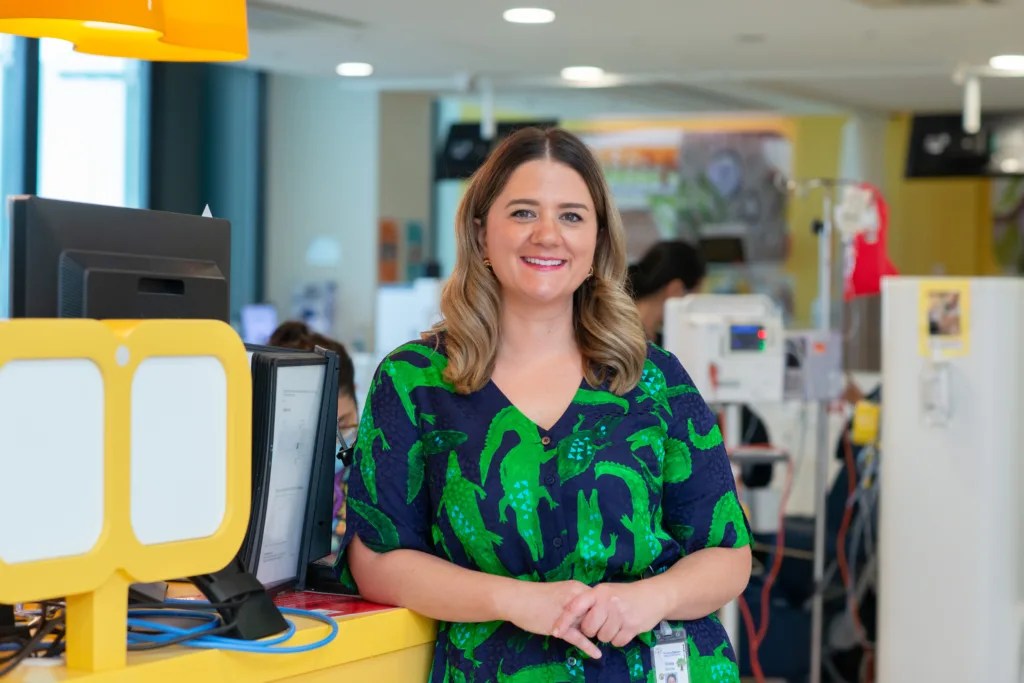
Eloise Borello, a Clinical Nurse Consultant who specialises in vascular access, explained that the project will make an enormous difference in the quality-of-care patients receive.
“Many children who present to the RCH often require urgent medical treatment, and the fastest way to administer the medications and fluids they so vitally need is through a PIVC.
“Whilst PIVCs are common, it can be challenging to insert these devices in children as they have smaller, more fragile veins which are often difficult to see. This becomes even more difficult in children who are critically unwell. No child likes to have a needle inserted, and young children can become very scared and distressed when they need a cannula,” Eloise explained.
“We know that inserting a cannula is one of the scariest procedures for children in hospital. Children and families have told us that the memories of a bad experience can last many years which can impact care in and out of the hospital. We are committed to reducing pain, anxiety and trauma that can be associated with PIVC insertion. The goal of the VAST is to create the best experience possible for children and their families”.
“By ensuring a best practice approach to PIVC insertion, including use of advanced technology like ultrasound guided insertion, by a team of highly skilled clinicians who are experts in the field, the RCH will be at the forefront of care for children and families”.

While ultrasound guidance is scientifically shown to be the best technique to insert PIVCs, its uptake has not been widespread across most Australian healthcare settings because it takes clinicians months of training and experience to develop the advanced ultrasound skills required.
“The new ultrasound machines, also supported thanks to the Good Friday Appeal and its partners, will be instrumental in allowing us to use ultrasound guidance routinely for PIVC insertion, which is key to the successful outcomes of this treatment.
“Growing a team of nursing experts skilled in the advanced ultrasound techniques will provide children who need this treatment with the best opportunity of having a successful insertion of the PIVC on the first attempt, drastically improving their experience,” said Eloise.
Importantly, the impact of the VAST will reach beyond the four walls of the RCH.
“Our goal is to create a service which includes a team of expert PIVC inserters and educators who will mentor and train junior doctors and nurses in best practice in PIVC insertion. As these clinicians rotate to different hospitals as part of their training, the skills they have developed will benefit children across Australia.
“We will also share our learnings around service design, data and outcomes. This collaboration will expand on the existing relationships the RCH has with our national colleagues and will ensure we cultivate a community of practice where ideas and learnings can be shared, and where implementation of best practice PIVC insertion is spread to all states,” said Eloise.
The introduction of VAST at the RCH will be a turning point for paediatric healthcare in Australia, something that Eloise knows would not be possible without the generosity of the Good Friday Appeal and its supporters.
“We’re so grateful for the community in making this project possible. For our team, receiving this support represents how our community shares in a vision that values improving the experience of treatment in hospital for sick children across Victoria and Australia.
“Your generosity allows us to innovate and develop a service which will be an Australian first in paediatric healthcare, and for that I would like to say thank you,”.
Eloise Borello
Impact Milestones
2025-2026 Update
This work has delivered meaningful improvements to the care experience of children, families and clinicians over the past year.
- The pre-implementation phase of this project was completed in February 2025. This meant VAST was able to purchase ultrasound machines, recruit team members, train new nurses in ultrasound-guided PIVC insertion, and collect pre-implementation data.
- Now, the project is in its implementation phase, with VAST offering expert support when needed, operating 7 days a week from 8am to 10pm across the hospital.
- This service continues to make a profound impact in paediatric healthcare, with VAST leading to less disruption to care and improved care. The implementation of this initiative is an exciting leap forward in paediatric healthcare, with it having the potential to become a national reference point for modelling paediatric vascular access services.
- Before the program was fully implemented, 22% of PIVCs failed before end-of-treatment, and only 30% was inserted on the first attempt.
- To prove the impact of this initiative, VAST co-designed surveys with a consumer representative and Child Life Therapists, giving children and families a voice.
- The survey consists of five questions related to their experience with PIVC insertion. 65 surveys have been completed, with 54% of parents and carers reporting they experienced some distress during PIVCs (before the implementation of VAST).
- So, during the implementation phase, the team found that first-insertion success has increased to 51% and that PIVCs are lasting longer. This means a significant reduction in pain, fear, and distress.
- These findings also led to an update in PIVC dressing and securement guidelines.
- VAST has continued to position the RCH as an industry leader, sharing learnings at the Australian Vascular Access Society Conference.
- It is anticipated that VAST will transform and modernise the approach to paediatric vascular access.
- The VAST team significantly improves patient, carer and clinician experience by enhancing PIVC insertion and care. Distress reported by parents has halved, and doctors’ confidence as they learn how to insert PIVCs has increased by 50%.
- In February 2026, VAST results have demonstrated outstanding levels of care:
- first attempt PIVC insertion success doubled
- VAST PIVC insertion success is 99%
- PIVCs are lasting longer
- reduction in PIVC complications
- referrals to the anaesthetics team for difficult PIVC insertion dropped by over half.
2024
- July: Recruited team leads
- October: Recruited VAST nurses. There are 11 VAST nurses in total who will work from 8am – 10pm, seven days a week, across the hospital.
- December: state-of-the-art ultrasound machines purchased
Last updated March 2026.
Read More

Explore More