The Melbourne Children’s Trials Centre
Thanks to the Good Friday Appeal, the Melbourne Children’s Trial Centre (MCTC) is increasing the capacity to support clinical trials across The Royal Children’s Hospital and Murdoch Children’s Research Institute.
The Royal Children’s Hospital (RCH) already conducts many high quality clinical trials and with a dedicated centre on campus, better co-ordination and an improved facility, the RCH is performing more clinical trials, more often. Some of these trials include screening, early treatment and new important therapeutics or improved clinical management and medical procedure.
Thanks to the Good Friday Appeal, the Melbourne Children’s Trial Centre (MCTC) has been able to increase the capacity to support clinical trials across The Royal Children’s Hospital (RCH) and Murdoch Children’s Research Institute (MCRI), also known as the Melbourne Children’s Campus. This is helping to drive healthcare innovation and support sick children all across the hospital.
Importantly, the centre has also helped support and oversee close to 400 clinical trials across last year alone. Professor Andrew Davidson, the Medical Director of the MCTC, knows first-hand the impact this program has had campus wide.
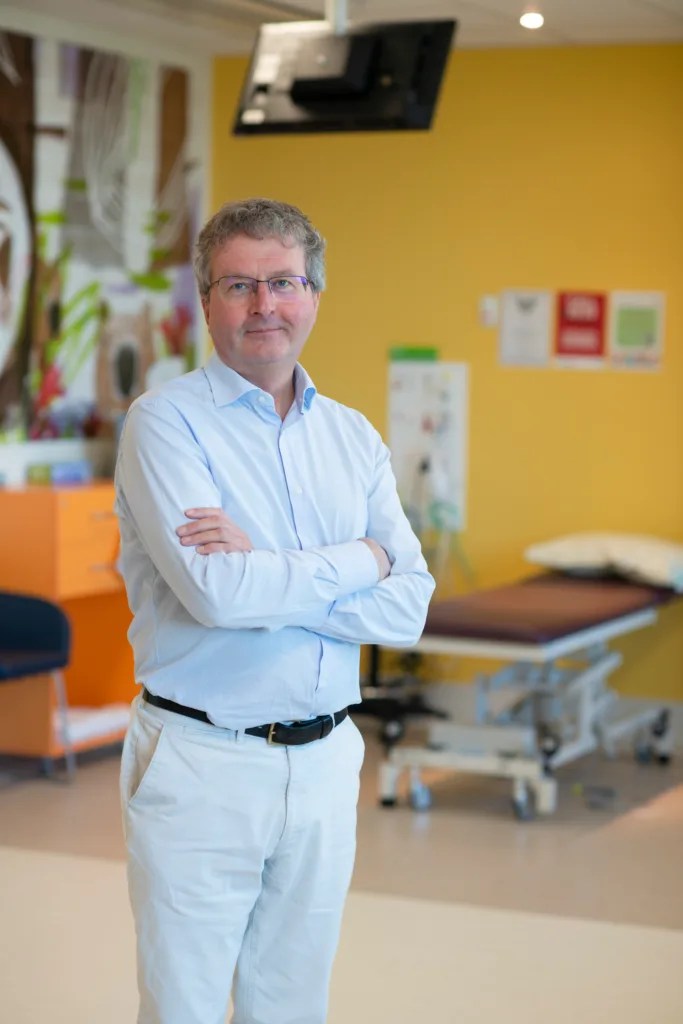
“The MCTC ensures that we have the best environment to support and perform trials across campus. This ensures that our trials are more powerful and efficient,” said Andrew.
The MCTC supports all types of trials, including commercially sponsored trials which aim to test the success of a new drug or medical device. Since the MCTC began, the centre has helped support over 250 of these types of trials, helping change countless lives.
Andrew was especially proud to share the recent impact this type of trial has had on a three-year-old boy living with a rare metabolic condition called phenylketonuria. This condition typically requires a lifelong restrictive diet, as a sudden increase in protein can risk neurological impairment and intellectual disability.
Fortunately, however, the toddler was able to participate in a clinical trial at the RCH, leading to a breakthrough in his treatment. This allowed the sick child to enjoy something many take for granted – his first birthday cake.
“Often these rare diseases have no treatment option other than a clinical trial – and most of the time, these trials are lifesaving, and it completely changes the child and family’s life,” Andrew explained.
The MCTC also supports investigator initiative trials. These trials respond to academic or clinician research questions, helping change the way that children are cared for globally.
“With investigator initiative trials, we want to continue to be at the forefront of innovative ways of doing them. We’re already very successful as a campus and we want to continue to be very successful,” Andrew said.
With over 100 investigator initiative trials running at any time, the MCTC is helping promote the advancement of medical knowledge, all while changing the lives of young people.
Looking forward, the MCTC aims to further advance paediatric healthcare innovation on both a regional, national and global scale.
“This funding has allowed us to work more closely with the Sydney Children’s Hospital, Monash Children’s Hospital and the Queensland Children’s Hospital. This has been particularly important for rare diseases, where we needed a national approach to trials,” Andrew shared.
The MCTC is revolutionising healthcare for children and young people across the world. Thanks to the Good Friday Appeal, the centre will be able to further establish themselves as leaders in enabling efficiency and high-quality paediatric trials.
“The Good Friday Appeal’s support is helping provide an environment so that children at the RCH and sometimes around Australia can get access to whatever treatments they need that can completely change their lives,”
Professor Andrew Davidson, the Medical Director of the Melbourne Children’s Trials Centre
“The MCTC makes a huge difference to children all over,” Andrew concluded.
Example Trials
Positive end-expiratory pressure levels during resuscitation of preterm infants at birth (POLAR) trial
Almost all premature babies receive help with their breathing using a treatment called positive end-expiratory pressure (PEEP). The device used can give air and oxygen to the lungs between each breath to stop their lungs from collapsing.
Currently, due to a lack of evidence, doctors around the world give different amounts of PEEP to premature babies.
The POLAR trial explores the right amount of PEEP to give at birth.
2026 Update
Over the past year, the impact of the MCTC was as follows:
- Trial spaces were upgraded and well-equipped, making it easier, safer, and more comfortable for children and families to take part in research.
- As of 31 December 2025, 337 open clinical trials were supported, showing the scale and activity of the paediatric trials program.
- The MCTC delivered large, high-impact trials across a wide range of patient groups and therapeutic areas, generating evidence to improve paediatric health.
- MCTC and the Clinical Research Development Office strengthened clinical trial quality through targeted mentoring, operational support, and regularly updated training programs and resources.
- Further, the initiative continues to build a skilled pipeline of junior and experienced trial coordinators and clinician-researchers to support long-term research capacity.
- The MCTC also continued to show an increased commitment to consumer and family involvement in trial planning and design, ensuring research reflected patient and family priorities.
- CEBU (Clinical Epidemiology and Biostatistics Unit) expanded its team, establishing the RCH as a national leader in its field, while also growing a world-class team of trial biostatisticians.
- Innovative trial models, including adaptive platform trials and embedded trials, were designed and delivered, improving efficiency and integration with hospital care.
- Advanced trial data systems were implemented, enabling early-phase regulatory trials and more sophisticated trial designs. This will help improve efficiency, maximise cost recovery, and drive outcomes faster.
- The RCH achieved full accreditation under the National Clinical Trials Governance Framework, demonstrating compliance and organisational maturity – and its world-leading impact.
- MCTC further strengthened its international partnerships with leading children’s hospitals, including Boston Children’s Hospital, Great Ormond Street Hospital, and Toronto SickKids, promoting shared knowledge across countries.
- Trial spaces were upgraded and well-equipped, making it easier, safer, and more comfortable for children and families to take part in research.
Last updated February 2026
Explore More