If the hat fits, Warwick Teague will wear it.
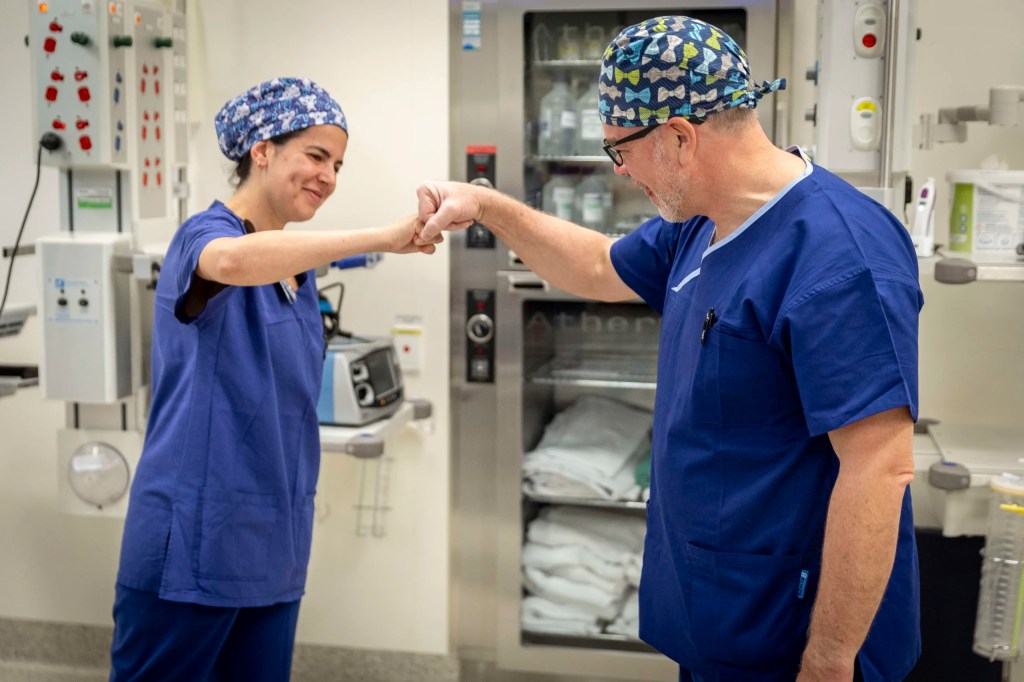
His scrub cap – headwear worn by a surgeon in the operating room – features a repetitive pattern of colourful bow ties.
“This hat was given to me by a patient,” Professor Warwick Teague said. “It’s one of my favourites.”
But it’s not the only hat Professor Teague wears at The Royal Children’s Hospital. His roles include consultant pediatric surgeon, lead consultant burns surgeon, and director of the RCH trauma service. He is also a researcher, and is funded through the Murdoch Children’s Research Institute.
Professor Teague, and the parents of patients Alfie and Parker, gave permission for myself (Herald Sun Journalist Nui Te Koha) and photographer Jake Nowakowski to shadow him in the operating theatre and watch him at work as a pediatric surgeon.
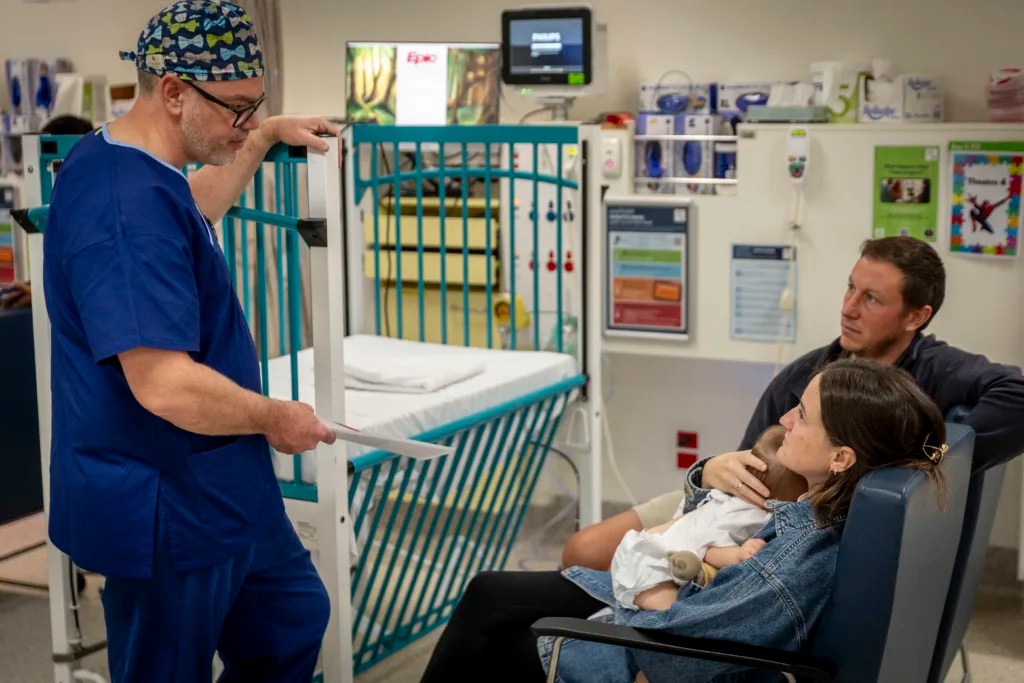
That role, Professor Teague said, means he performs surgery on children “from the day they’re born … even the tiniest ones who arrive prematurely … through to a 17-year-old.”
But the multifaceted medico added: “On any given day, the hats come on and off. And that makes for a very busy schedule. People see me, and meet me, in so many roles. Some people think of me as the burns guy and, yes, I am that guy. But I’m also the research, trauma, surgeon and caring clinician guy. I need to wear all these hats, sometimes several at once.”
Alfie, six months old, was born with a rare birth defect where his oesophagus had failed to develop properly and didn’t connect to the stomach.
“He couldn’t swallow or eat anything,” Alfie’s mother Karen said.
When we met Alfie, he was about to undergo his latest surgery to stretch up the “join” Professor Teague fashioned in his oesophagus in the early days.
“We’ve been at the RCH for more of Alfie’s life than not. He’s been really tough to get through it all,” Karen said. “He’s now eating well, and we’re hoping he continues to smash the bottles.”
Professor Teague agreed.
“We’ve had to walk this long road together … and now we have a ‘join’ (connecting the oesophagus and stomach) which is behaving well,” he said. “But sometimes these joins start to narrow, stopping milk and food being swallowed. That means it slows down the flow. We need a wide- open join for the oesophagus to work.”
Alfie’s surgery today will include using a camera to look into his oesophagus, and gently stretching the “join” with specially-sized tubes. “It will look like the same action is being repeated,”
Professor Teague tells us. “But each tube we pass is slightly bigger than the last. Each step is like working up the keys of the keyboard, playing a slightly different with a bigger tube each time.”
He visits Alfie and Karen before the surgery and, soon after, huddles with a team, including an anaesthetist, nurses and other clinicians, all of whom will work together in caring for Alfie in the operating theatre.
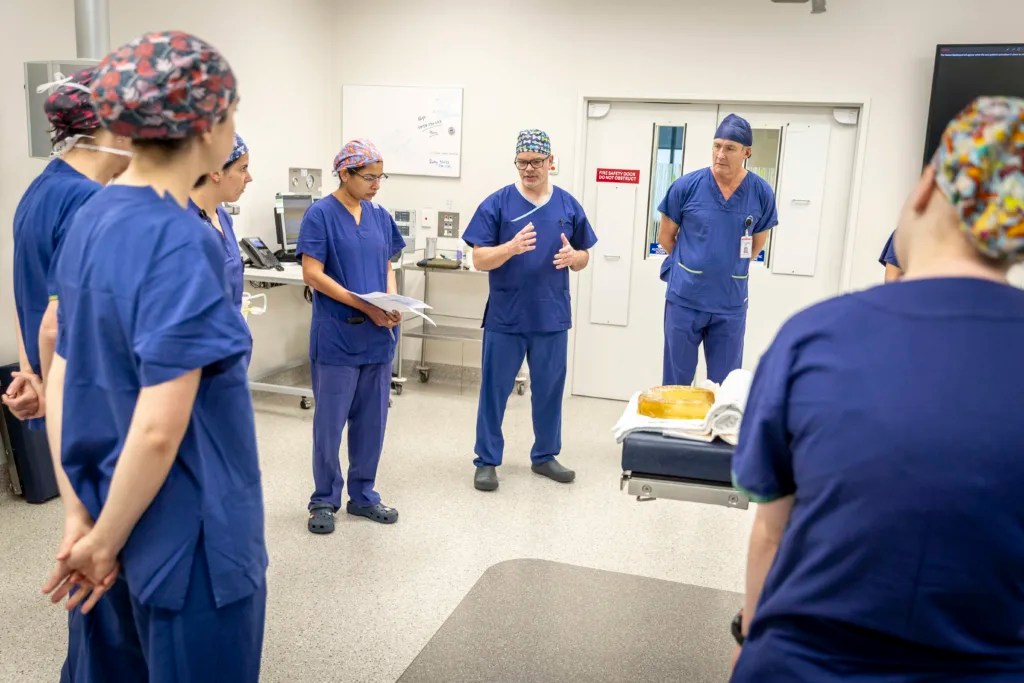
“The huddle is about making sure everyone is aware of the activities for the day,” Professor Teague said. “That mental model needs to be shared with everyone.”
He added: “It’s like the team huddle before a sporting match. It’s that sort of moment.”
Karen and her husband Henry are grateful to Professor Teague and the RCH for saving Alfie. They also have a daughter, Camilla, who is 3.
“Everybody here is warm and inclusive and we feel listened to, when we have concerns,” Karen said.
“Warwick is very available, even though he’s extremely busy and has other patients. I’ve never felt like we’ve not been able to talk to him when we’ve needed to.”
“Eating is always going to be a challenge for Alfie,” she said. “Hopefully, his life will start to be more pleasant than what he’s been through.”
She looked lovingly at her son and smiled: “He was meant to be our easy second child.”
Professor Teague’s second surgery of the day is similar to the one for Alfie. Parker, 11 months old, was “born with a missing part of his oesophagus,” his father Laurence said.
Parker spent his first 104 days at the RCH, had two major surgeries and finally went home for the first time aged three months. However, a few weeks ago, Parker hit a life-threatening hurdle.
Firstly, Parker developed a cough or cold, Professor Teague said, and “then things got worse. Parker was choking and unable to swallow the puree down”.
“Unable to breathe, he turned blue, which is a sign of real danger,” Professor Teague added.
“His parents were trained in what do for first aid, and to call an ambulance straight away.”
Professor Teague said Parker’s surgery would involve looking at both his breathing tube (trachea) and oesophagus, to see what might explain Parker’s choking and blue spell.
He explained: “(Parker’s) oesophagus might have narrowed at the join or been blocked by mucus, which could also impact his floppy trachea.”
Laurence, and his wife Claire, said Professor Teague’s ongoing treatment and care for Parker is immeasurable.
“It’s incredible what he’s done for our son,” Laurence said. “He’s given Parker the ability to eat, swallow – and live.”
An hour later, Professor Teague is in a different theatre conducting another huddle ahead of a hernia operation, a common surgery at the RCH.
This time, his patient is nine-months-old.
Another theatre, same hat.
“I’ve got a meeting in my research lab this afternoon. You’re very welcome to come along,” Professor Teague told us, then laughed:
“Different hat.”
Written by Nui Te Koha
Images by Jake Nowakowski
Published in the Herald Sun April 2025
Updated October 2025
Read More


Explore More