Enuara can let her light shine
Eight-year-old Enuara lies on a hospital bed in a white gown. Her father, Adnan, is on one side, stroking her hair. Her mother, Valdete, is on the other, looking deeply into her eyes. Within minutes, Enuara is being wheeled down the corridor to an operating theatre. She leaves behind her sobbing mum but tightly grips […]
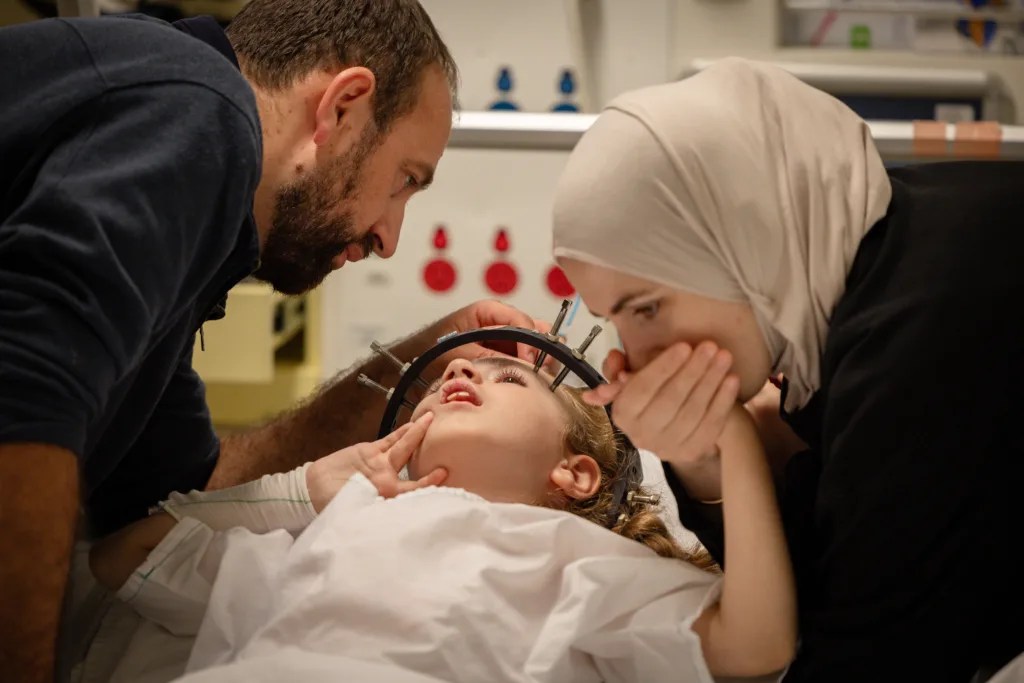
Eight-year-old Enuara lies on a hospital bed in a white gown. Her father, Adnan, is on one side, stroking her hair. Her mother, Valdete, is on the other, looking deeply into her eyes. Within minutes, Enuara is being wheeled down the corridor to an operating theatre.
She leaves behind her sobbing mum but tightly grips her dad’s hand.
Enuara is taken to the anaesthetic room, where she chooses a flavoured scent before Adnan gently holds the mask over her mouth.
One, two, three, four, five … Adnan calmly counts to 15 before his daughter falls asleep. He walks out of the room with tears rolling down his face. There’s a fear of the unknown.
“All sorts of bad thoughts go through your head,” Adnan says. “Is she able to cope with the anaesthetic? Is she able to breathe properly? Are her lungs collapsing? Did she survive?”
“It’s a big process.”
The couple walk up and down the hallways of the Royal Children’s Hospital to pass the time, constantly checking their phones for an update. They wait a gruelling five-and-a-half hours before they receive the news that their daughter’s spinal surgery was a success.
Relief, at last.
Enuara was six months old and holidaying in Albania with her family when her parents realised something was wrong.
“We were there for over two months when she became very floppy and she couldn’t control any of her movements,” Adnan says.
“We took her to one of the doctors and they said she might have been affected by the food or the milk.”
Upon returning home to Melbourne, Enuara was diagnosed with spinal muscular atrophy type 1, a genetic neuromuscular condition which causes progressive muscle wasting and weakness leading to a loss of movement.
It affects one in every 10,000 babies and is one of the most prevalent genetic disorders in young children.
“(The doctor) said children with this disease usually last about a year or a maximum of two, and at the moment we don’t have any treatment,” Adnan says.
We were devastated.
“You wait for such a long time to have a child, and it’s hard to imagine that child not being part of you anymore. It affects your whole life that you’re trying to build.
Adnan spent the next several days praying for a miracle.
“By the end of the week, the doctor called me back and said they just approved a new drug,” he says.
“She asked whether we wanted Enuara to do the trial … I said yes straight away.”
That drug was nusinersen, a medication that enables a backup gene to produce a protein to support motor neurons, which is the underlying deficiency in patients, leading to muscle wasting. Adnan says he broke down in tears when he received the call.
“I was very touched. Within four or five days my prayer was accepted,” he says.
“I was just so overwhelmed to know she had a small chance of surviving another year, maybe two.”
Soon after, Enuara started receiving nusinersen injections in her spine. While it’s not a cure, the medication – which was trialled at The Royal Children’s Hospital and listed on Pharmaceutical Benefits Scheme in 2018 – improves motor function.
“She has to be flat for a period of an hour and a half … so she has to be asleep while they put the needle into her spine,” Adnan says.
“She takes it every four months … without it she will die.”
Devastatingly, Enuara started todevelop scoliosis, a common complication in spinal muscular atrophy patients due to the weakened back muscles failing to support the spine. She wore a back brace for several years to halt the progression but by her eighth birthday, the curve had reached an alarming 105 degrees.
“She can’t eat, she can’t drink, she can’t walk, she can’t roll – she can’t do any of that,” Adnan says.
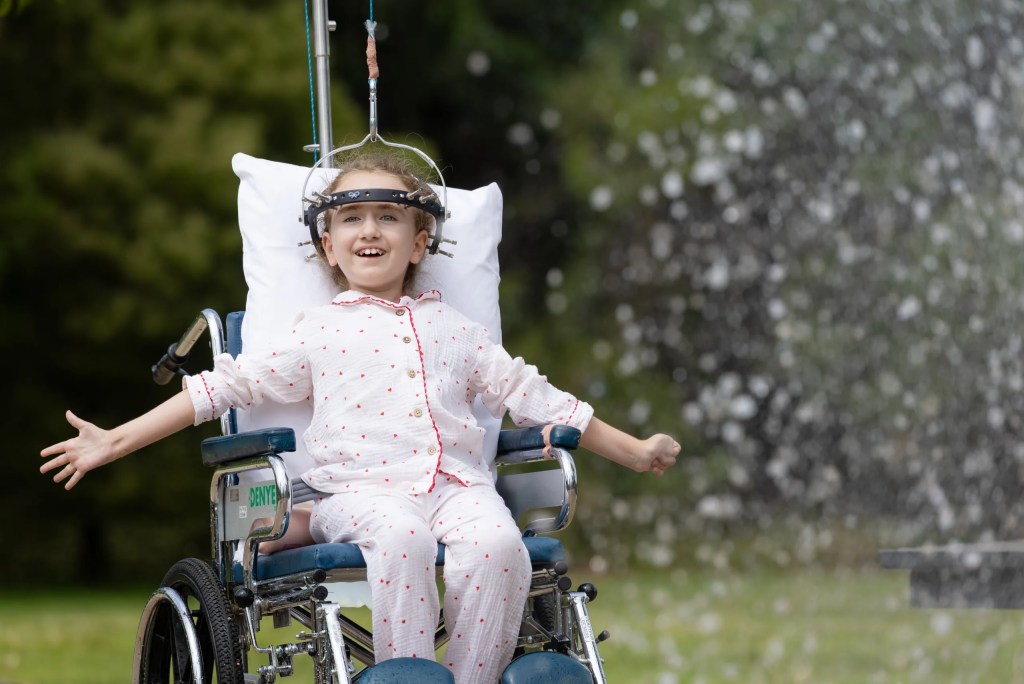
Surgery was the only way to correct it. But before the operation could happen, a halo traction would need to be attached to Enuara’s skull by pins to help straighten and stretch the spine.
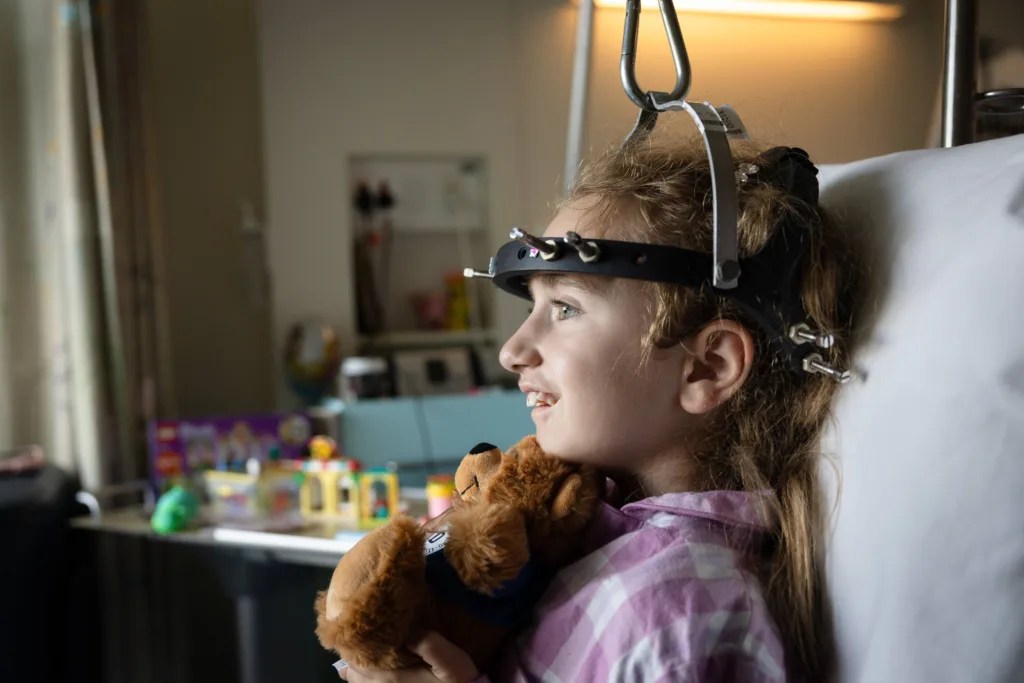
“At the beginning, she really didn’t like it,” Adnan says. “It hurt, it was too heavy and she was in a lot of pain.”
“She felt really scared with it but then she enjoyed it.”
The metal ring was connected to Enuara’s head for four weeks before it was removed on the day of her spinal surgery.
Pediatric orthopaedic surgeon Dr Michael Johnson says the operation decreased her curve to 38 degrees.
“Enuara has an underlying neurological disease called spinal muscular atrophy and part of that disease is a very early onset of scoliosis, which gets steadily worse as it grows,” he says.
“The number one reason why we did the operation was to stop that progression.”
“A very severe deformity starts to have an impact on the ability to breathe and the ability to sit comfortably in a chair.”
During the surgery, a 29cm rod was inserted in Enuara’s spine.
“(The rod) is made to expand with her,” Johnson says.
“She’s got another seven years of growth … we will need to watch this space, but if it all goes well this is the only operation she’ll need to have done.”
Johnson says spinal muscular atrophy was a “lethal condition” in the past, but the nusinersen injections are helping patients live longer.
“We’re in this era of the last nine to 10 years where kids are surviving,” he says.
“We don’t really know about their extreme long-term future.”
“No one around the world really knows what these children will be like at 20, 30, 40. How long will they live? We don’t know.”
“All of it is uncharted territory in that respect.”
But there is hopefor Enuara. Just two weeks after the surgery, she is kicking goals.
With her dad by her side, she is sitting, standing and throwing a ball – all thanks to physiotherapy sessions at the hospital helping her regain her strength and confidence.
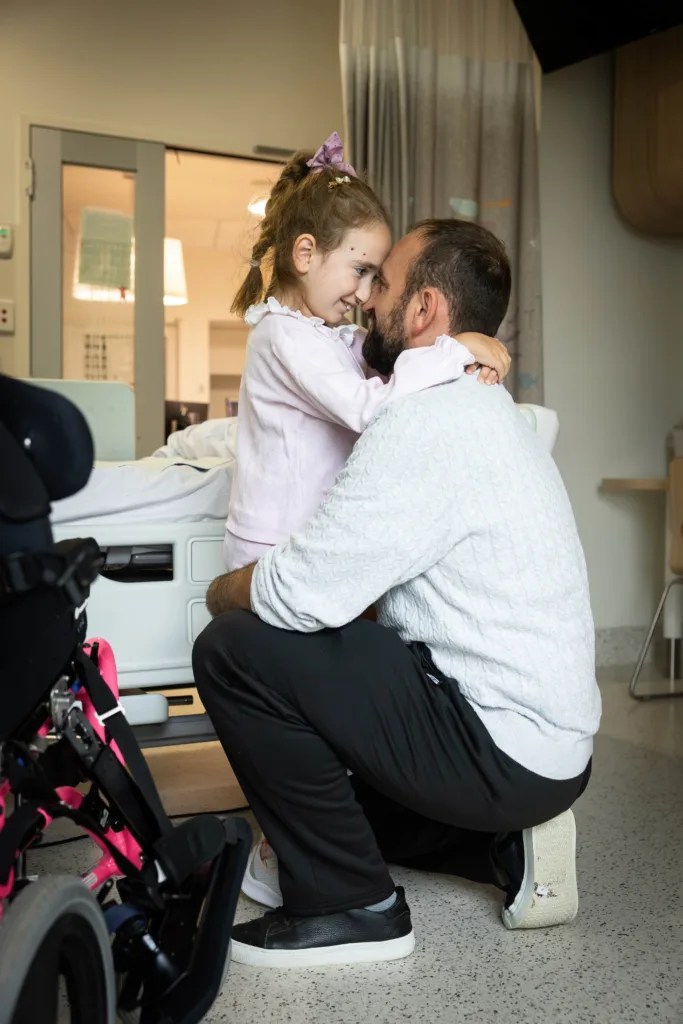
“She’ll stay physically in the hospital but she’ll move to the rehabilitation ward,” Johnson says. “It might be a couple of weeks of intensive work.”
“She’s quite safe to go home … but we feel that there’s some rehabilitation goals to reach first.”
Even in times of hardship, Enuara lights up the room with her cheeky grin and sparkling eyes. Her confidence made her the perfect candidate to co-host Hospital Lingo just five days before her spinal surgery.
The bingo-like game show – which is funded by the Good Friday Appeal and aired directly to patients’ rooms – has kept her entertained for hours at her second home.
“Co-hosting the show was a blessing,” Adnan says.
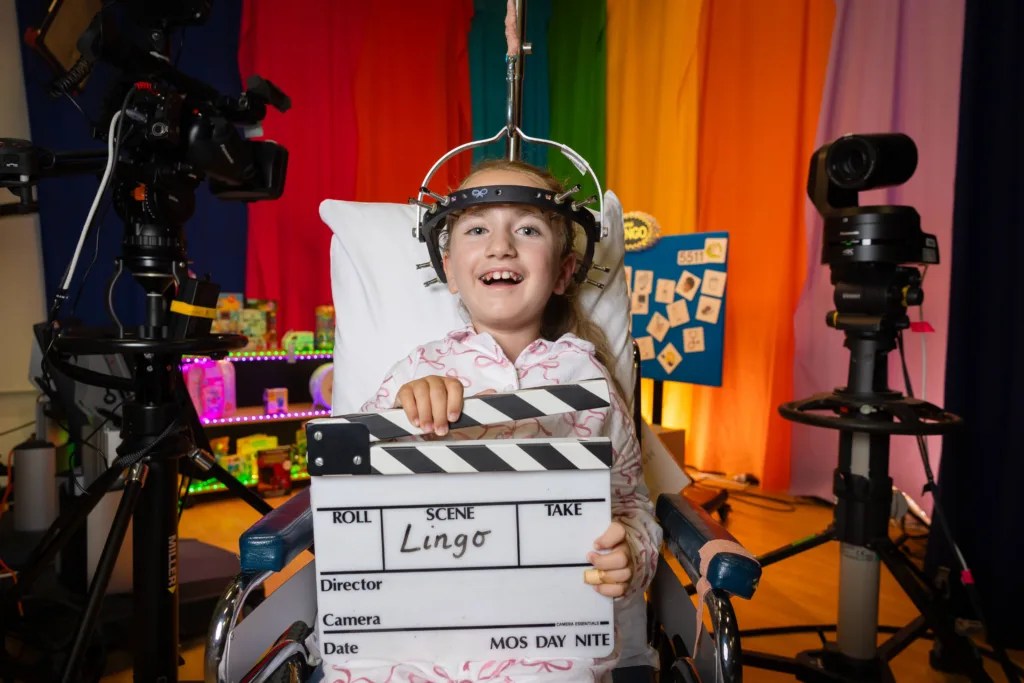
“It’s a miracle that she pushed through the pain, succeeded through her fears of the halo and people looking at her in the wrong way, all while being able to present, speak clearly and have the knowledge of all the equipment.”
The eight-year-old aced the game, confidently naming all of the hospital equipment, including a tourniquet and stethoscope.
Adnan says his daughter’s intelligence is “beyond people’s expectations”.
“She’s on a different level,” he says. “She likes to compete, she likes to challenge herself. There are times where she challenges me as well.”
Enuara has spent most of her short life in and out of The Royal Children’s Hospital, finding joy in the small things, like the aquarium, water fountain and the cinema. She spends her time drawing, playing with slime and reading books.
Enuara also loves feeding her pet fish, sneaking Nemo into her room to keep her company.
“At the beginning (of her journey in hospital), she was very scared,” Adnan says.
“It was a big process. She had a fear of doctors and nurses and people gathering around her. Now she is more mature, she’s more stronger and she’s wiser.”
“She’s funny, she’s open and she’s kind. She’s pretty much a light into my heart.”
Adnan says he is eternally grateful for The Royal Children’s Hospital.
“The hospital is one of the best in the world,” he says.
“It’s a blessing to have a hospital like this. Not many people have the privilege.
Now, Enuara is looking forward to going home, is excited to play with her sister Adeena and brother Omer and to return to school.
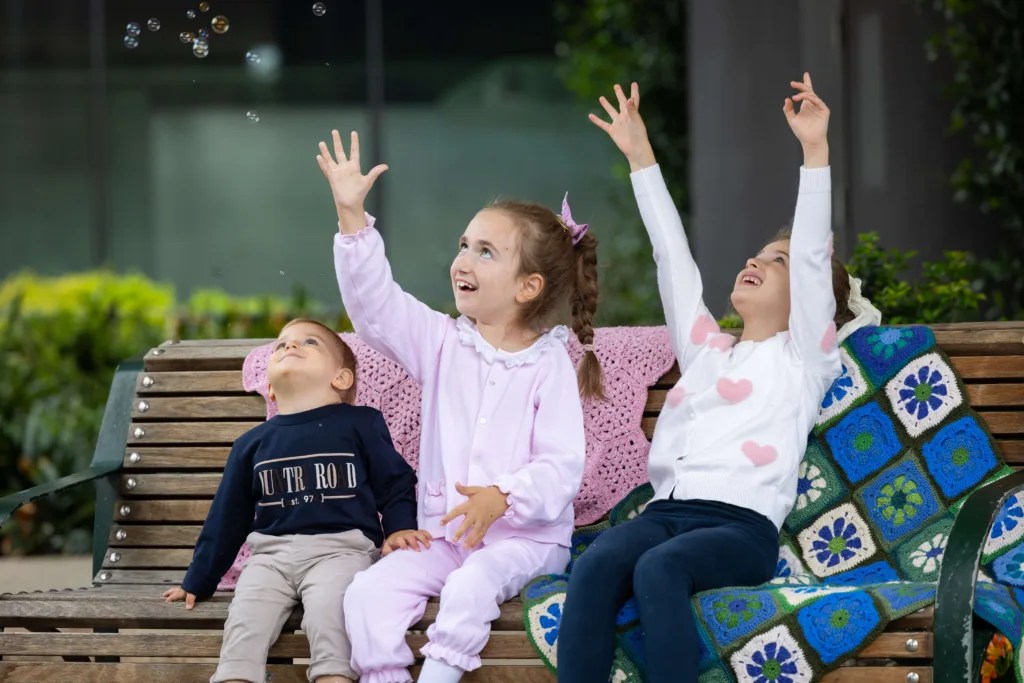
The determined year 3 student also has another goal in mind.
“Hopefully, with the help from the walkers, there will be a point where she’s strong enough to be able to walk by herself,” Adnan says.
“She can do it – she’s a fighter.”
Written by Brooke Grebert-Craig
Images by Jason Edwards
Published in the Herald Sun 28 March 2026
Updated March 2026
Read More
Explore More